A migraine diary your doctor can use has two parts: a quick entry for each attack, noting when it started and ended, how bad it was, what you took and whether it helped, plus a short check-in every day, good days included. At the end of each month, you count headache days and medicine days. Steady, simple entries beat a detailed log you only keep on bad days.
The usual mistake is writing only on bad days, and that feels natural. When your head is pounding you want a record of it, and when you feel fine the notebook stays in the drawer. But a migraine diary with only bad days in it cannot answer the questions a doctor is likely to ask: how many days a month, how often you take something for it, and what was different about the days you were fine. You end up saying “maybe eight or nine?” and hoping it is close.
A good diary turns those guesses into counts. It does not need to be long. It needs to be steady.
Please read this first. This post is general information about keeping records, not medical advice. A diary helps you and your doctor talk about what is happening; it cannot diagnose anything or tell you what to take. If your headaches are frequent, getting worse or changing, see a doctor. If a headache is sudden and severe, different from your usual ones, or comes with symptoms that worry you, get medical help straight away. MedlinePlus keeps a list of headache danger signs that need care right away.
What to write in a migraine diary for each attack
Keep the attack entry quick, because you will often be writing it in a dark room with a phone at its dimmest. These are the essentials:
- When it started and when it ended. If you do not know the end yet, note the start and fill in the rest later.
- How bad it was. Pick one scale, such as 0 to 10 or mild, moderate and severe, and use it every time.
- Warning signs. Any aura or other signs before the pain began.
- Other symptoms. Nausea, sensitivity to light or sound, dizziness, or anything else you notice.
- What you took and when. Write the medicine and dose exactly as it appears on the label.
- Whether it helped. Check at a set time afterward, such as two hours, and note none, some or full relief.
- What it cost you. A missed shift, a canceled plan, a day in bed.
That last point is easy to skip and often useful. “Six headache days” and “six headache days, four of them spent in bed” are different conversations.
What to record every day, including good days
Here is where most diaries go wrong. If you only note your sleep on attack days, you will never know whether you sleep just as badly on days you feel fine.
So add a short daily check-in, attack or no attack. Keep it under a minute or you will stop doing it. Choose five or six items that matter to you, for example:
- Hours of sleep, and roughly when you went to bed
- Meals, and whether you skipped any
- Caffeine and water
- Stress, on a simple 0 to 10 scale
- Cycle day, if it applies to you
- Anything else you suspect, such as alcohol, long screen time or a change in weather
Good days are what make the comparison fair later on. If you already tick off habits like water or a set bedtime in a habit and mood tracker, you have part of this daily record already.
How to count headache days each month
At the end of each month, count three things. Counting days rather than attacks keeps the numbers clear.
- Headache days. Any calendar day a headache was going on. A day counts once, however many attacks touched it.
- Migraine days. Headache days that included a migraine, if you and your doctor are tracking them separately.
- Medicine days. Days you took any as-needed pain or rescue medicine. Count days, not doses.
A small worked example. Say in one month you had attacks on the 3rd, overnight from the 9th into the 10th, the 17th, the 24th and the 25th. That is five attacks but six headache days, because the overnight one touched two dates. If you took medicine on the 3rd, 9th, 17th and 24th, that is four medicine days. Your doctor may care about each of these numbers for different reasons, so bring all three.
If counting by hand is the part you dread, a migraine tracker that counts headache days and rescue-medicine days does the sums for you, including attacks that run past midnight.
How do you find migraine triggers in a diary?
Once you have six or eight weeks of entries, you can start looking for patterns. Keeping a log of what seems to set off your attacks is a common suggestion, including on MedlinePlus’s migraine page, but the trick is to compare, not just to notice.
Say you suspect short sleep. Over two months you logged under six hours of sleep on 10 nights, and an attack followed on 4 of them. On the 40 nights with more sleep, an attack followed on 6. That is 4 in 10 against 6 in 40, roughly 40 percent against 15 percent. That is worth raising with your doctor.
Two cautions:
- Small numbers mislead. Ten nights is not many. Treat a pattern as a question to discuss, never as proof of a cause.
- Do not overhaul your life on a hunch. Cutting out whole food groups or changing medicine because of a diary pattern is something to talk through with your doctor first.
Also look at timing. Attacks clustered at weekends, early mornings or a particular point in your cycle are all worth mentioning.
Bringing it to the appointment
Doctors rarely have time to read a whole notebook. Lead with a summary and keep the full diary as backup.
On one page, write:
- Headache days, migraine days and medicine days for each of the last one to three months.
- What you took, and how often it helped.
- Any patterns you have noticed, with the numbers behind them.
- Your questions, with the most important first.
After the appointment, note what changed and the date it changed. Then the next month of your diary can show whether it helped. Once you have a plan, add your medicines and your doctor’s details to a one-page medical summary in your household emergency binder, so someone else can find them on a bad day.
Keeping it all in one place
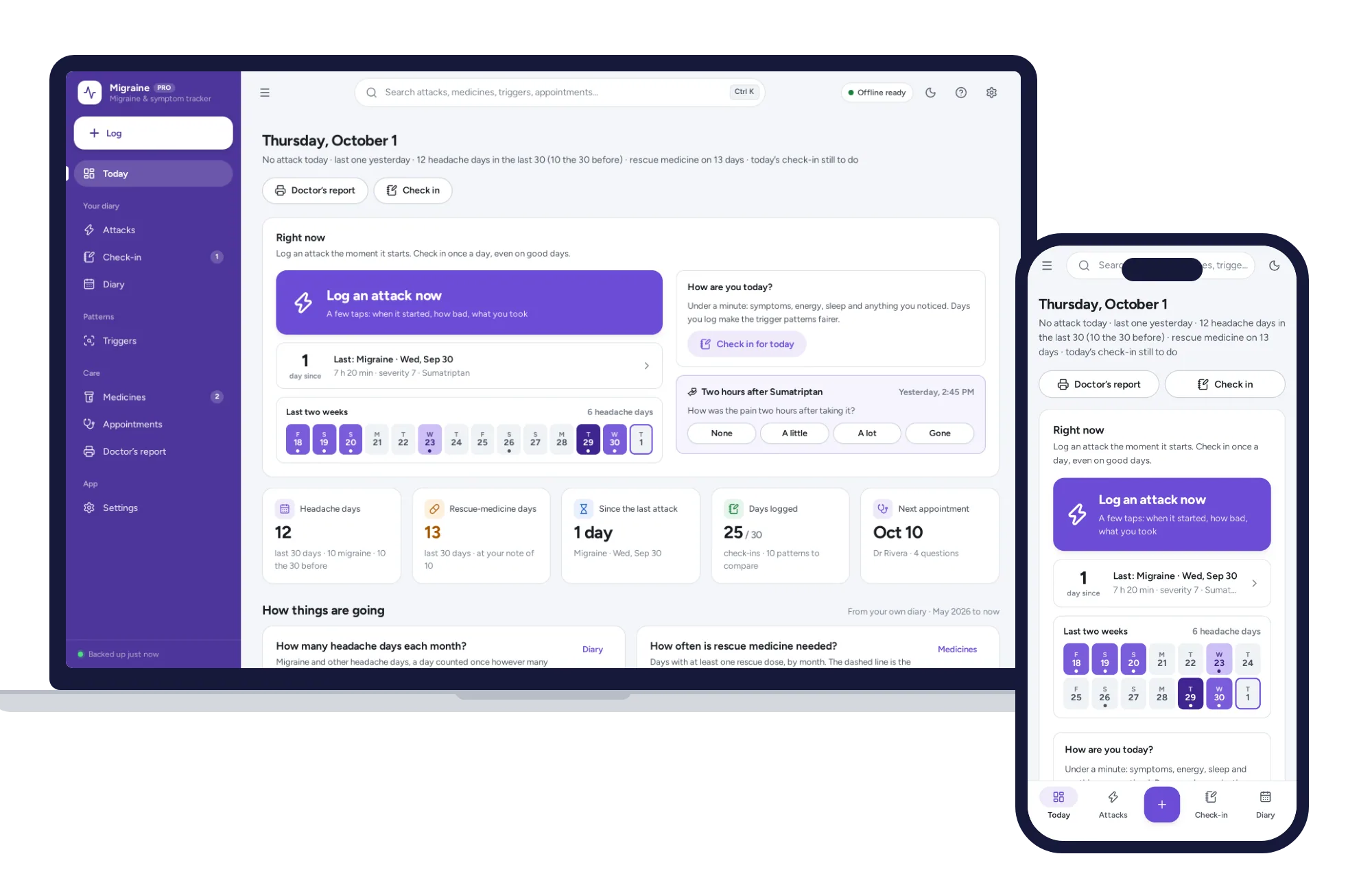
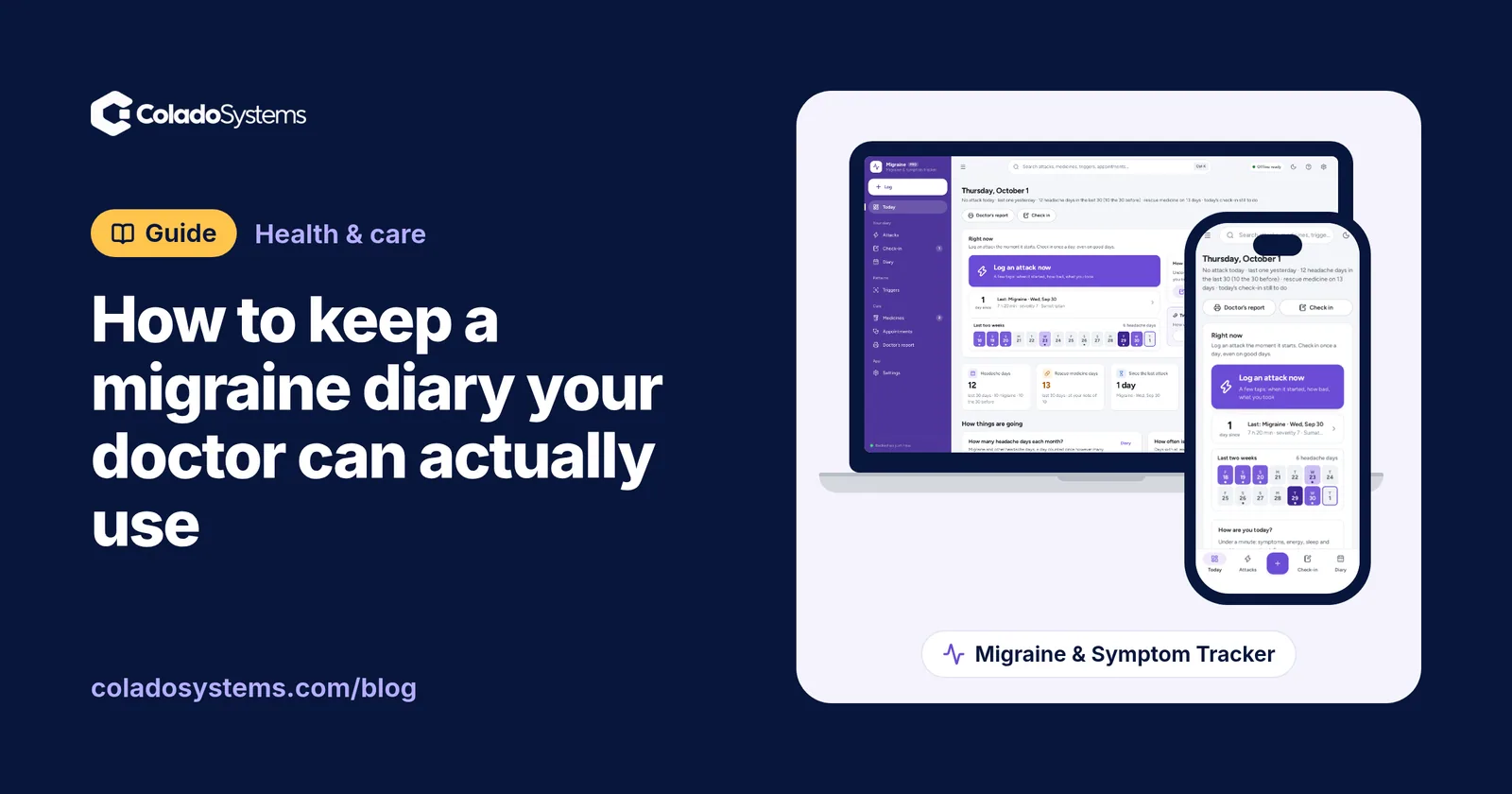
A paper diary works if you keep it up. If you would rather the counting was done for you, the Migraine & Symptom Tracker is built around exactly this routine.
You log an attack in a few taps: when it started, how bad it was, aura, symptoms and medicine. A timer runs until you end the attack, even past midnight, and two hours after a dose it asks how the medicine helped. The daily check-in scores your own symptoms from 0 to 10, with energy in spoons, sleep and cycle day. The headache diary shows a month on one screen, and the app counts headache days, migraine days and rescue-medicine days by month. You can set a number of medicine days that prompts a note to mention it to your doctor; it is your own number, not a medical limit.
Trigger patterns compare days with each trigger against days without, show both day counts, and wait until there are at least five days on each side. The doctor’s report prints the last 30 or 90 days, with your questions at the end. Dark mode stays dim in a dark room. It does not diagnose anything and gives no advice about medicines.
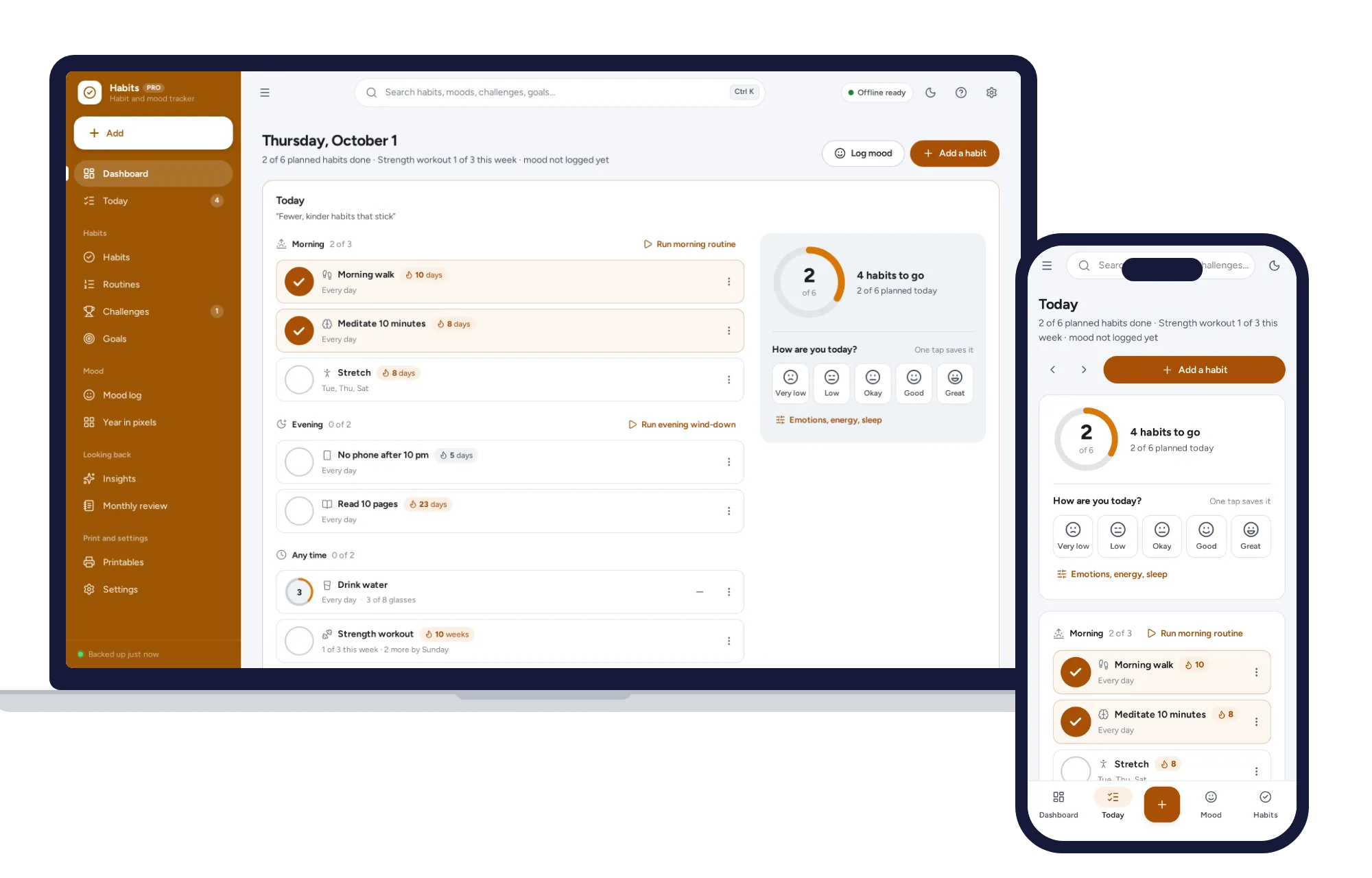
The routines around your attacks matter too. The Habit & Mood Tracker lets you tick habits in one tap, including counted ones like glasses of water, and log a daily mood with emotions, energy and sleep. After 14 days it compares your mood on days you did a habit against days you did not, with the day counts shown, as a pattern rather than a cause.
Both run offline on your own device, with nothing uploaded and no account. Bring what you record to your doctor, and let them guide what you do with it. For more, browse other offline systems for health and care.
Skip the setup
The Migraine & Symptom Tracker has the records this guide describes already set up. Log an attack in seconds, check in on your symptoms each day, and see headache days, rescue-medicine days and trigger patterns on one dashboard — then print a report for your doctor. No formulas to break, no subscription.
$14.99 one-time
- Sample data to try it the same day
- Works offline, records stay on your device
- A PDF guide in the download
See everything inside the Migraine & Symptom Tracker. Or take the whole Health & care shelf: 10 systems for $139.99, $87 less than one by one.
Common questions
What should I write in a migraine diary?
For each attack, note when it started and ended, how severe it was on one consistent scale, any warning signs or aura, other symptoms, what medicine you took and when, and how much it helped. On every other day, a quick check-in on sleep, meals, caffeine, stress and cycle day gives you the good days to compare against.
How do I count headache days per month?
Count calendar days, not attacks. Any day a headache was present counts once, however many attacks happened, and an attack that runs past midnight counts on both dates. Keep a separate tally of days you took as-needed pain medicine, counting days rather than doses. Your doctor can tell you which of these numbers matters most for you.
How long should I keep a migraine diary before seeing a doctor?
You do not need to wait. If your headaches are frequent, changing or worrying you, book an appointment now and bring whatever you have recorded, and seek urgent help for a sudden, severe or unusual headache. For spotting patterns, a couple of months of steady entries, good days included, gives you and your doctor more to work with than a few weeks.
Can a migraine diary tell me what my triggers are?
It can show patterns, but not prove causes. Compare how often an attack followed days with a suspected trigger against days without it, and look at how many days sit behind each figure. A pattern from a handful of days can easily be chance. Treat what you find as something to discuss with your doctor before changing your diet or medicine.