The water heater gives out at 2 a.m. Water is spreading across the basement floor, and the one person who knows where the main shut-off valve is happens to be on a work trip, asleep in another time zone.
That is what a household emergency binder is for. It is not a filing cabinet. It is the short folder that answers the first questions anyone in your home will ask when something goes wrong: who do I call, where do I turn it off, what does this person take, and where are the papers?
Here is what to put in it, and how to keep it from going stale.
Write it for someone else
The person reading your binder may be your partner, a teenager, a babysitter, a neighbor or a house sitter. It may also be you, at 2 a.m., with your heart racing. Write for that reader:
- Short lines, not paragraphs
- Plain words, with no shorthand only you understand
- Precise locations: “basement, behind the furnace, red handle,” not “by the furnace”
- Photos wherever a photo is faster than words
Put the date it was last updated on the cover.
Who to call, in the order to call them
Start with the list someone will reach for first. In a real emergency in the US that means 911, but this list is for everything around it.
Put the contacts in the order you would want them called:
- Adults in the household, with their work numbers
- A nearby relative or friend, and a neighbor with a spare key
- An out-of-area contact everyone checks in with if local lines are busy
- Each person’s doctor, your pharmacy and your vet
- Utility emergency lines for gas, water and electric
- A plumber, an electrician and a locksmith you trust
- Insurance claims numbers
Mark who holds a key. Then copy the first few numbers and any serious allergies onto a wallet card for each adult. An emergency and home binder app can print those wallet cards straight from the same list.
Shut-offs and the emergency plan
For water, gas and electricity, write down three things: where the shut-off is, how to turn it off, and what tool it needs. Add a photo of each, with the valve or switch circled. Label your breaker panel while you are at it, so “kitchen” and “basement” are not guesses.
Check your gas company’s guidance on what to do if you smell gas, and copy it onto the page in their words.
Then the plan itself:
- A meeting point just outside the house, such as the neighbor’s mailbox
- A second meeting point outside the neighborhood
- Where the first-aid kit, flashlights and grab bag are kept
- Where the spare keys are
A one-page medical summary per person
This is not a medical record. It is what someone needs in the first ten minutes:
- Full name and date of birth
- Allergies, and what a reaction looks like
- Current conditions
- Medicines, doses and when they are taken
- Where the inhaler or auto-injector is kept
- Doctor, pharmacy and health plan member number
Keep it to one page each. When a medicine or dose changes, update the page that week. If you are unsure how to describe a condition or what to include, ask your doctor or pharmacist.
Add a page for each pet too: the vet, food and medicines, and who has agreed to take them if you cannot.
If you also look after an older parent, their medicines and appointments need a fuller record than one page. How to organize an aging parent’s care and share the load covers the medication list, appointments and an emergency sheet.
Insurance, the home and vehicles
For each policy, note the insurer, the policy number, the claims phone number, the renewal date and your agent. Record where the deed, vehicle titles and registrations are kept. If you have photos or a video of your home’s contents for insurance purposes, write down where that file lives.
This section earns its place after a fire, a storm or a break-in, when you need to start a claim quickly and cannot think straight.
Accounts and legal documents, kept safe
This is the section people most often get wrong. An emergency binder should never hold passwords or full account numbers, because anyone who picks it up could use them.
Instead, list each bank, card, retirement and utility account with only the last four digits, and write where the login is kept: “in the password manager under Bank,” or “the grey notebook in the desk drawer.”
Do the same for legal documents. Note where each adult’s will, power of attorney and health care directive is kept, who holds the original, and who the executor is. The binder only records where these things are. Whether a will or power of attorney is valid depends on the law where you live, so talk to a lawyer about writing or updating them.
If you want to record more than locations, such as your final wishes and who should tell whom, an end of life planner keeps those alongside where the will and documents are.
Store the binder somewhere safe but findable, and tell at least two people where it is.
How often should you update a household emergency binder?
A binder that is three years out of date can be worse than none, because people trust it. Two habits keep it current.
Update on the trigger. Change the binder when something changes: a new phone number, a new doctor, a new prescription, a new insurance policy, a new pet, a move.
Review on a schedule. Twice a year, sit down for 20 minutes. Pick dates that already mean something, like the days you test the smoke alarms. Go through each section and ask whether it is still true. Then reprint any changed pages, date them, and shred the old ones.
Keeping it all in one place
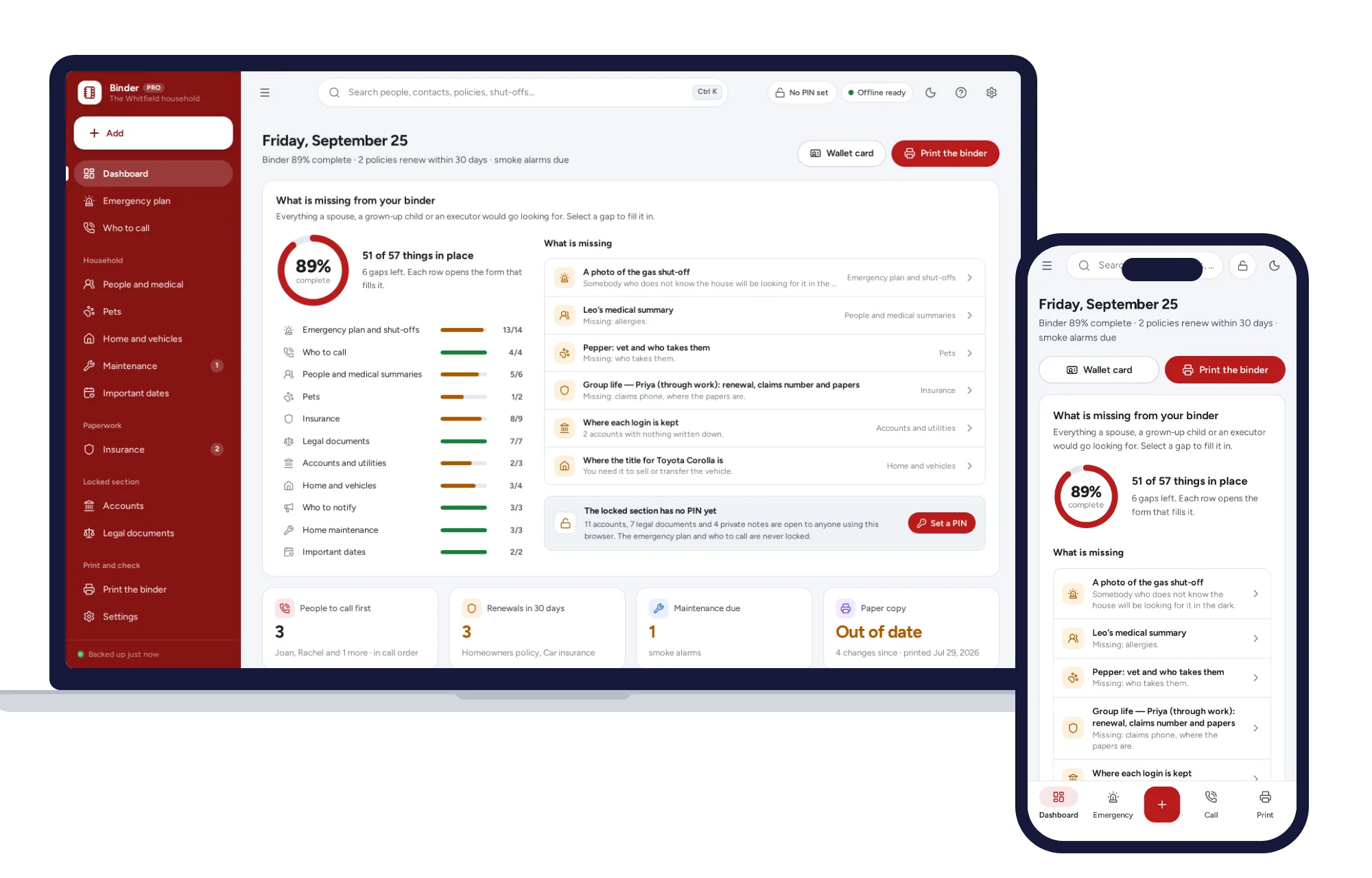
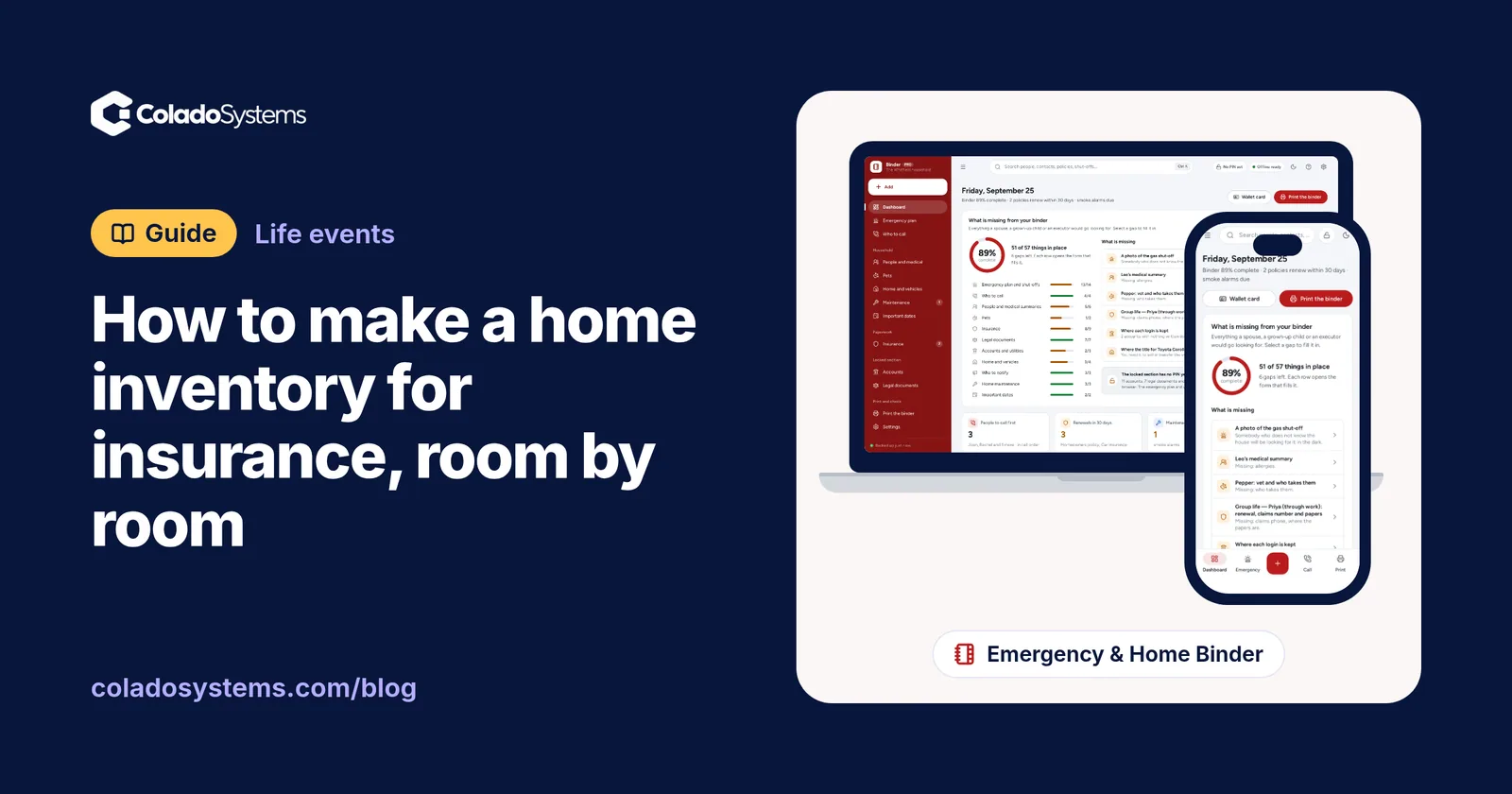
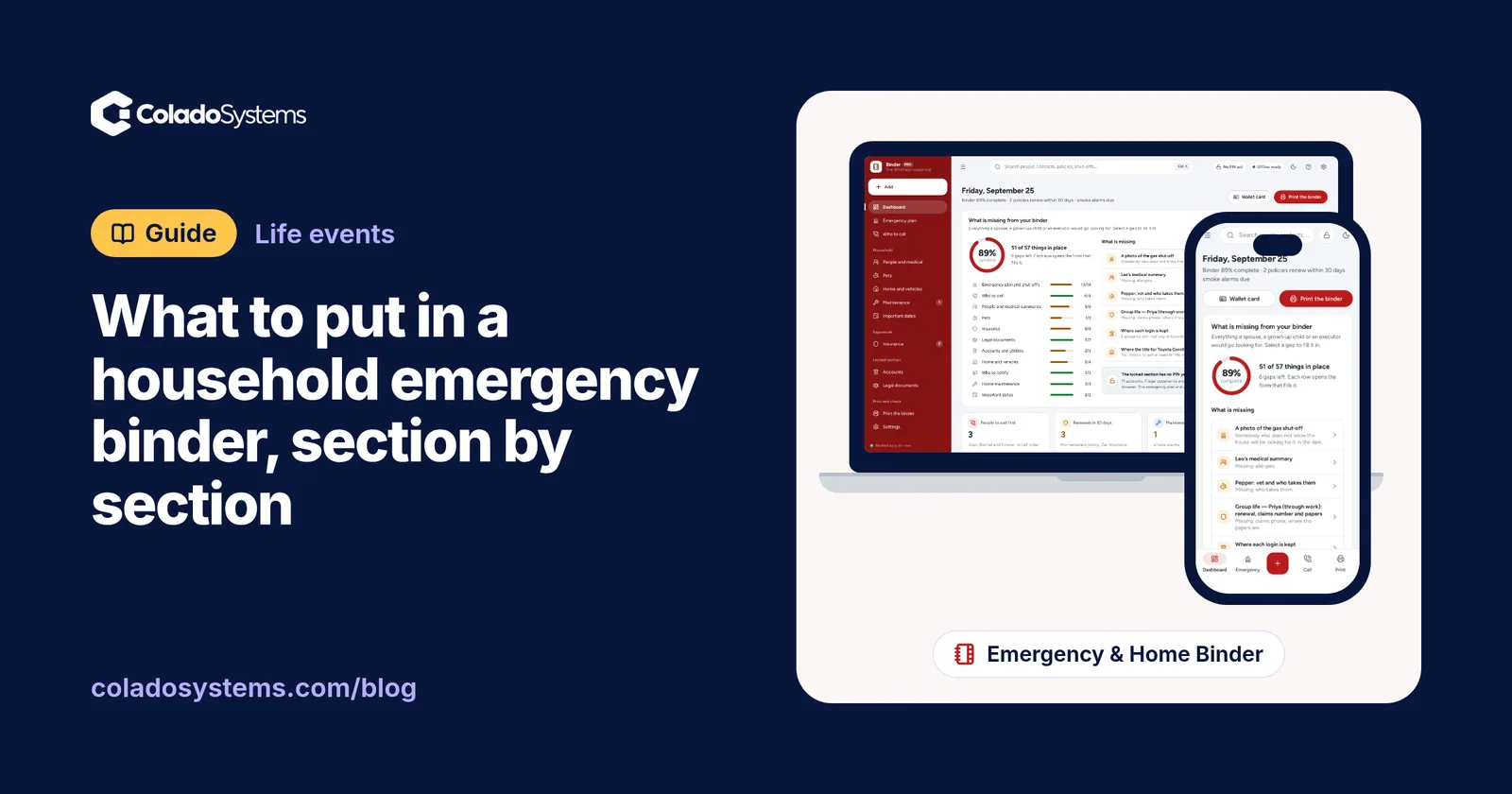
A ring binder and a pen will do the job. If you want help seeing what is missing and keeping the paper copy current, the Emergency & Home Binder does this as an offline app. Its dashboard checks what is missing, section by section, as a percentage, and selecting a gap opens the form that fills it. It covers the emergency plan and shut-offs with a photo, who to call in order, a one-page medical summary per person, pets, insurance renewals and claims numbers, the home and vehicles, and maintenance.
Account numbers and legal notes sit in a section behind a PIN you choose. The PIN hides that section on screen. It does not lock the data itself, so keep the device locked too. The binder will not store passwords; it asks where each login is kept instead. When you are ready, the whole binder prints in one click, with wallet cards, and the app tells you when the paper copy is out of date.
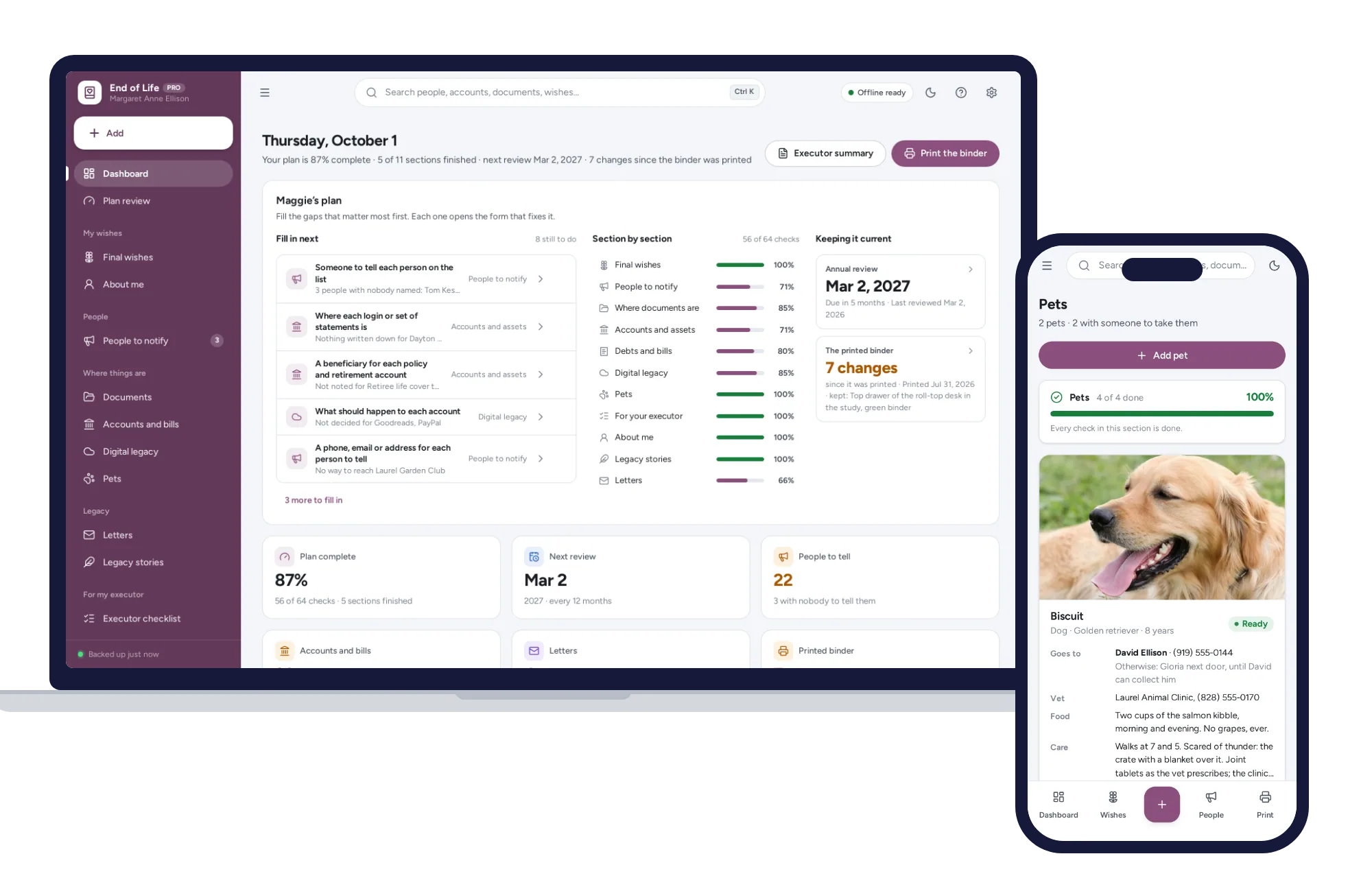
For the longer view, the End of Life Planner covers what your family would need after a death: final wishes, people to notify and who tells each one, where the will and documents are, accounts listed without passwords, and an executor checklist, with an annual review reminder. It is not a will and not legal advice. It records where things are.
Both run in your browser, with no account and no subscription, and your records stay on your own device. You can find them with other planners for life events.
Skip the setup
The Emergency & Home Binder has the records this guide describes already set up. Who to call, where the shut-offs are, a medical page per person and a PIN-locked section. Prints the whole binder in one click.
$24.99 one-time
- Sample data to try it the same day
- Works offline, records stay on your device
- A PDF guide in the download
See everything inside the Emergency & Home Binder. Or take the whole Life events shelf: 4 systems for $69.99, $19 less than one by one.
Common questions
What should be in a household emergency binder?
Start with an ordered list of people and numbers to call, then where the water, gas and electric shut-offs are and how to use them, meeting points, and a one-page medical summary for each person and pet. Add insurance policies with claims numbers, where key documents are kept, and a list of accounts that shows only where each login is stored.
Should you keep passwords in an emergency binder?
No. A printed binder can be read by anyone who picks it up, and copies tend to multiply. List each account with the last four digits only and note where the login can be found, such as a password manager or a notebook kept somewhere private. The people who need access can then find it without the binder giving it away.
Where should you keep an emergency binder?
Somewhere safe that the people who would need it can reach quickly, such as a closet shelf near the main exit or a fire-resistant box at home. Tell at least two people where it is, including someone outside the household, and think about leaving a second copy with a trusted relative or neighbor.
How often should you update an emergency binder?
Change it whenever something changes, such as a phone number, doctor, prescription, insurance policy or address, and go through the whole thing twice a year. Reprint the pages that changed, put the date on them and shred the old copies, so nobody in a hurry relies on an outdated number or medicine list.