The wedding budgets that hold up usually start with two numbers, not one: what you can actually spend, and how many people you are inviting. Pick a total without the guest count and you will spend months trying to make the two fit.
Here is how to build a wedding budget from the ground up, keep it honest as quotes come in, and still be on good terms with each other when the final invoices arrive.
How to build a wedding budget from the money you have
Before you look at a single venue, work out the real total. Add three things:
- What you have saved for the wedding today
- What you can realistically save each month until the date
- What family has offered, confirmed in a conversation and not just implied
Say you have $9,000 saved, you can put away $600 a month for the 14 months until the wedding, and your parents have offered $5,000. That is $9,000 + $8,400 + $5,000 = $22,400.
Now hold back about 10% as a contingency for things that are not on anyone’s list yet: alterations, a rain plan, a last-minute rental. In this example you would plan around $20,000 and keep $2,400 in reserve. If the contingency is never touched, it becomes the start of the honeymoon fund.
One caution on family money: talk about what comes with it. Some gifts are simply gifts. Others come with expectations about the guest list or the venue. Better to know which before you sign anything.
Choose your three priorities together
Each of you writes down, separately, the three parts of the day that matter most. Photography, food, the band, the dress, the location, an open bar, the flowers. Then compare lists.
Where you overlap, those categories get funded first and generously. Where you differ, each of you gets one. Everything neither of you listed gets a modest amount and no agonizing. This is the step that stops a budget turning into a long series of arguments about centerpieces.
A sample wedding budget breakdown, as a starting point
A percentage split gives you a first draft to react to. Here is one way to sketch a $20,000 budget. These are not averages from anywhere, just round numbers to push against:
| Category | Share | Amount |
|---|---|---|
| Venue and catering | 45% | $9,000 |
| Photography and video | 12% | $2,400 |
| Attire, hair and makeup | 8% | $1,600 |
| Music and entertainment | 8% | $1,600 |
| Flowers and decor | 8% | $1,600 |
| Rings | 6% | $1,200 |
| Stationery and postage | 3% | $600 |
| Officiant, transport, favors and other | 10% | $2,000 |
Now bend it to your priorities. If photography is top of both lists, move it to 18% and take the difference from flowers and favors. If you are marrying in a garden that needs little decoration, cut flowers to 4%. The table is only useful as something to change.
How much does guest count change a wedding budget?
More than anything else. Almost every line grows with the guest list: food, drinks, rentals, chairs, invitations, favors, even the size of the venue you need.
Say food, drink and rentals come to $85 per guest. Going from 120 guests to 90 saves 30 × $85 = $2,550. That is more than the whole flower budget in the table above, and you have not given up anything you care about.
Some ways to shorten the list without hurt feelings:
- Agree on a rule and apply it evenly, such as “we invite people we have both seen in the last two years.”
- Decide plus-ones by rule too: married, engaged or living together, for example.
- Decide early whether children are invited, and say so clearly on the invitation.
- Split the list into people you would be upset to leave out and people you would be glad to see. Fund the first group fully.
Map every deposit and due date
Most vendors take a deposit to book and the balance some weeks before the day. A $3,000 photographer might be $1,000 at booking and $2,000 a month before the wedding. Spread across eight or ten vendors, those payments become a cash-flow schedule, and it is easy to end up with three balances due in the same month.
For every vendor, record:
- The total agreed in the contract
- Each payment, its amount and its due date
- What happens if you cancel or change the date
- The final guest count deadline, if there is one
Then add the payments up month by month and check that the money will be there by each date. A wedding budget planner that tracks deposits and due dates saves you building that calendar by hand.
Before you sign, ask whether the quote includes tax, service charges and gratuities. They can add a noticeable amount to catering and bar costs, and they are easy to miss in a headline price.
Track estimated, actual and paid
A wedding budget needs four columns per category:
- Estimated: what you planned to spend
- Actual: what you agreed to pay once a contract is signed
- Paid: what has already left your account
- Balance: what is still owed
Spend ten minutes on it once a week, together. When a category comes in over its estimate, the money has to come from somewhere else, and you decide where on the spot. A $400 overrun on the cake comes out of the favors or the contingency, not out of thin air.
Two rules help a lot. First, any unplanned purchase over an amount you agree on, say $150, gets talked about before it is bought. Second, do not count on gift money to pay for the wedding itself. Treat it as a bonus.
If some of the costs do end up on a credit card, debt snowball vs avalanche, with a worked example shows how to choose a payoff order once the day is over.
Keeping it all in one place
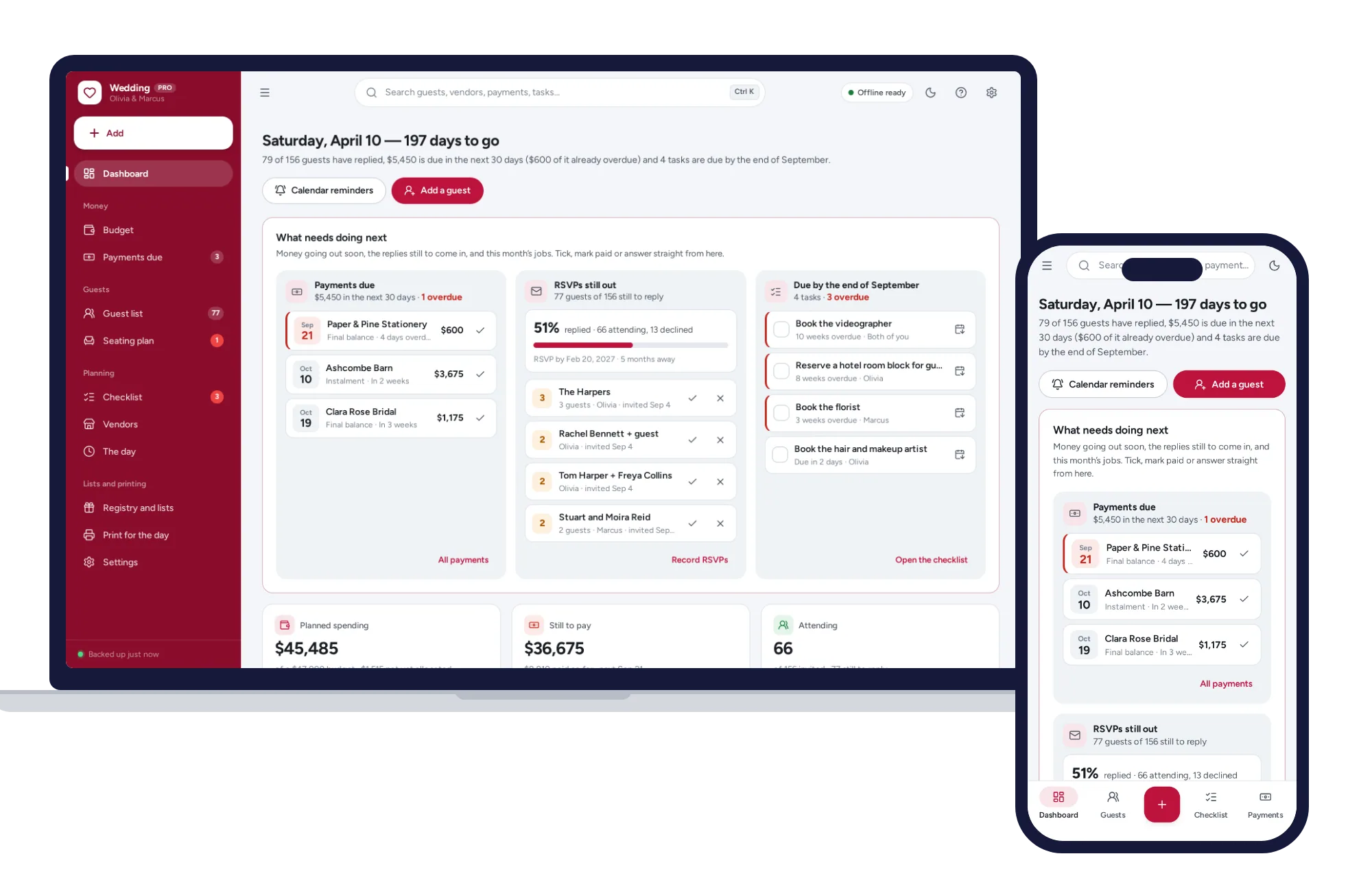
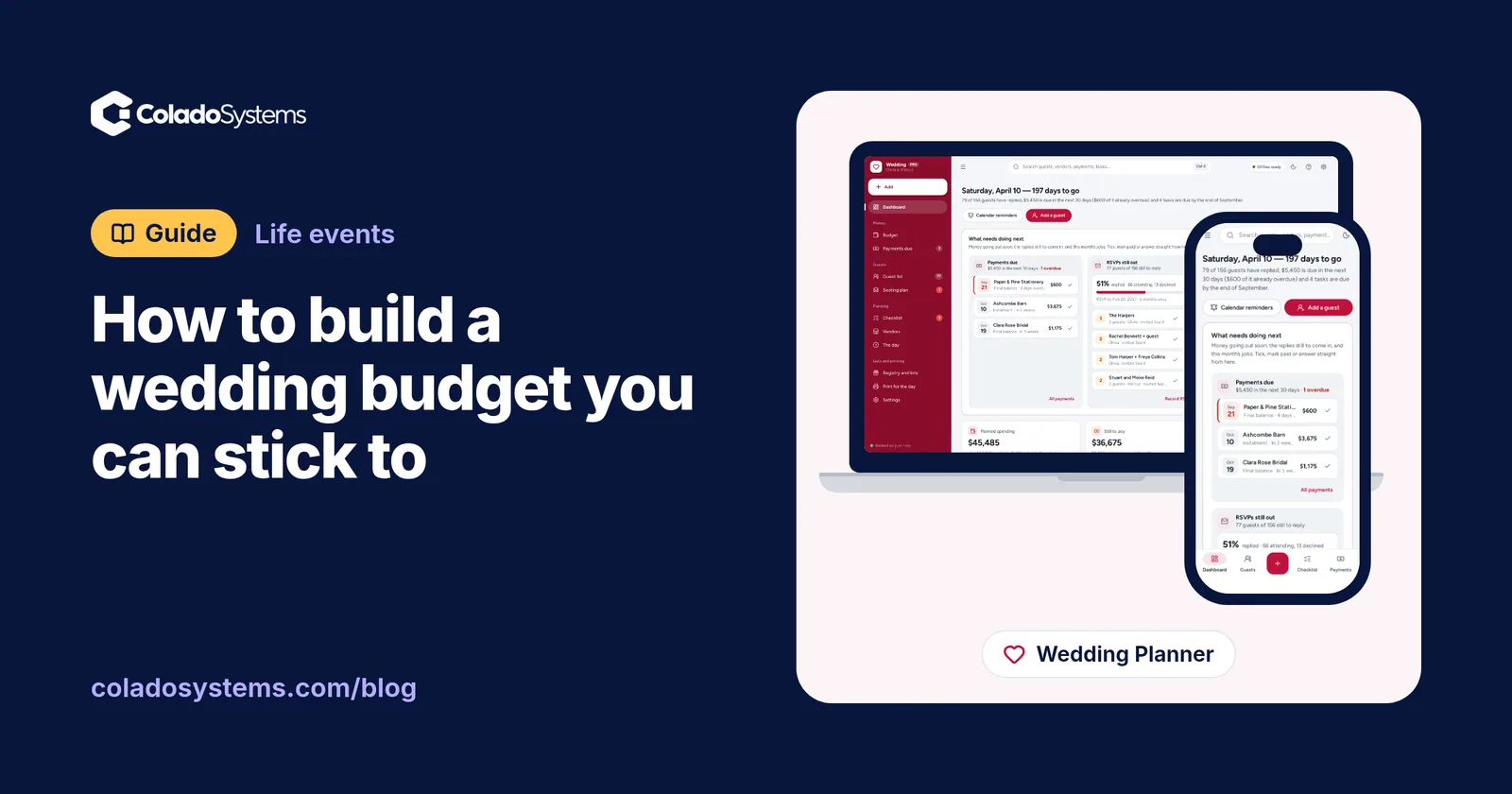
A spreadsheet can do this until the formulas get typed over. The Wedding Planner is built for one couple planning one wedding. Its budget tracker shows estimated, actual, paid and balance for every category, with each deposit and balance listed against the date it is due. The app cannot send notifications, so it hands those dates to your own calendar instead: it saves a calendar file with every unpaid payment, and each one lands in your calendar with an alert a few days before.
The vendor tracker lets you compare quotes side by side against your own estimate, and booking a vendor sets up the deposit and the balance. The guest list and RSVP tracker holds addresses, replies, meals and plus-ones, which keeps the guest count you are budgeting around honest. The checklist dates every task from your wedding day and moves with it if the date changes, and the printouts give the venue and caterer the seating chart, meal numbers and dietary needs.
It runs offline in your browser, with no account and no subscription, and your records stay on your own device. You will find it with other planners for life events.
However you track it, the habit matters more than the tool: one shared record, a weekly check, and a conversation every time a number moves.
Skip the setup
The Wedding Planner has the records this guide describes already set up. Budget tracker with payment due dates, guest list, seating chart and checklist on one dashboard. No formulas to break, no subscription.
$24.99 one-time
- Sample data to try it the same day
- Works offline, records stay on your device
- A PDF guide in the download
See everything inside the Wedding Planner. Or take the whole Life events shelf: 4 systems for $69.99, $19 less than one by one.
Common questions
What percentage of a wedding budget should go to the venue?
There is no fixed rule. Venue and catering tend to be the biggest share because they grow with every guest, so a first draft might set aside close to half the total for them and adjust from there. If the venue package includes food, chairs and decor, or you care more about photography or music, move the money to match your own priorities.
How much should you set aside for unexpected wedding costs?
Holding back around a tenth of your total is a sensible starting point. It covers things nobody budgeted for, such as alterations, extra rentals, a rain plan or service charges missed in a quote. Keep it as its own line rather than spreading it across categories, and whatever is left over can go toward the honeymoon or your savings.
When are wedding vendor deposits due?
Most vendors ask for a deposit when you book and the balance a few weeks before the wedding, but the timing and amounts vary, so read each contract. Write down every payment with its amount and due date, total them by month, and check the money will be there. Also note the cancellation terms and any final guest count deadline.
How can you cut wedding costs without losing what matters?
Start with the guest list, since food, drink, rentals and stationery all scale with it. Then protect the two or three things you both ranked highest and trim the categories neither of you cares much about. Ask whether each quote includes tax, service charges and gratuities, and compare more than one vendor before you book.