The short answer to debt snowball vs avalanche: the avalanche method puts extra money on the highest interest rate first and costs less in interest, while the snowball puts it on the smallest balance first and gets your first debt paid off sooner. The right choice is the one you will still be following in month fourteen.
If you have several debts and a fixed amount you can put toward them each month, here is how to decide which one gets the extra money, with real numbers instead of a slogan.
How both methods work
Both methods start the same way. You pay the minimum on every debt, every month. Whatever is left of your monthly debt budget goes to one target debt. When that debt is paid off, its minimum joins the extra payment, and the bigger amount rolls onto the next target. Your total monthly payment stays the same the whole way through.
The only difference is the order:
- Snowball: target the smallest balance first, whatever its interest rate.
- Avalanche: target the highest interest rate first, whatever its balance.
Snowball is built for momentum. Avalanche is built for arithmetic.
Debt snowball vs avalanche: a worked example
Say you have these three debts. The figures are made up to show how the methods compare:
| Debt | Balance | APR | Minimum |
|---|---|---|---|
| Store card | $700 | 15% | $25 |
| Credit card | $5,500 | 27% | $140 |
| Personal loan | $3,000 | 11% | $95 |
The minimums total $260 a month. You can afford $500, so there is $240 extra each month.
Snowball order: store card ($700), then personal loan ($3,000), then credit card ($5,500).
Avalanche order: credit card (27%), then store card (15%), then personal loan (11%).
Running both month by month, charging interest monthly on each balance and holding the $500 level throughout, gives roughly this:
| Snowball | Avalanche | |
|---|---|---|
| First debt paid off | Month 3 | Month 18 |
| Debt-free | Month 24 | Month 22 |
| Total interest | About $2,355 | About $1,795 |
The avalanche saves about $560 and two months. The snowball clears the store card in month 3 and the personal loan in month 11, while the avalanche has nothing fully paid off until month 18.
That is the real trade-off, in plain numbers: a much earlier first win against a few hundred dollars of interest. To see it on your own figures, a debt payoff planner that compares snowball and avalanche side by side does the month-by-month math for you.
When the gap is small, and when it is not
The difference depends mostly on how far apart your interest rates are and how large the high-rate balance is.
Change one figure. Say the credit card is at 16% instead of 27%. The orders stay the same, but now the snowball costs about $1,315 in interest and the avalanche about $1,192. The gap shrinks to around $120 and one month. At that point, the early win may well be worth it.
When one large balance carries a much higher rate than the rest, as in the first example, the avalanche pulls clearly ahead.
Which is better for you, snowball or avalanche?
- Have you started a payoff plan before and stopped? If motivation was the problem, the snowball’s early wins may be worth the extra interest.
- How far apart are your rates? When they are close, the two methods often cost about the same. When they are far apart, the avalanche saves real money.
- Is there a small debt you could clear in two or three months? Some people clear that one first for the boost, then switch to the avalanche for the rest.
- Does one debt matter for other reasons? Money owed to a relative, or a payment plan that keeps you up at night, can go first even if the math says otherwise. Just know what that choice costs.
Before you start
List every debt with its balance, APR, minimum payment and due date. Then check each minimum against the interest. If a minimum barely covers a month’s interest, that balance will hardly move unless it gets extra money.
Stop adding to the balances where you can. A plan that puts $240 extra toward debt each month will not get far if $200 a month goes back on the cards. Many people also keep a small cash buffer, so a surprise car repair does not end up on a card.
If you have never written a budget, the FTC’s consumer.gov guide to making a budget starts with your bills and pay stubs and includes a simple worksheet. To find the extra payment in the first place, give every category a monthly limit, on paper or in a personal finance manager with category budgets that warns you before you go over. Recurring charges are worth a look too: one-time purchase vs subscription walks through the five-year cost of the software you pay for monthly.
How to stay on track
Automate the minimums. Set every minimum to pay automatically, so a busy month never turns into a late fee.
Pay the extra right after payday. Money that sits in checking tends to get spent.
Log what you actually paid. Plans drift. Each month, update the real balances from your statements and recalculate.
Watch for rate changes. A promotional rate that ends can move a debt to the top of the avalanche order overnight.
Put windfalls to work. A tax refund or a bonus on the target debt can bring your debt-free date in by months. Even small, steady increases add up: in the example above, raising the budget from $500 to $550 moves the avalanche finish to month 20 and saves about $217 more in interest.
Mark the milestones. Each paid-off debt deserves notice, even a small one. It is part of what keeps you going.
If you miss a month, restart. One bad month does not cancel the plan. Pick it back up from the new balances.
Keeping it all in one place
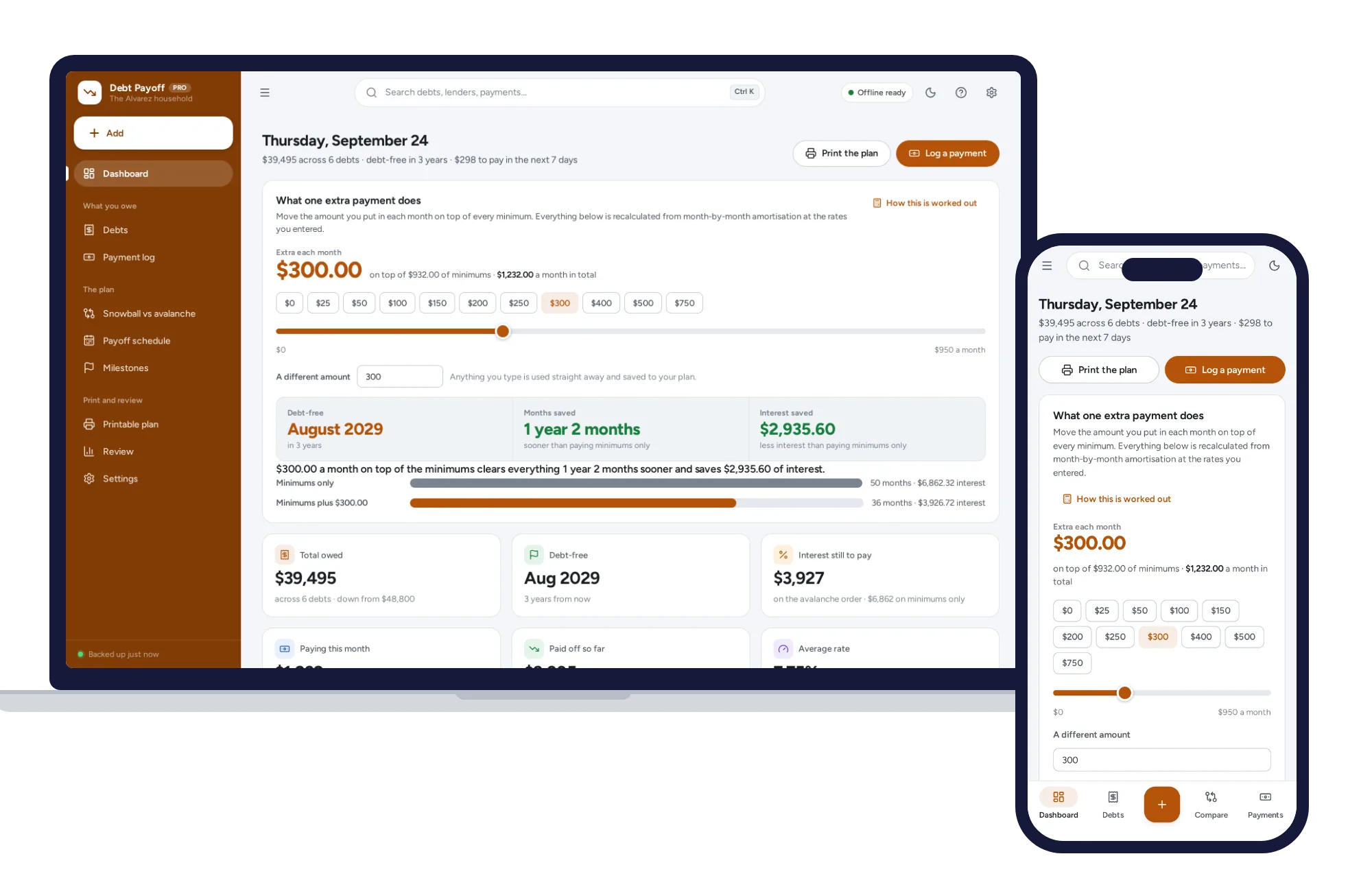
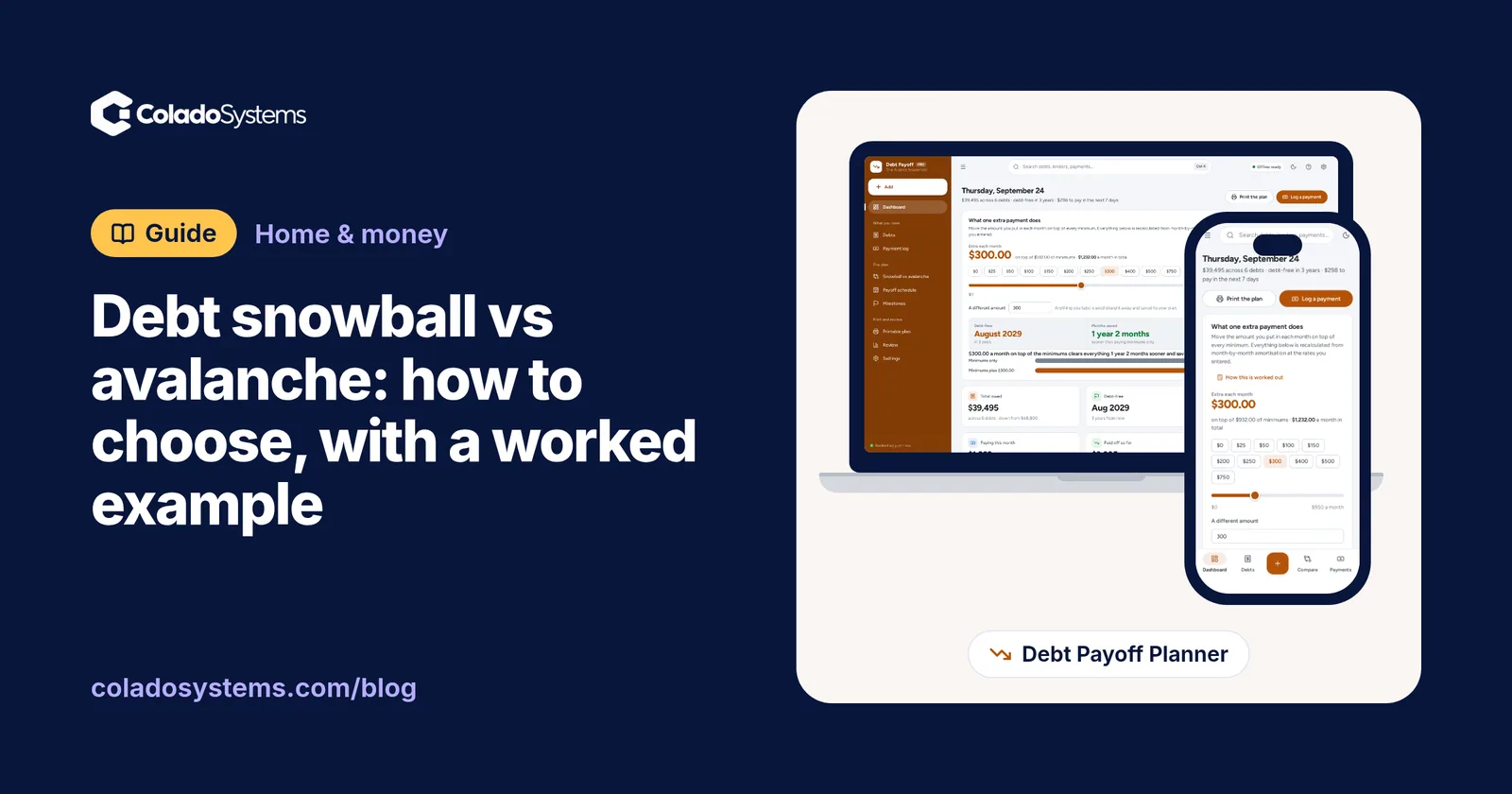
The Debt Payoff Planner runs this comparison on your own figures. You enter each debt’s balance, APR, minimum and due day, and it costs snowball and avalanche side by side, or an order of your own, showing the debt-free date, the total interest and when the first debt goes. One control shows what an extra payment buys, in months and interest saved. It flags any minimum that barely covers the interest, builds a month-by-month payoff schedule, and rebuilds every projection from the payments you actually log. A one-page payoff plan prints for the fridge.
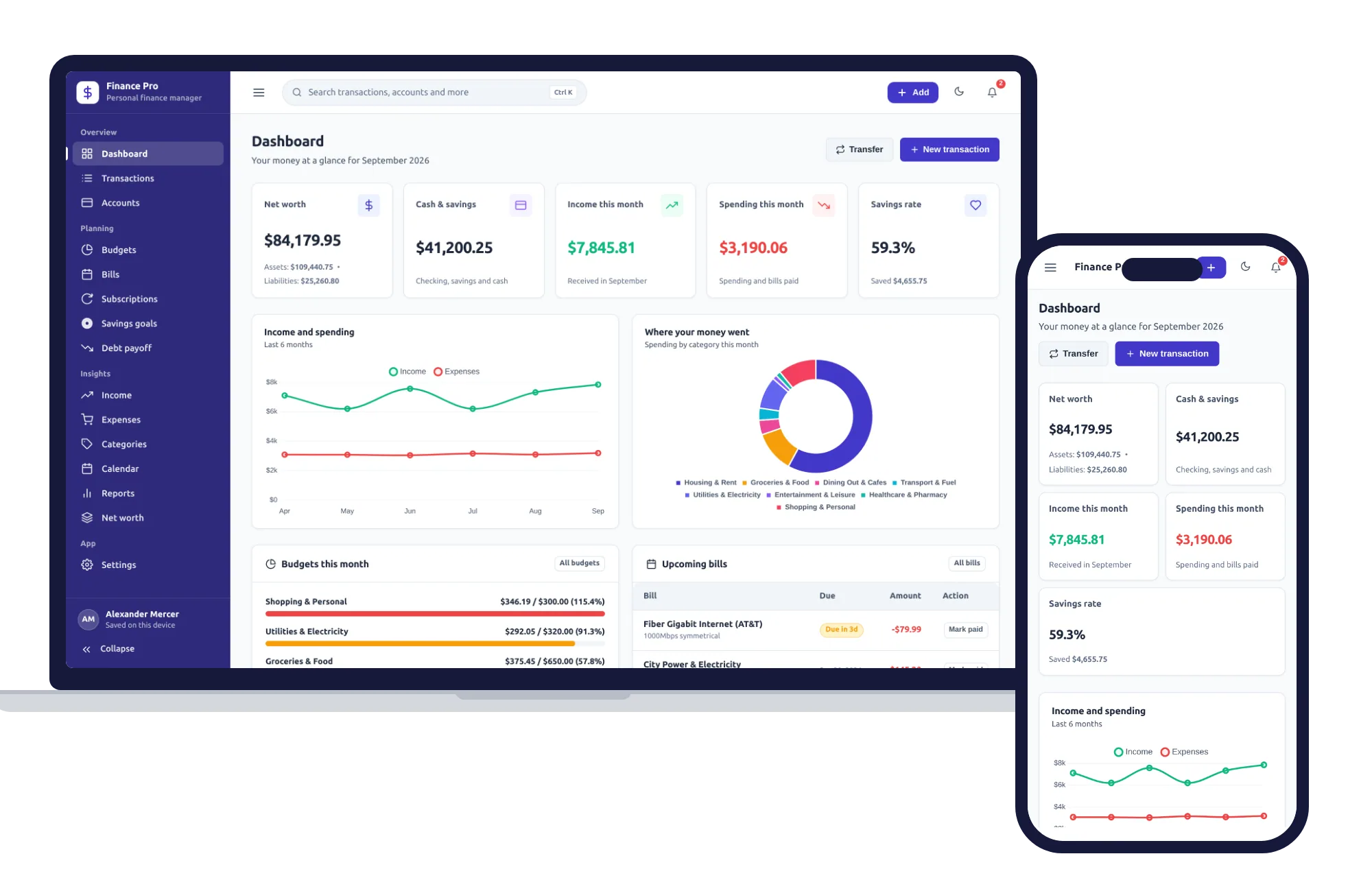
If you also want to see where the extra money will come from, the Personal Finance Manager covers the wider picture: monthly budgets by category, bills and due dates, savings goals, net worth, and its own snowball or avalanche debt payoff view.
Both run offline in your browser, with no account and no subscription, and nothing you enter is uploaded. You will find them with other planners for home and money.
A word of caution
This is general guidance, not financial advice. Real lenders vary. Some charge interest daily rather than monthly, many recalculate card minimums as the balance falls, and fees or promotional rates change the math. Treat any payoff date as a plan to work toward, not a promise. If your debts are causing real trouble, a nonprofit credit counselor or a qualified financial professional can look at your situation in a way no article can. The FTC’s guide on how to get out of debt explains what a good credit counselor does and how to spot one to avoid.
Skip the setup
The Debt Payoff Planner has the records this guide describes already set up. Every debt in one place, snowball and avalanche side by side, and one control that shows what an extra payment really buys — offline, on your own device.
$24.99 one-time
- Sample data to try it the same day
- Works offline, records stay on your device
- A PDF guide in the download
See everything inside the Debt Payoff Planner. Or take the whole Home & money shelf: 7 systems for $89.99, $84 less than one by one.
Common questions
Which is better, the debt snowball or the debt avalanche?
On interest alone, the avalanche comes out ahead, because the highest-rate balance shrinks first. The snowball pays off your smallest debt sooner, which can help you keep going. If your rates are close together, the difference may be small and the early wins may be worth it. If one large balance carries a much higher rate, the avalanche usually saves noticeably more.
Should you include your mortgage in a debt snowball?
Often it makes sense to leave it out. A mortgage is usually a large balance at a lower rate than cards or personal loans, so it would sit last in either order and push your debt-free date out by many years. Focus the plan on the debts you are actively trying to clear and keep paying the mortgage as agreed. A financial professional can advise on your own situation.
What if my minimum payment barely covers the interest?
Then that balance will hardly move, however long you pay the minimum. Estimate a month of interest by multiplying the balance by the APR as a decimal and dividing by 12. If the minimum is close to that figure, the debt needs extra money early or a conversation with the lender. If your budget cannot cover the interest at all, a nonprofit credit counselor can help.
Can you switch from the snowball to the avalanche method?
Yes. Nothing locks you into one order. A common approach is to clear one small debt first for a quick win, then point the extra money at the highest rate. Whenever you switch, recalculate from your current balances so the plan reflects where you actually are, and keep paying every minimum while you change targets.