Most cleaning schedules fail in week two. You print a lovely chart: bathrooms Monday, dusting Tuesday, floors Wednesday. Then a child gets sick on Tuesday, Wednesday runs late, and by Thursday you are three jobs behind and the chart on the fridge feels like a scolding.
The fix is not more willpower. It is a home cleaning schedule built around how often each job needs doing and how much time you really have, shared with everyone who lives there.
Why most cleaning schedules fall apart
- Jobs are pinned to weekdays. Miss Monday and the bathroom waits a whole week, or doubles up with Tuesday.
- The list is too long. A schedule that needs 90 minutes a day will not survive a household that has 20.
- One person carries it. Whoever made the chart ends up doing the chart.
- Missed jobs pile up. A wall of overdue tasks is where most people give up.
How to build a home cleaning schedule that bends
- List every task, room by room. For each one, note how often it needs doing and how long it takes. One line each: “Kitchen, wipe counters, daily, 5 minutes.”
- Sort them into daily, weekly, monthly and a few times a year (lists below).
- Add up the minutes. Say your daily jobs take 20 minutes, your weekly list comes to 150 minutes, and your monthly jobs total 2 hours, or about 30 minutes a week. That is 140 minutes of daily jobs across seven days, plus 150, plus 30: 320 minutes, a little over 5 hours a week for the whole household.
- Count from the last time a job was done, not from a weekday. If the bathrooms are weekly and you cleaned them on Saturday instead of Monday, they are next due on Saturday. Nothing piles up. This is how a cleaning planner that works out today’s list from when each task was last done runs, and it works with a pencil too: write a last-done date beside each task.
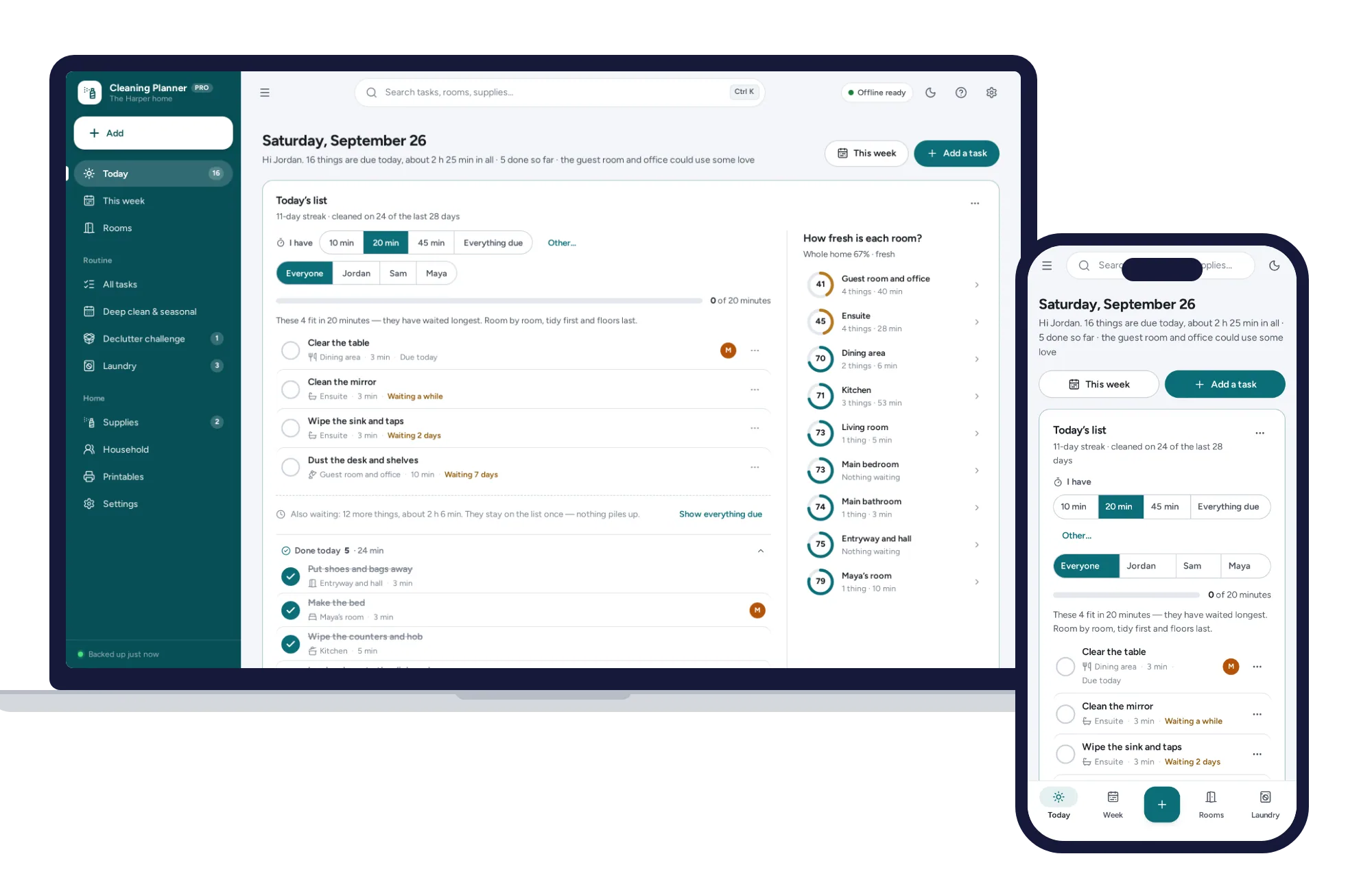
- Think in time blocks. Each morning, decide whether today is a 10, 20 or 45-minute day, then do the jobs that have waited longest.
Daily, weekly and monthly cleaning tasks
Daily (about 15 to 20 minutes)
- Dishes done, or the dishwasher loaded and run
- Kitchen counters and stovetop wiped
- A 10-minute tidy of the main living space
- Bathroom sink wiped
- A load of laundry, if your household needs one daily
Weekly
- Bathrooms: toilet, shower or tub, mirror and floor
- Vacuum and mop the floors
- Dust surfaces and shelves
- Change bed sheets and towels
- Empty every trash can and take out the recycling
- Clear old food from the fridge
Monthly
- Vacuum the sofa and under the cushions
- Wipe baseboards, light switches and door handles
- Dust blinds and ceiling fans
- Clean the dishwasher filter
- Clear out one cabinet or drawer
A few times a year
Windows, the oven, grout, behind the appliances, the gutters and the closets. Give each its own month so no single weekend has to carry them all.
How do you split chores fairly in a busy household?
Count time, not tasks. Cleaning a bathroom and emptying a trash can are both “a chore,” but one takes ten times longer.
With the 320 minutes from your list to share, two adults might take 2 hours each, a 13-year-old an hour, and an 8-year-old 20 minutes. That adds up to 320.
- Give children real jobs that suit their age. An 8-year-old can unload cutlery, feed the cat and wipe the table. A teenager can vacuum, clean a bathroom sink and do their own laundry.
- Rotate the jobs nobody wants. The toilet moves around the house every week.
- Make it visible. Who does what goes on the fridge, not in one person’s head.
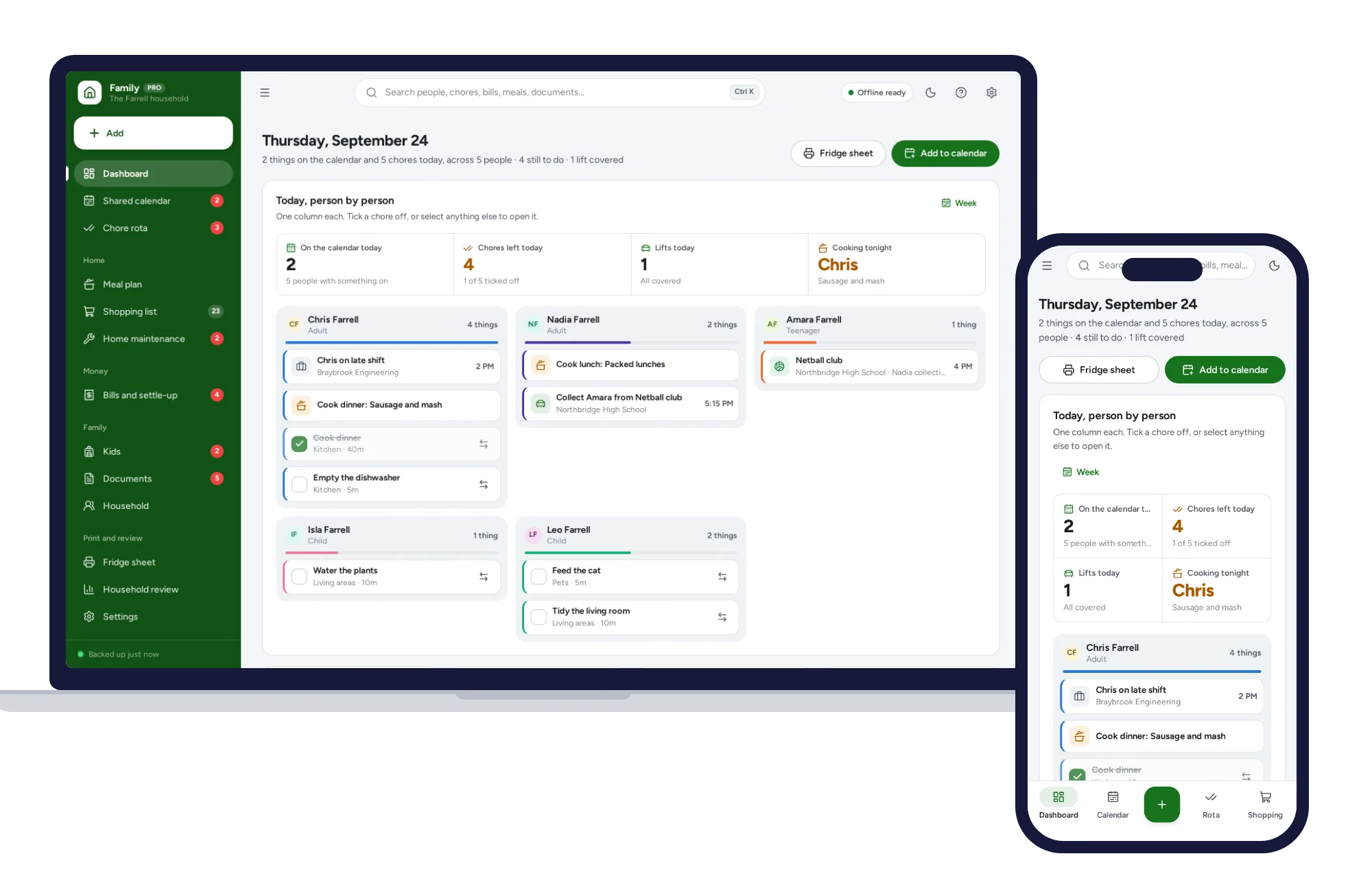
A family organizer with a chore chart that rotates whose turn it is can also show each person’s share next to what they actually did, which settles arguments. If you already run a Sunday reset to plan the family’s week, add five minutes to agree on this week’s chores.
Catching up after a bad week
Skip the Saturday marathon and do the 20-minute rescue:
- Dishes and kitchen counters
- Toilet and bathroom sink
- Floors in the room you use most
- One load of laundry
Then restart. Anything you cannot reach this week starts a fresh round from today rather than sitting on the list as overdue. A clean kitchen and bathroom carry a house through a rough patch.
Printable chart, spreadsheet or app?
| Printable chart | Spreadsheet | Subscription chore app | Offline cleaning planner | |
|---|---|---|---|---|
| Setup | Print and go | Build tabs and formulas | Sign up, add tasks | Download, add rooms and tasks |
| Due dates | Fixed weekdays | Formulas you write | Worked out for you | Worked out for you |
| Everyone sees it | On the fridge | If the file is shared online | Live on every phone | One device, plus printouts |
| Cost | Paper and ink | Free | A monthly or yearly fee | A one-time price |
| Account needed | No | For online sharing | Usually | No |
| Where it lives | The fridge | Your computer or cloud drive | The company’s servers | Your own device |
A printed chart is visible and simple, but goes stale the first week you miss. A spreadsheet can count from last-done dates if you write the formulas, but breaks when someone types over a cell. A subscription app puts the list on every phone with live sync, a real plus for a big household, for a monthly fee and an account each. An offline planner is bought once with no account, but it lives on one device, so everyone else relies on printouts, and you keep your own backups.
What it takes to build it yourself
To make a spreadsheet do everything in this guide, you need a row per task with its room, frequency, minutes and last-done date; a formula for the next due date; a filter for today; a way to pick what fits into 20 minutes; a rotation for who does what; a weekly printout; and somewhere for the seasonal jobs.
The Home Cleaning Planner already works this way. Each task in its chore list has a room, how often and how long. The Today dashboard works out the list from when each task was last done, and a missed task waits on today’s list once instead of piling up, with “Not today”, “Skip this round” and “Fresh start” for the weeks that go sideways. The time budget takes 10, 20 or 45 minutes, picks the tasks that have waited longest and lays them out room by room, floors last. Room scores show which room needs you. The deep-clean calendar spreads the bigger jobs across the year, with spring, fall and holiday checklists, plus a 30-day declutter challenge, a laundry routine and a restock list. Printables give you a weekly checklist and a card for each room. You can give tasks to people, though it keeps no points or rankings.
For the fairness side, the Family Organizer has a rotating chore chart that moves jobs down a list you set, from daily to monthly, with a bar for what each person did and a line for their share. Its fridge sheet puts the chore chart, calendar, meals and shopping on one printed page.
On cost, a chore app at, say, $5 a month is $60 a year, every year. These are a one-time price.
Keeping it all in one place
The Home Cleaning Planner opens with a sample home, and each room you add can start with a ready-made routine, so you are not typing forty tasks on day one. There is no account or sign-up, it works offline, and your routine stays in the browser on your own device. The honest limit: there is no sync to everyone’s phone, so print the weekly checklist and room cards for the fridge, and download a backup now and then.
To fit cleaning around everything else, see how to plan your week in 20 minutes, or browse other planners for home and money.
You can see everything inside the Home Cleaning Planner and try it with the sample home before setting up your own rooms.
Skip the setup
The Home Cleaning Planner has the records this guide describes already set up. Today’s list works itself out, missed tasks never pile up, and “I have 20 minutes” picks what fits. No subscription.
$24.99 one-time
- Sample data to try it the same day
- Works offline, records stay on your device
- A PDF guide in the download
See everything inside the Home Cleaning Planner. Or take the whole Home & money shelf: 7 systems for $89.99, $84 less than one by one.
Common questions
What should be on a weekly cleaning schedule?
A weekly list usually covers the bathrooms, vacuuming and mopping floors, dusting, changing bed sheets and towels, emptying trash and recycling, and clearing old food out of the fridge. Keep daily resets like dishes and counters separate, and spread monthly and seasonal jobs across the year, so the weekly list stays short enough to finish when the week gets busy.
How many hours a week should you spend cleaning your house?
There is no right number. It depends on the size of your home, how many people and pets live there, and how tidy you like it. To find yours, list every task with how often it needs doing and roughly how long it takes, add up the minutes for a week, then divide the total among the people who live there.
How do I keep a cleaning routine when I work full time?
Keep the daily part tiny, around 15 to 20 minutes of dishes, counters and a quick tidy. Do weekly jobs in short blocks on whichever evenings are free instead of saving them all for Saturday. Count due dates from when a job was last done rather than from a fixed weekday, and share the work by time with everyone in the house.
How often should you deep clean your house?
Rather than one exhausting deep clean, most households do better spreading the big jobs across the year. Windows, the oven, grout, behind appliances and closets can each get their own month, with a bigger push in spring or before the holidays if you like. That way no single weekend carries the whole job and the house never slides too far.