Short answer: a GLP-1 weight loss journal records each dose with its date, the amount as prescribed and the injection site; side effects with how bad they were and how many days after the dose they began; weigh-ins read as a 7-day average; and questions for your next visit. Your prescriber sets the plan. The journal only records it.
It doesn’t need to be elaborate: a few lines after each dose, a quick weigh-in, a tally of protein and water, and a running list of questions. That’s enough to turn “mostly fine, I think” into real answers when your prescriber asks how the weeks since your last dose change have gone. Here’s what to track, how to read it, and how to keep it going for months.
First, the important part. This is general guidance about keeping records, not medical advice. Your prescriber decides which medicine you take, your dose and when it changes. Follow their instructions and the pharmacy label, never change a dose because of anything you track or read, and ask your prescriber or pharmacist whenever something is unclear.
Why keep a GLP-1 weight loss journal?
Appointments are short, and memory leans heavily on the last few days. A written record shows you and your prescriber what’s actually happening: how your weight is trending, whether side effects are settling, and whether doses are going in on schedule.
It also shows you your own patterns. Nausea that tends to arrive two days after a dose is much easier to describe from notes than from memory.
Doses, injection sites and supply
For every dose, write down:
- The date and time
- The medicine name as it appears on your label
- The dose, exactly as prescribed
- Where you injected it, if it’s an injection
- Whether it was on schedule, late or missed, and why
If your prescriber has given you a schedule of dose steps, copy it into your journal exactly as written, with the dates they gave you. The journal is there to record their plan, not to adjust it. If you miss a dose or aren’t sure what to do next, call your prescriber or pharmacist rather than guessing.
For injections, rotate sites the way your prescriber or pharmacist showed you, and log each one so you know which spot has rested longest. The patient information for common GLP-1 medicines says the same: MedlinePlus’s pages on semaglutide injection and tirzepatide injection both say to change the site with each injection. A short list of sites with the date each was last used works fine on paper.
Then keep an eye on supply, because finding an empty box the night before a dose is stressful and avoidable. Here’s the arithmetic. Say you take a weekly dose on Sundays, you have three doses left after today, and your pharmacy likes a week’s notice. Those three doses cover the next three Sundays, so the fourth Sunday is the first one not covered. Order a week before that. A GLP-1 tracker that works out your refill date from the doses you have on hand does this sum after every dose, though a reminder in your calendar does the job too.
Side effects: what to note
Keep side effect notes short so you’ll keep writing them:
- What it was: nausea, constipation, tiredness and so on
- How bad, on a simple scale from very mild to severe
- How many days after a dose it started, and how long it lasted
- Anything that seemed to make it better or worse, like a large meal
Over a few weeks, this shows whether symptoms are settling and when they tend to turn up, which is worth bringing to your prescriber.
One rule matters more than the log. If a side effect is severe, or you’re worried at all, contact your prescriber, pharmacist or urgent care right away. Don’t wait for a pattern.
How often should you weigh yourself on a GLP-1?
Ask your prescriber what they’d like you to track, and go with that. Whatever the schedule, weigh yourself under the same conditions each time: same scale, same time of day, similar clothing.
If you weigh in daily, expect noise. Water, salt and yesterday’s meals can move the number from one morning to the next. A 7-day average smooths that out. Say your week reads 212.4, 213.0, 211.8, 212.2, 211.6, 211.0 and 211.4. The average is about 211.9. Next week’s average is the number to compare, not Tuesday against Wednesday.
For a slower view, compare averages a few weeks apart and divide the difference by the weeks between them to get a rate per week. What pace is right for you is a conversation with your prescriber, not a target from the internet.
Beyond the scale, a waist measurement once a month and the occasional progress photo can show changes the scale misses.
Protein, water and the rest of the day
Your prescriber or a dietitian may give you goals for protein, water or fiber. Track against those numbers, not ones you found online. A tally is enough: a mark for each glass of water, and a running protein total from labels or a short list of the foods you eat most.
Quick notes help too. “Small lunch, felt full fast” takes five seconds and gives your side effect log some context. If you’re planning meals around your goals, this guide to meal planning on a budget has a weekly routine that adapts easily.
Appointments and questions
Write questions down the moment you think of them. Before each appointment, pull together a one-page summary:
- Your weight trend since the last visit, using averages
- Doses taken, including any missed or late
- Side effects, with how bad and how long
- Your questions, with space to write the answers
The idea behind keeping a migraine diary your doctor can actually use applies here too: steady, simple records beat a detailed log you only keep on bad days.
Paper, a spreadsheet or an app?
A paper journal is quick and private, and writing by hand suits some people. It can’t work out averages, a refill date or which site is next.
A spreadsheet can do the sums if you build them, but formulas break when someone types over them, photos don’t fit well, and it’s awkward on a phone.
A subscription health app may offer syncing and reminders, at, say, $10 a month, which is $120 a year, every year. Your weight and medication records also live on someone else’s servers, usually behind an account.
An offline tracker costs a one-time price, needs no account, and keeps records on your own device with nothing uploaded. The trade-offs: each device keeps its own copy with no sync between them, and you make your own backups.
Keeping it all in one place
To build this yourself, you’d need a weigh-in sheet with a rolling 7-day average, a rate-per-week formula that copes with missed days, a dose log holding your prescriber’s steps, a site rotation list, a side effect scale, a supply count that projects a refill date, tallies for protein and water, and a printable summary for appointments.
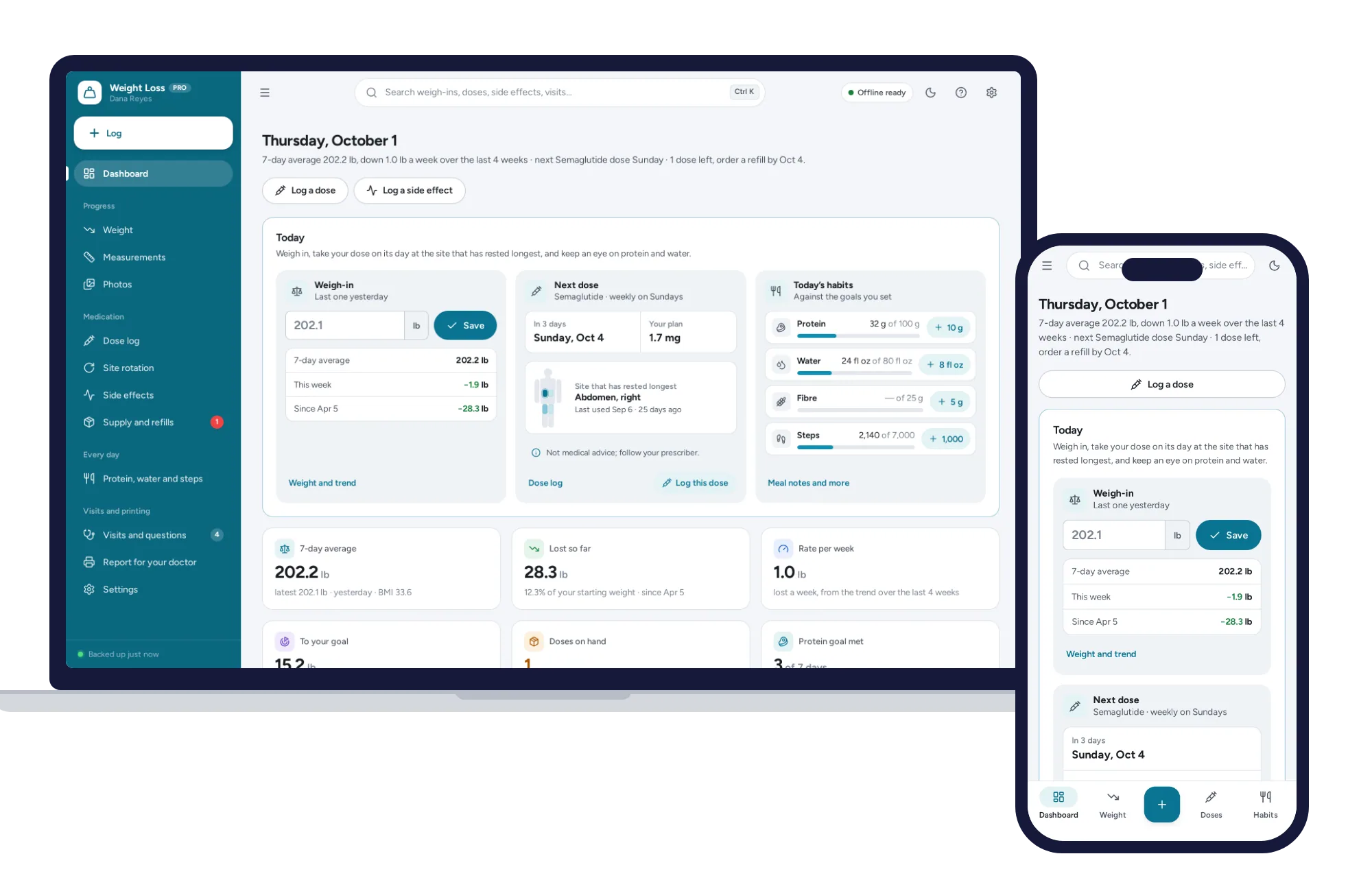
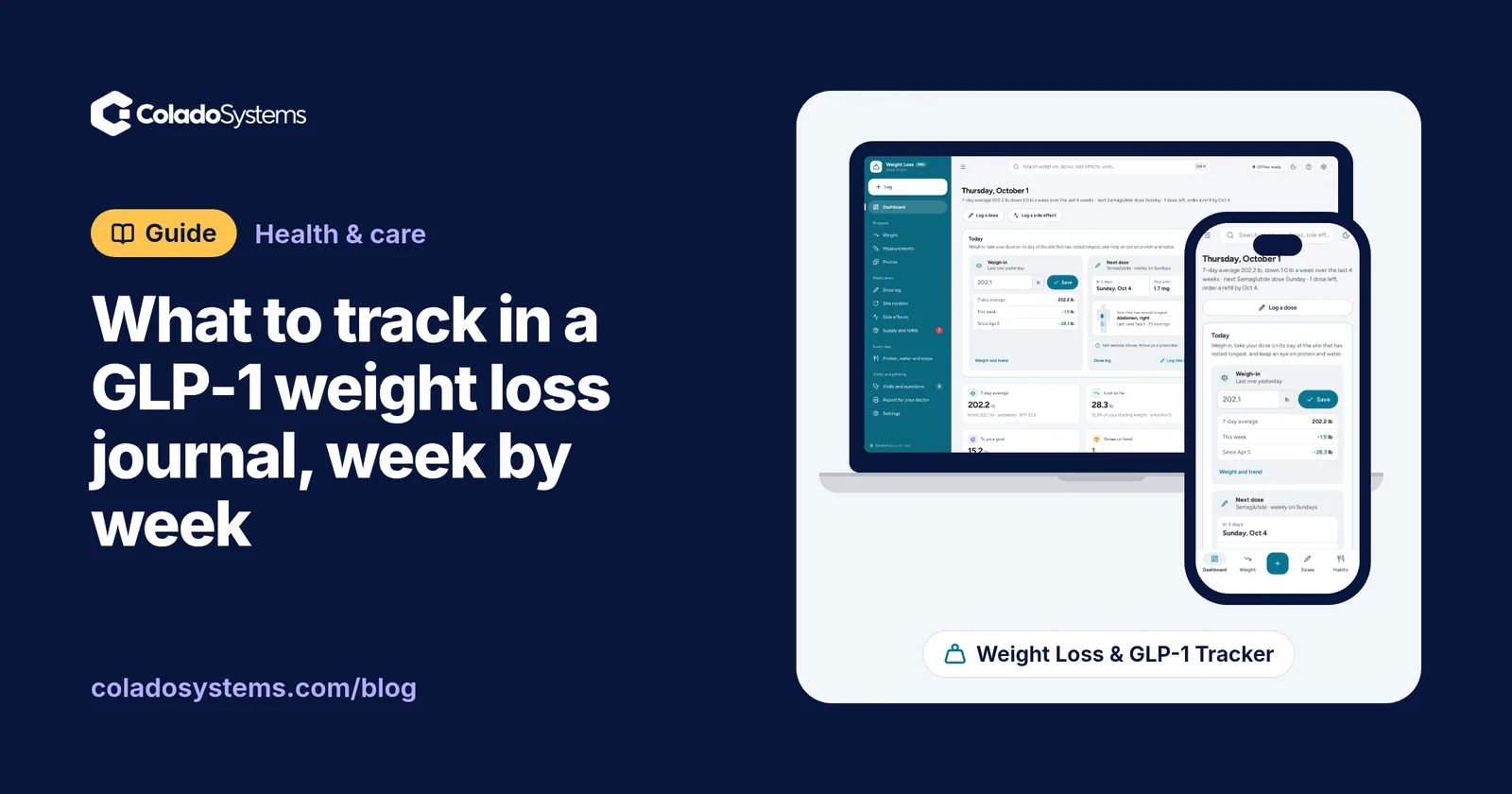
The Weight Loss & GLP-1 Tracker has those pieces already:
- Weight loss tracker with a 7-day average trend, plus Rate per week, which allows for gaps and gain weeks.
- GLP-1 dose log, with Dose steps as your prescriber set them and the dose from their plan filled in.
- Site rotation, which suggests the site that has rested longest across abdomen, thigh and arm, left and right, skipping any you don’t use.
- Side effects, rated from very mild to severe, with how many days after a dose each came and a week-by-week view of whether they’re settling.
- Pen supply, which works out your refill date from the doses you have on hand.
- Protein and water against your own goals, Steps and exercise with quick meal notes, and Measurements and Progress photos kept on your device.
- Visits and questions, plus a printable Report for your doctor with your weight trend, doses over time, side effects and questions.
It never suggests a dose, a change of dose, a diet or a target. Every dose step, goal and refill timing comes from what you enter from your prescriber. It works with any medicine you type in, by injection or tablet, and switches between pounds and kilograms whenever you like.
It opens with a sample journal, so you can see weeks of trends before entering anything of your own. There’s no account or subscription, it runs without internet, and progress photos are never uploaded. You’ll find more trackers on the health and care shelf. When you’re ready, see everything inside the Weight Loss & GLP-1 Tracker and try it with the sample data the same day.
Skip the setup
The Weight Loss & GLP-1 Tracker has the records this guide describes already set up. A weight loss dashboard with a 7-day average trend, a GLP-1 dose log that suggests the next injection site, side effects and your refill date. No formulas to break, no subscription.
$19.99 one-time
- Sample data to try it the same day
- Works offline, records stay on your device
- A PDF guide in the download
See everything inside the Weight Loss & GLP-1 Tracker. Or take the whole Health & care shelf: 10 systems for $139.99, $87 less than one by one.
Common questions
What should I track while taking a GLP-1 for weight loss?
Useful records include each dose with the date, the amount as prescribed and the injection site, any side effects with how bad they were and how many days after a dose they began, regular weigh-ins, protein and water against goals your care team gave you, and questions for your next visit. Your prescriber decides the dosing; the journal records their plan rather than changing it.
How often should I weigh myself on a GLP-1?
Ask your prescriber what they want you to track. Some people weigh in daily and watch a seven-day average, while others prefer once a week. Either way, use the same scale at the same time of day in similar clothing, and compare averages over several weeks rather than reacting to a single morning's number.
What should I do if I miss a GLP-1 dose?
Do not guess or adjust anything on your own. Check the instructions that came with your medicine, then call your prescriber or pharmacist and follow what they tell you. Note the missed dose in your journal with the date and the reason, so the record is complete when you next review it with your prescriber.
What should I bring to a GLP-1 follow-up appointment?
Bring a short summary: your weight trend since the last visit, ideally as averages, the doses you took including any missed or late ones, the side effects you had with how severe and how long, and a written list of questions. Leave room to write down the answers and any changes your prescriber makes, so you can follow them exactly.