A men’s health checklist by age tells you which checks to ask your doctor about, and roughly when. Blood pressure, weight, teeth, eyes and mood matter at every age; regular cholesterol and blood sugar tests and a first prostate conversation come up in your 40s; bowel cancer screening often starts in your late 40s or 50s; and bone health and an aneurysm scan are worth asking about in your 60s. Keep the dates, readings and results in one simple record, so you walk in knowing your own numbers instead of “a couple of years ago, maybe three.”
One thing first. Screening advice differs between countries, changes over time, and depends on your family history and your own health. Treat everything below as questions to ask your doctor, not a schedule to follow.
The checks worth knowing about at any age
Some things matter in every decade. Ask your doctor how often each makes sense for you.
- Blood pressure. High blood pressure often causes no symptoms, which is why it gets measured.
- Weight and waist. Tracked over time, not judged on one day.
- Teeth, eyes and skin. Regular dental visits, an eye exam as your eye doctor advises, and a word about any mole that changes.
- Vaccines. Ask which are due; the answer changes with age.
- Mood and sleep. These count as health too.
- Medications and supplements. Bring a full list, including over-the-counter ones.
The men’s health checklist by age
In your 20s and 30s: set a baseline
This is the easiest time to learn your normal. Ask about:
- A blood pressure reading, and how often to repeat it
- Whether and when a first cholesterol test makes sense
- Testicular self-checks: what to look for and what to report
- Sexual health testing, if it applies to you
- Your family history (start writing it down while relatives are easy to ask)
In your 40s: the numbers start to matter
The questions shift toward heart and metabolic health. Ask about:
- Cholesterol and blood sugar tests, and how often to repeat them
- Blood pressure, more regularly than before
- The prostate: whether and when a PSA test makes sense for you, a decision to make with your doctor rather than one to demand or refuse. In the US, the USPSTF’s prostate cancer screening recommendation also treats it as an individual choice, made after talking through the benefits and harms
- Eye checks, once small print starts to blur
In your 50s: screening often begins
Many health systems offer bowel cancer screening starting somewhere in your late 40s or 50s. In the US, for example, the USPSTF recommends colorectal cancer screening from age 45. Ask what applies where you live, and whether your family history means starting earlier. Also ask about:
- The prostate, revisiting the conversation from your 40s
- Cholesterol, blood sugar and blood pressure, on whatever interval you agreed
- Hearing and skin, especially after years of noisy or outdoor work
In your 60s and beyond
Everything above continues. Add questions about:
- Vaccines commonly recommended for older adults
- Bone health and balance
- An abdominal aortic aneurysm scan, which some health systems offer to older men, particularly those who have ever smoked (the USPSTF recommendation covers men aged 65 to 75)
- A full medication review, especially if more than one doctor prescribes for you
How often should men get a checkup?
There is no single answer. A healthy man of 25 and a man of 65 with high blood pressure need very different rhythms. The useful habit is to leave every appointment knowing when you should next be seen, and for what, and to write that date somewhere you will see it.
If you have a family history of heart disease, diabetes or cancer, say so. It may change when your doctor wants to start a check.
How to keep your health records at home
Your doctor holds the official record. You need a working copy, enough to answer questions and spot what is overdue. On paper or in a spreadsheet, keep five lists.
- Checks. Name, date last done, the result as you were given it, and the next date your doctor suggested.
- Readings. Date, number, unit and where it was taken. A pharmacy machine, a nurse and your own cuff at home do not always agree, and a clinician will ask.
- Medications. Name, dose, what it is for and who prescribed it, plus every supplement.
- Symptoms. What happened, when it started, how bad out of five and how long it lasted, written down the day it happens. It is the same idea as a migraine diary your doctor can actually use, applied to anything.
- Family history. What your parents, brothers and sisters had, and at what age.
A readings list might look like this (made-up numbers):
- March 4: 138/86, pharmacy machine
- April 12: 131/84, home cuff, morning
- May 20: 135/82, practice nurse
You are not judging those numbers. You are giving your doctor something better than “about 135, I think.”
Before each appointment, put your questions at the top of one page, numbered, because questions are what gets forgotten. Leave space at the bottom to write down what you were told. If a symptom is getting worse, do not wait for your next booked visit. Call your doctor.
Rather than building those lists from scratch, you could use a men’s health organizer that tracks checks due by age and your readings over time. And if one person in your house already keeps everyone’s appointments and prescriptions, a family medical records organizer with a record for each person may suit the household better.
Paper, spreadsheet, portal or app?
Each works if you actually use it. The honest trade-offs:
- A paper folder costs nothing. It cannot remind you of anything, trends are hard to see, and it is easy to leave at home.
- A spreadsheet can chart your readings. You build every tab and formula yourself, and it is awkward on a phone in a waiting room.
- Your practice’s patient portal, if it has one, shows official results, but only what that practice holds.
- A subscription health app syncs across devices and sends reminders. You pay every month, and your records sit on the company’s servers.
- A ready-made offline app is bought once and keeps records on your own device. There is no syncing between devices, you make your own backups, and the records are not encrypted, so the device needs a lock.
What it takes to build this yourself
A good spreadsheet version needs a checks tab with last-done and next-due columns, a readings tab with a source column and a chart, a medications list with repeat dates, a symptom log, and an appointment page you rebuild before every visit. It is doable, and it tends to stall halfway through a Sunday.
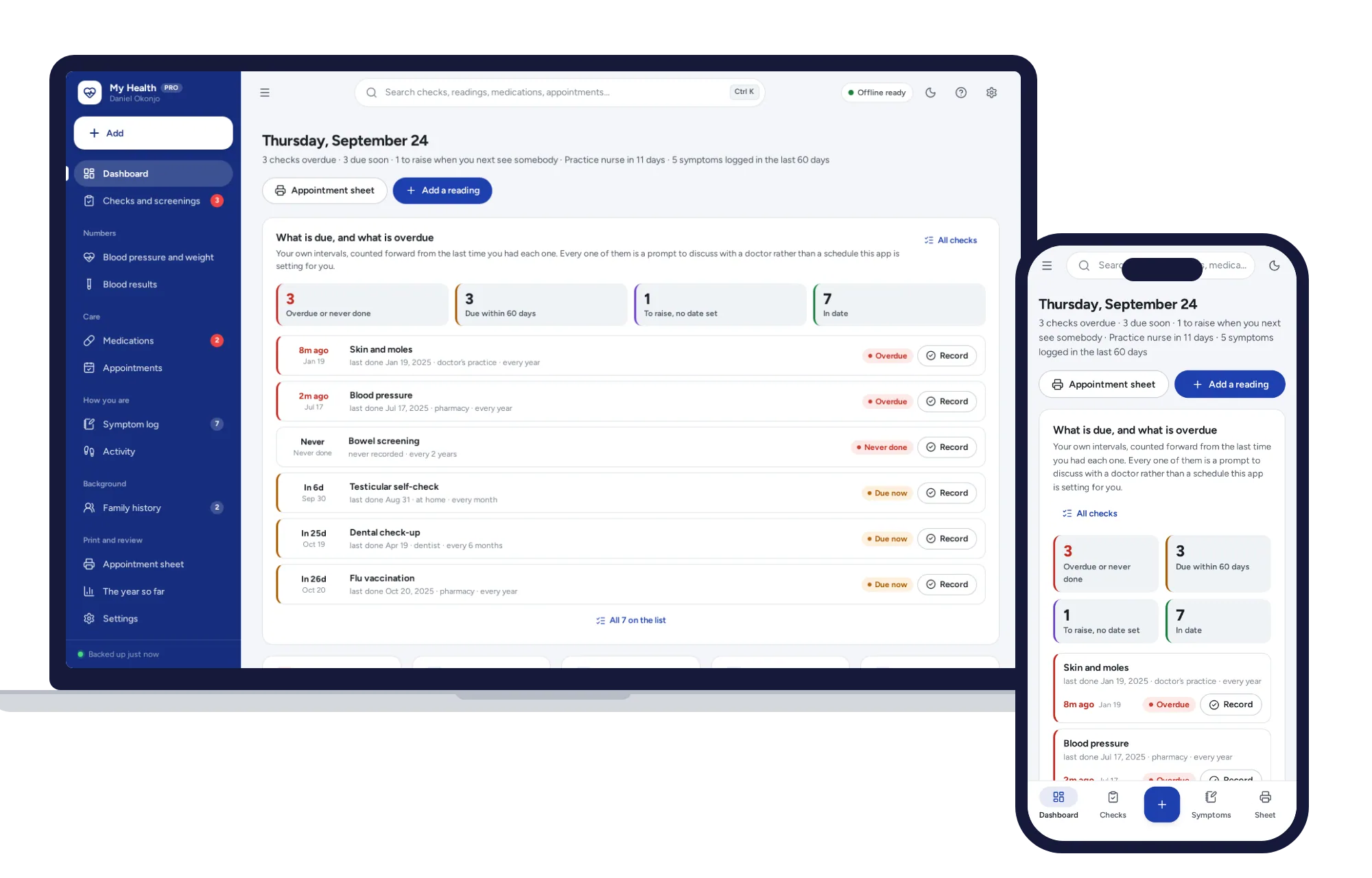
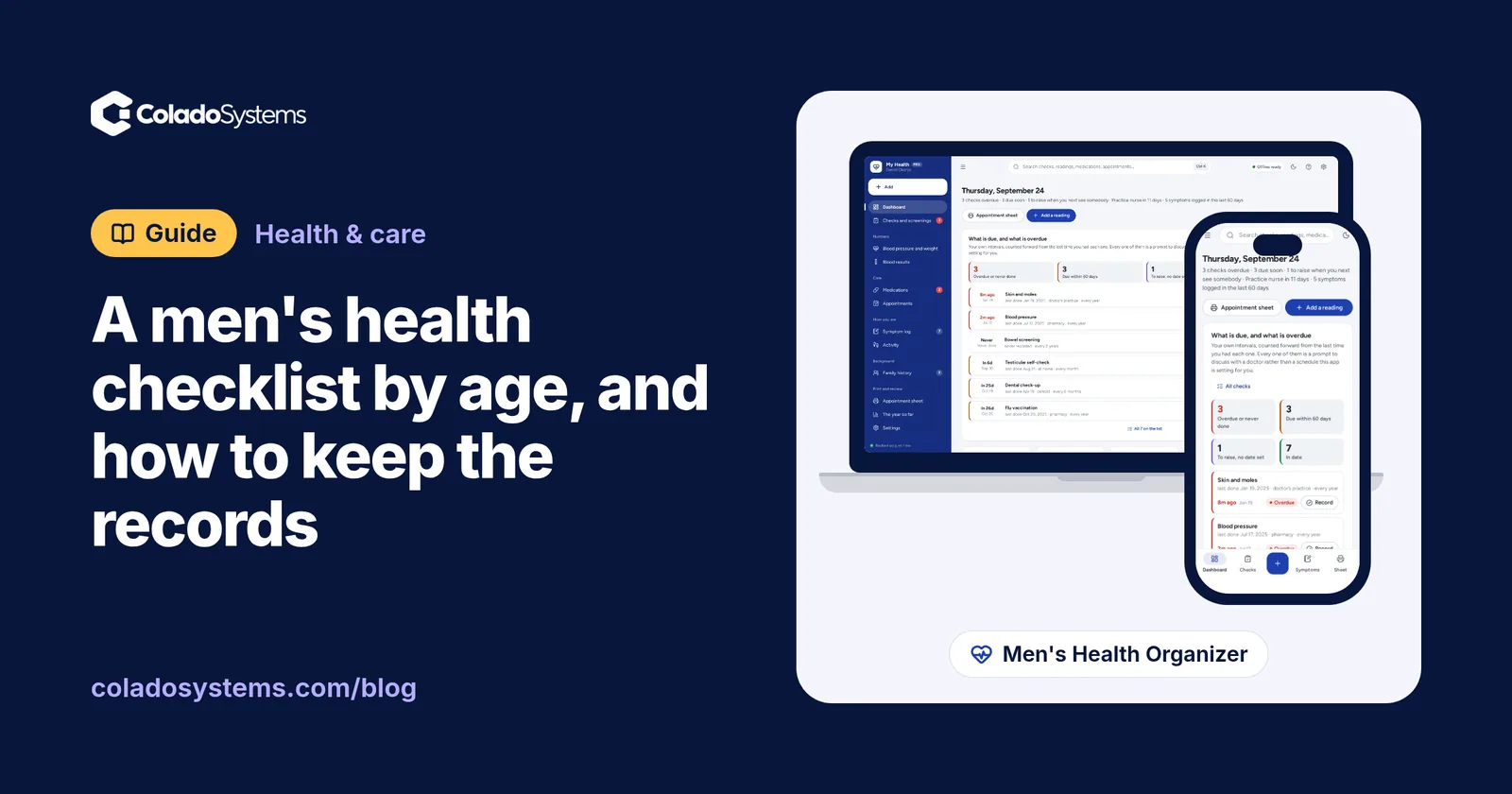
The Men’s Health Organizer already has those pieces. Its Checks screen covers blood pressure, cholesterol, blood sugar, prostate, bowel, skin, eyes and teeth, each with the date last done and the next date due. The intervals are prompts to discuss with your doctor, and every one is yours to change. Blood pressure, weight and waist are kept over time, blood results such as cholesterol, HbA1c and PSA keep the units on your result sheet, and each reading records where it came from. Any symptom you mark to mention prints on the appointment sheet: one page, your numbered questions first, with a box at the bottom for what you were told.
It gives no diagnosis, works out no risk score and never tells you whether a number is high. Family history becomes a question to ask, not a percentage.
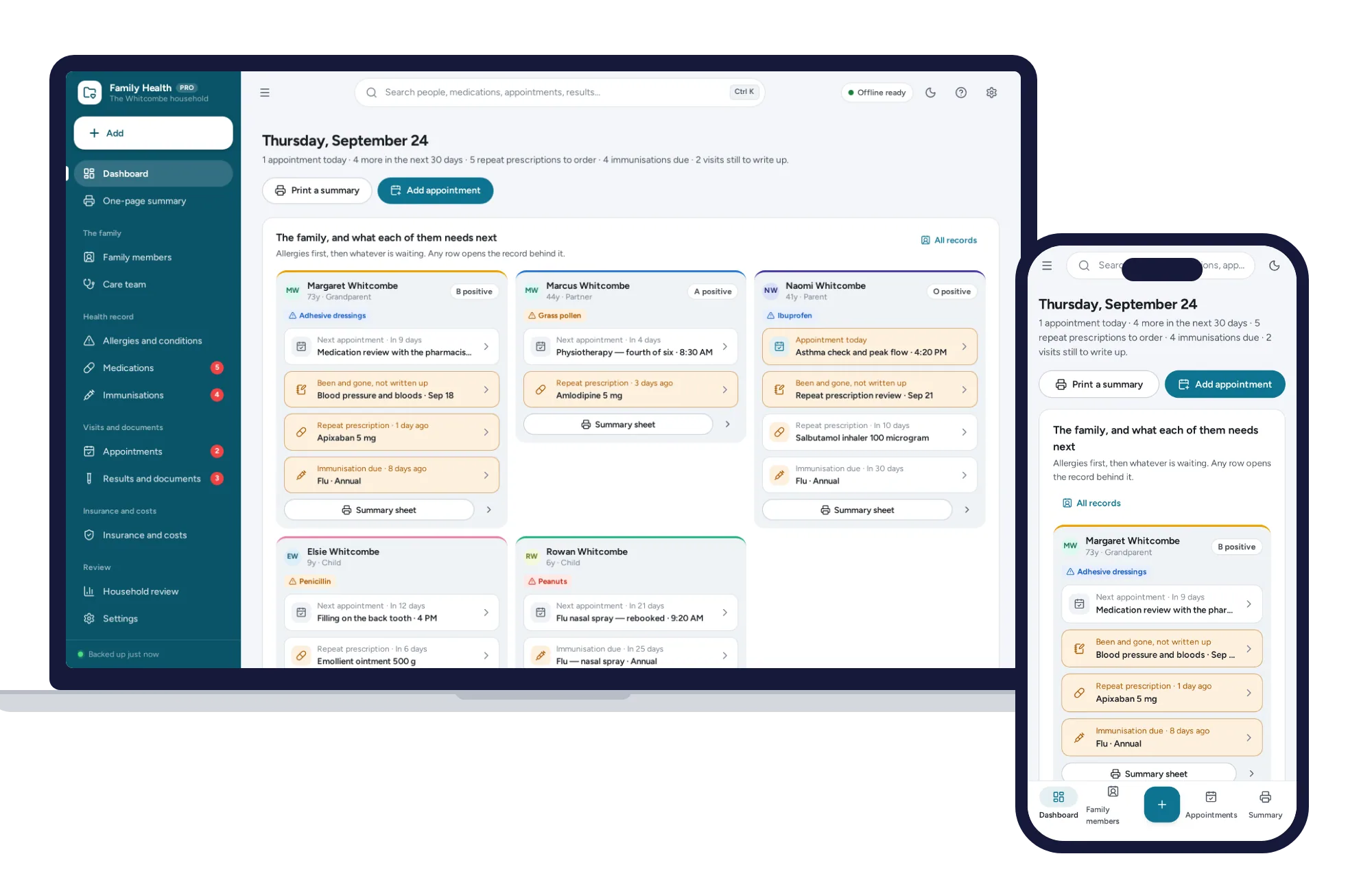
It holds one person’s record. For the whole household, the Family Medical Records Organizer keeps a record for everyone: immunizations, medications with repeats flagged, appointments, insurance costs split into billed, paid and outstanding, and a one-page summary that always prints allergies first.
On cost, a health app at, say, $6 a month is $72 a year, every year. These are a one-time price.
Keeping it all in one place
Both open with sample data, so you can look around before typing anything of your own. There is no account or sign-up, they work offline, and your records stay in the browser on your own device with nothing uploaded. Download a backup now and then, using a simple weekly routine for backing up your records.
Both sit on the Health & care shelf, so they also come together in the bundles, which cost less than buying them one by one. You can also browse other organizers for health and care.
You can see everything inside the Men’s Health Organizer and try it with the sample data today, then add your own first reading.
Skip the setup
The Men's Health Organizer has the records this guide describes already set up. Every check with a date on it, your numbers over time, and one printed page you can actually take in.
$24.99 one-time
- Sample data to try it the same day
- Works offline, records stay on your device
- A PDF guide in the download
See everything inside the Men's Health Organizer. Or take the whole Health & care shelf: 10 systems for $139.99, $87 less than one by one.
Common questions
What health screenings should a man get at 40?
Common topics at 40 include blood pressure, cholesterol, blood sugar, weight and waist, eyes and teeth, and a first conversation about the prostate and whether a PSA test makes sense for you. What is actually recommended depends on where you live, your family history and your own health, so ask your doctor which checks apply and how often to repeat them.
How often should a man get a physical?
It depends on your age, your health and how your health system organizes routine care. Younger men with no ongoing conditions are often seen less frequently than older men or anyone managing blood pressure, diabetes or another long-term condition. Ask your doctor at the end of each visit when they want to see you next, and write that date down so it does not drift.
At what age should men start prostate cancer screening?
There is no single age that applies to everyone. Guidance differs between countries and depends on family history and other risk factors, so some men are advised to talk about it earlier than others. PSA testing has benefits and downsides, which is why it is usually a shared decision. Raise it with your doctor in your 40s, or sooner if a close relative had prostate cancer.
What medical records should I keep at home?
Keep a working copy rather than the full file: the checks you have had with dates and results, your blood pressure and weight readings with where they were taken, a list of medications and supplements, notes on symptoms, and your family history. Add vaccination dates and insurance details. Your doctor holds the official record, but your own copy helps you answer questions accurately.