It is 5:40 on a Friday. You are parked outside your co-parent’s place, the kids’ bags are in the trunk, and nobody answers the door. Somewhere between a text in March and a phone call in June, the two of you stopped agreeing on whose weekend this is.
Most co-parenting friction does not come from big disagreements. It comes from small gaps: a pattern nobody wrote down, a holiday swap that lived in one person’s memory, a $60 field trip that never got split. A co-parenting schedule that works closes those gaps before they turn into arguments.
Here is how to build one, keep it accurate and keep the conversation around it calm.
Which co-parenting schedule pattern is right for you?
A custody pattern is the repeating cycle the calendar follows when nothing special is going on. If your parenting plan or court order already sets one, that document comes first. If you are still working it out, these are the patterns you will hear about most.
Week on, week off
The children spend seven nights with one parent, then seven with the other. There is one handover a week, which makes it simple to remember and easy on packing. The trade-off is a full week without seeing each parent, which some children (and parents) find long.
2-2-3
Two nights with Parent A, two with Parent B, then three with Parent A. The next week flips, so Parent B gets the three. Nobody goes more than three nights without the kids, but there are more handovers, and the weekdays change from one week to the next.
2-2-5-5
Parent A always has Monday and Tuesday nights, Parent B always has Wednesday and Thursday, and the weekends alternate, joining onto those days to make five-night stretches. Weekdays stay fixed, which helps with school routines and activities.
Every other weekend
One parent has the children most of the time, and the other has alternate weekends, often with a midweek dinner or overnight. It can suit families whose homes are far apart or whose work schedules are very uneven.
Whichever you choose, write down the start date and which parent the cycle begins with. “2-2-3 starting Monday, March 2, with Dad” can be checked by anyone. “We do 2-2-3” cannot.
Decide what overrides the pattern
The usual cycle covers most of the year. Then come school breaks, Thanksgiving, birthdays, Mother’s Day and Father’s Day, and summer trips.
Agree on a simple rule for these: holidays and vacations replace the usual pattern for their nights, and an agreed one-off swap replaces both. A common approach is to alternate holidays by year, so one parent has Thanksgiving in even years and the other in odd years. Holidays that move, like Easter or Thanksgiving, need their actual dates entered each year.
Put these on the calendar months ahead, not the week before spring break. A weekly look helps too: a short Sunday reset routine for busy families walks through the calendar, meals, chores and school things in under an hour.
How to track handovers and overnights
The handover log
For each handover, note the date, time, place, who handed over, and what went with the children: the inhaler, the soccer cleats, the permission slip, the medicine. It takes thirty seconds, and it answers “did the retainer come back?” without a phone call.
It also replaces memory with dates: if pickups keep running 40 minutes late, the record shows it.
Each home should also have the basics written down for every child: allergies, medicines and the doctor’s number. The one-page medical summary in what to put in a household emergency binder works well for this.
Counting overnights
The cleanest rule is that a date means the night of that date: if the kids sleep at your place on the 14th, the 14th is yours.
Overnight counts are worth checking because the calendar drifts. A 2-2-5-5 schedule gives each parent 7 nights in every 14-day cycle, but a few swaps and a long summer trip can tilt the year without anyone noticing. Some parenting plans and support arrangements refer to overnights. If yours might, ask your lawyer how they should be counted where you live, and keep your own record either way.
A paper calendar and a highlighter will do the counting, or a co-parenting planner that counts overnights for the year, a month or any dates you choose.
Split shared expenses without the arguments
Money is where small gaps grow fastest, mostly because it is so easy to lose track. Three decisions make it manageable.
- What is shared. Agree on the categories: school fees, medical and dental copays, activities, school trips, perhaps big clothing purchases. Anything not on the list is paid by whoever has the kids.
- The split. It might be 50/50, 60/40 or whatever your agreement sets. Write it down.
- When you settle. Once a month is plenty. Settling every receipt one at a time keeps money in every conversation.
Say you have agreed to a 60/40 split, with you paying 60%. This month you paid $120 for soccer and $60 for a school trip. Your co-parent paid a $40 dentist copay.
- Soccer: they owe you 40% of $120, which is $48.
- School trip: they owe you 40% of $60, which is $24.
- Dentist: you owe them 60% of $40, which is $24.
The trip and the dentist cancel out, so the balance is $48 owed to you. One number, one payment, with receipts to back it up. Keep a photo of each receipt, and carry a running balance from month to month.
Keep communication factual
Most messages between co-parents can follow the same shape: one topic, the facts, a clear request and a polite close.
Compare these two:
You’re always changing plans at the last minute. Can you at least tell me if you’re taking them on the 12th or not?
Hi, are you able to take the kids on Saturday the 12th from 9 to 5 as we discussed? If not, I’ll arrange a sitter. Please let me know by Wednesday. Thanks.
The second gets an answer. The first gets a reply about its first sentence.
A few habits help:
- Put swap requests in writing, with the exact nights and any make-up nights.
- Leave the history out. Each message is about the next thing that needs deciding.
- Wait before replying to anything that stings. Most messages can wait an hour.
- Keep your own dated notes of what was agreed, so you are not relying on memory.
Keeping it all in one place
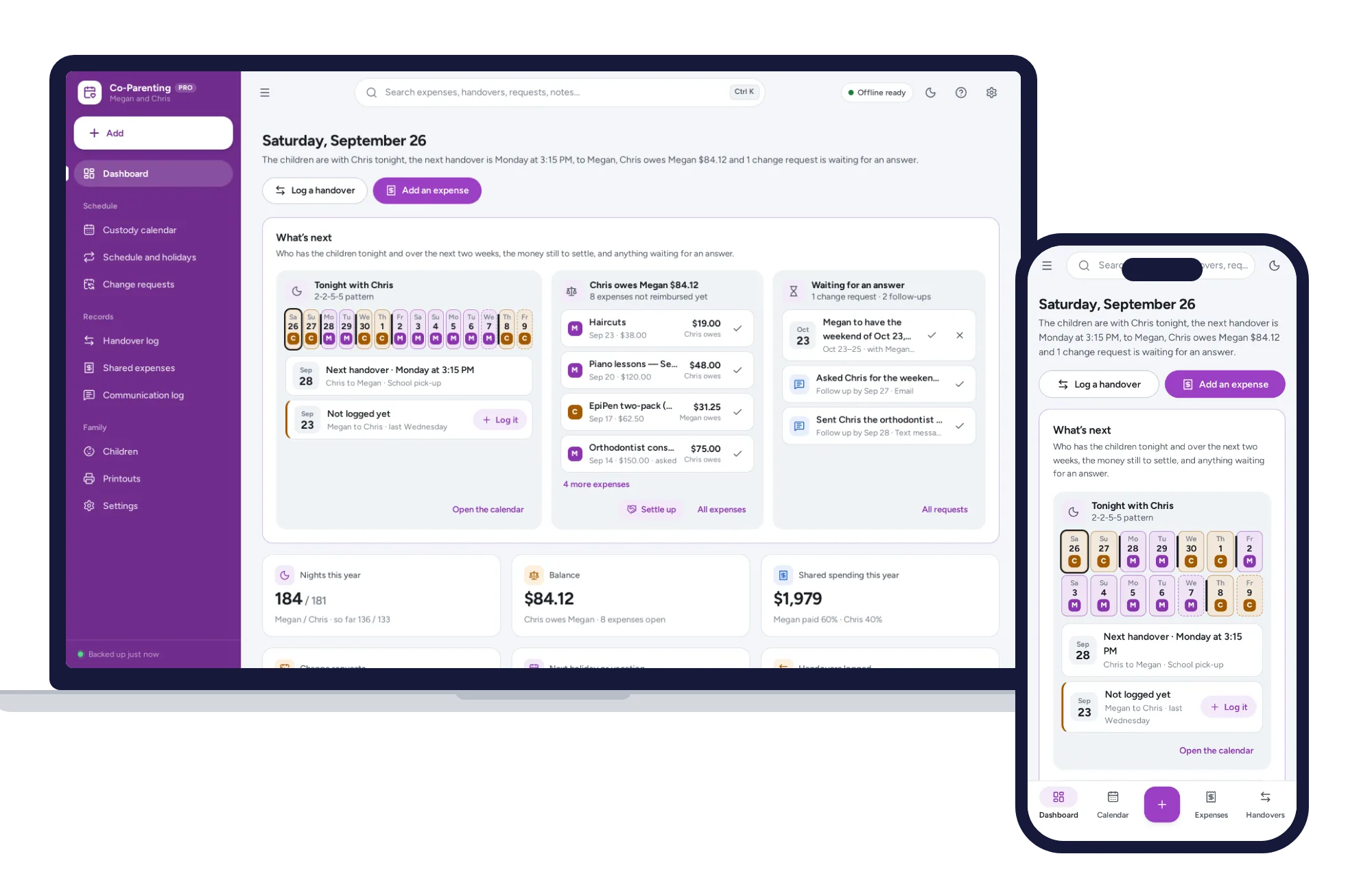
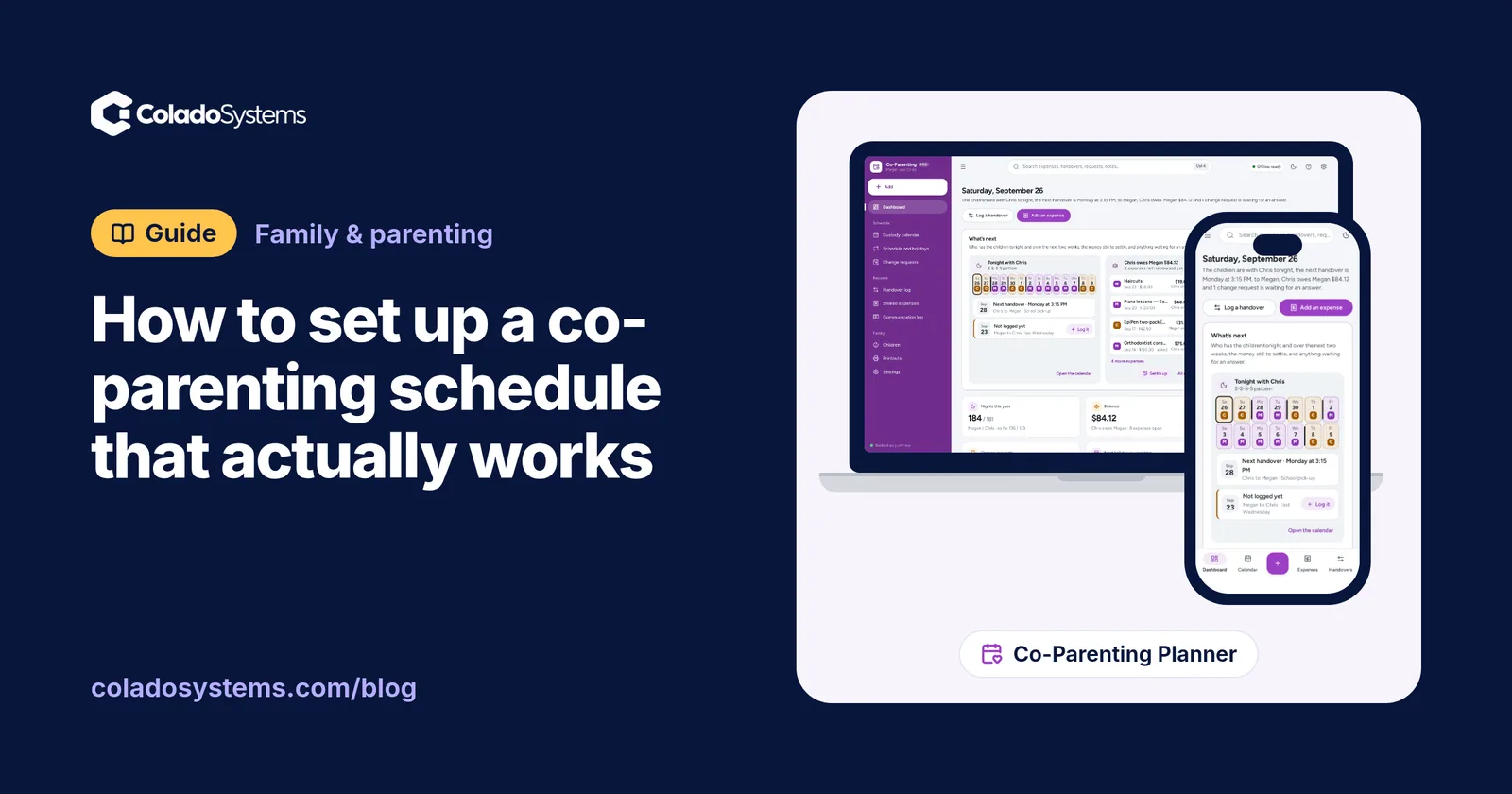
A paper calendar and a notes app will get you started, but the pieces drift apart. The Co-Parenting Planner puts them in one offline app. You pick your pattern (week on/week off, 2-2-3, 2-2-5-5, every other weekend or your own) and the date it started, and the custody calendar fills itself in, color-coded by parent. Holiday overrides and agreed swaps take priority over the usual pattern, and it counts overnights for the whole year, the year to date, a month or any dates you choose.
The handover log records the time, place, who and the items sent, and flags handover days you have not logged yet. The expense tracker lets you set the split per expense and keeps a running balance between the two households. There is a communication log for your own records and a children’s info page for school, doctor and allergies.
It runs in your browser with no account and no subscription, and your records stay on your own device. It is not a messaging app, so the other parent does not see it. When they need something, print the month calendar or an expense statement, or export a list. If your household needs more than a custody calendar, browse other planners for family and parenting.
A note on the legal side
None of this is legal advice. Your parenting plan, or any court order that applies to you, takes priority over any app, calendar or habit. If you have questions about changing the schedule, holidays, relocation or support, talk to a family lawyer or a mediator where you live. A clear record helps you have that conversation, but it does not replace it.
Skip the setup
The Co-Parenting Planner has the records this guide describes already set up. A custody calendar built from your pattern, overnight counts and a running expense balance on one dashboard. No formulas to break, no subscription.
$24.99 one-time
- Sample data to try it the same day
- Works offline, records stay on your device
- A PDF guide in the download
See everything inside the Co-Parenting Planner. Or take the whole Family & parenting shelf: 5 systems for $79.99, $44 less than one by one.
Common questions
What is the difference between a 2-2-3 and a 2-2-5-5 custody schedule?
Both give each parent seven of every fourteen nights. In a 2-2-3, the weekdays each parent has switch from one week to the next, and nobody goes more than three nights without the children. In a 2-2-5-5, each parent keeps the same two weekdays every week and the weekends alternate, which creates five-night stretches and makes school routines easier to plan around.
How do you count overnights in a custody schedule?
Pick one rule and use it every time. A simple one is that each date stands for the night of that date, so whoever has the children overnight on the 14th gets the 14th. Count the usual pattern first, then apply holidays and agreed swaps on top of it. If your parenting plan or a support arrangement depends on overnights, ask a family lawyer how they are counted where you live.
How should co-parents split child expenses?
Start by agreeing which costs are shared, such as school fees, copays, activities and trips, and which are simply paid by whoever has the children. Then agree on the split, which might be equal or weighted, and settle once a month from a running balance rather than receipt by receipt. Keep a photo of every receipt. If a court order or written agreement sets the split, follow that.
How do you communicate with a difficult co-parent?
Keep each message short and about one thing. State the facts, ask for a specific answer by a specific day, and leave past disagreements out of it. Put any change to the schedule in writing, wait before answering a message that upsets you, and keep your own dated notes of what was agreed. If talking keeps breaking down, a mediator can help you both reach decisions.