You do not need to record every minute of your baby’s day. In the newborn weeks, a newborn feeding and sleep log needs three things: when each feed happened, how your baby slept, and what ended up in the diaper. Get those down briefly, in one place, and you will have answers at 3 a.m., at shift change and at the pediatrician’s office.
This is about record keeping, not medical advice. How often a newborn should feed, how much they should sleep and how many diapers to expect are questions for your pediatrician or nurse, who will tell you what to watch for. If anything worries you, call your pediatrician straight away. Do not wait for a pattern to show up in a log.
Why keep a newborn feeding and sleep log?
- Memory fails at night. Was the last feed at 1:30 or 2:30? After a week of broken sleep, nobody knows.
- More than one person does feeds. A partner, a grandparent or a night helper needs to know what happened before they arrived.
- Pediatric visits come with questions. “How many wet diapers a day?” is easier to answer from a page than from memory.
- It stops the second-guessing. Seeing the last feed written down settles the “did she eat?” debate at 4 a.m.
It does not have to last forever. Once feeding is settled and your pediatrician is happy, many parents cut back to a few notes a day, or stop.
What to write down for each feed
Keep each entry to one line.
- Breastfeeding: start time, which side you started on, and roughly how long. If you alternate sides, the note tells you where to start next.
- Bottle: time, amount, and whether it was breast milk or formula.
- Pumping: time and amount, if you are pumping.
A night’s entries might read “2:10 a.m., left then right, about 25 min” and “5:40 a.m., bottle, 3 oz breast milk.”
Decide as a household whether you log the start or the end of a feed. Most logs use the start time, which also matches how the American Academy of Pediatrics counts the gap in its guide to how often and how much your baby should eat: from the start of one feeding to the next. What matters is that everyone does the same.
Tracking sleep, diapers and medicine
- Sleep: the time down and the time up. Over a day, the longest stretch is the number people ask about.
- Diapers: time, and wet, dirty or both. If something looks unusual, note it as a question for the doctor.
- Medicine and vitamins: the time, the dose exactly as on the label or as your pediatrician told you, and who gave it. When two people share care, this is what prevents a double dose. The AAP’s guide to using liquid medicines for children explains how to read the label and measure a dose.
A daily tally takes thirty seconds. Here is a made-up example: “Thursday: 9 feeds, 7 wet diapers, 3 dirty, longest sleep 3 hours 10 minutes, vitamin drops at 9 a.m.” Those numbers are illustrative, not targets. Your pediatrician will tell you what they want to see at your baby’s age.
Sharing the night shifts
Keep one log for everyone. Two logs give two answers, usually at the worst moment.
- Put your name or initials on each entry.
- At hand-over, the person coming on reads four things: last feed time and side, asleep or awake and since when, any medicine and when, and anything odd.
- For a grandparent or babysitter, write a one-page note with the same four things and your phone number.
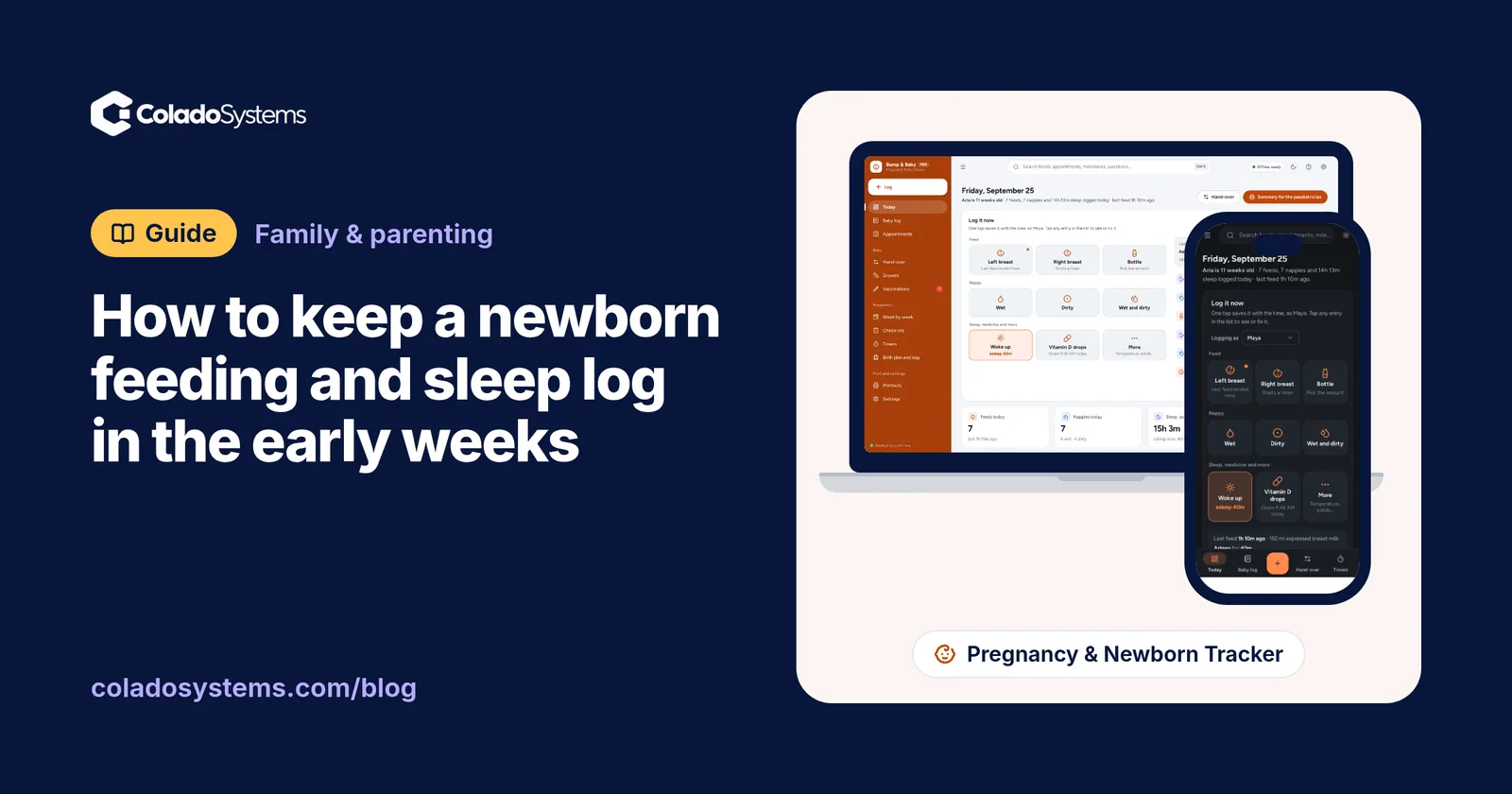
A newborn tracker with one-tap feed, sleep and diaper logging can do the hand-over by name: pick yours, and it shows everything since your last entry.
What to bring to pediatric visits
For each appointment, pack:
- A summary of the last week or two by day: feeds, diapers and sleep.
- Your questions, numbered. Write them down when you think of them, which is often at 3 a.m.
- Medicines and vitamins with doses.
- The record book and any weights you were given at earlier visits.
- Your insurance card, spare diapers, wipes and a change of clothes.
- A pen, to write down what you are told.
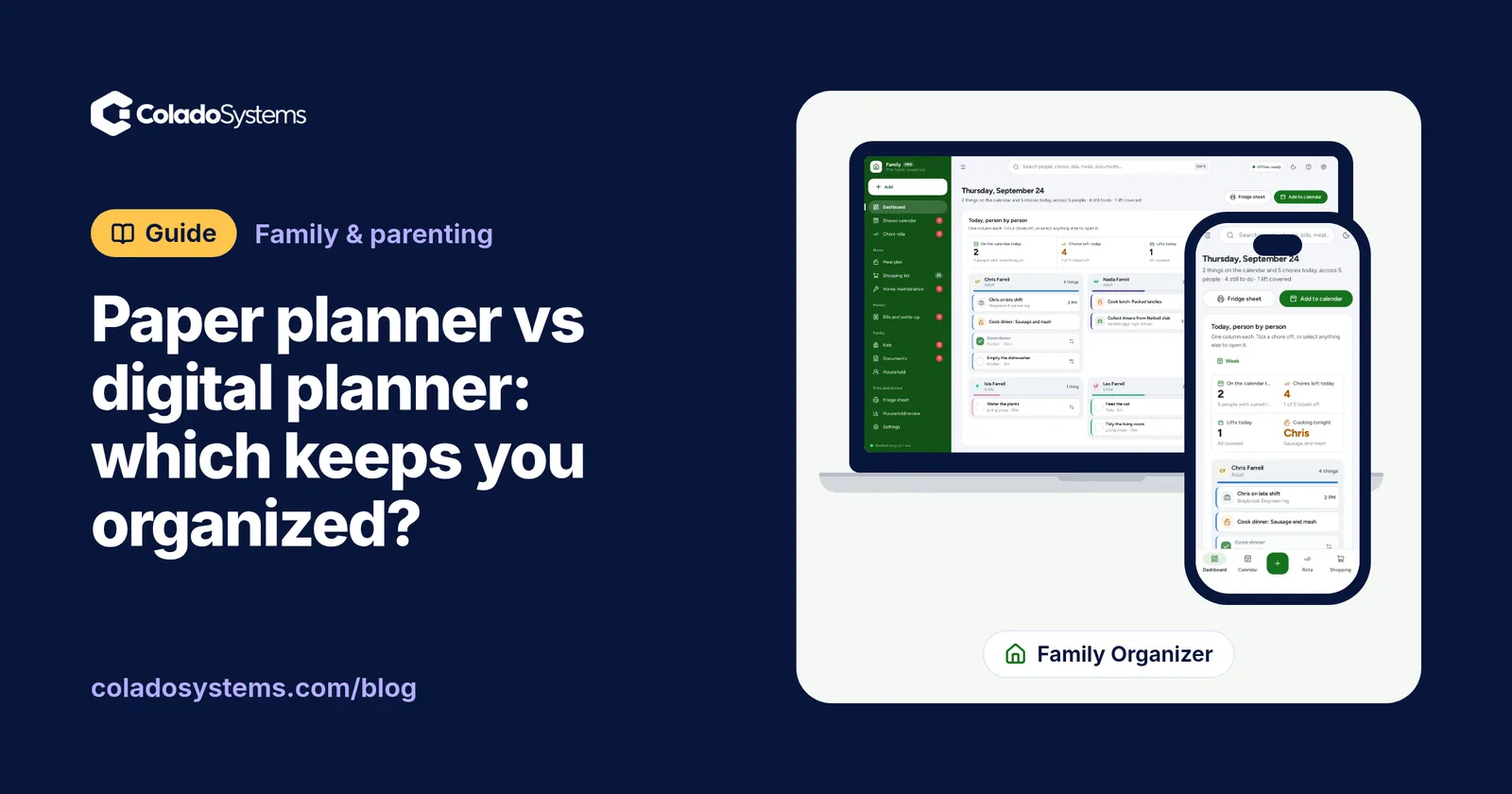
Keep every appointment on one calendar the whole family can see. A family organizer with a family calendar, health records and medication reminders holds the pediatric visits alongside everything else the household has going on.
Paper, spreadsheet or a baby tracker app?
Any of these works, with different trade-offs.
| Paper log | Spreadsheet | Subscription baby app | Offline tracker app | |
|---|---|---|---|---|
| Logging at night | A pen and a nightlight | Typing on a small screen | Usually a tap or two | Usually a tap or two |
| Daily totals | Count by hand | Formulas you write | Worked out for you | Worked out for you |
| Two caregivers | Wherever the notebook is | A shared online file | Live sync between phones | One shared device, no live sync |
| Cost | A notebook | Free | A monthly or yearly fee | A one-time price |
| Account or signal | Neither | For online sharing | Usually both | Neither |
| Where records live | On the counter | Your computer or cloud drive | The company’s servers | Your own device |
Paper is a perfectly good choice for the first weeks; its weak spot is adding up. A spreadsheet totals well but is miserable to type into one-handed in the dark. A subscription app’s real strength is live sync, which matters if both parents carry the log everywhere. An offline app avoids the fee and the account, but the records live on one device and you make your own backups.
What it takes to build it yourself
To make a spreadsheet do everything above, you need start and stop times, a side column, bottle amounts, sleep blocks, diaper tallies, daily totals, a view of everything since the other person’s last entry, and a two-week summary laid out for the doctor. Then you have to type into it at 3 a.m.
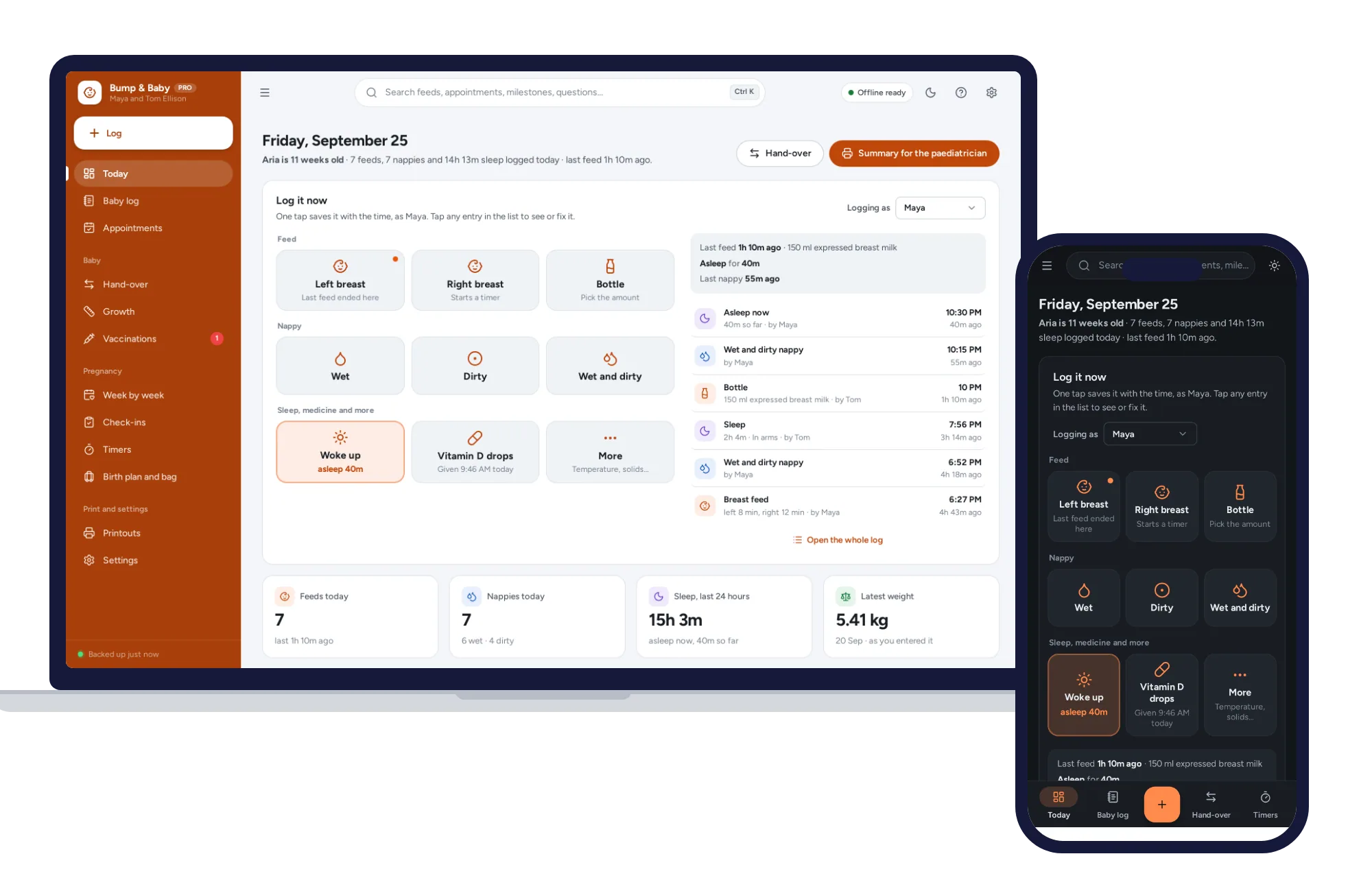
The Pregnancy & Newborn Tracker has those parts ready. The Today screen is a one-tap quick log: tap a side to time a breastfeed and Stop to save it, choose bottle and then the amount, and log sleep or a diaper with one tap each. Big buttons, dark mode and Undo on every entry make it workable in the dark, and medicine and vitamins are logged with every dose timed. Hand-over shows the last feed and side, asleep or awake, and medicine times since your last entry, and prints a one-page note for a grandparent or babysitter. The Doctor’s summary puts two weeks on one page: your questions first, then feeds, sleep and diapers by day, plus growth, medicines and vaccinations exactly as you logged them. You can set it to say diaper and ounces.
It is a home log, and it says so. There are no normal ranges or percentiles in it, and it never tells you whether something is wrong. That stays between you and your pediatrician. If you are still expecting, the same app starts earlier, with a week-by-week journal, a kick counter, a contraction timer and a birth plan and bag list.
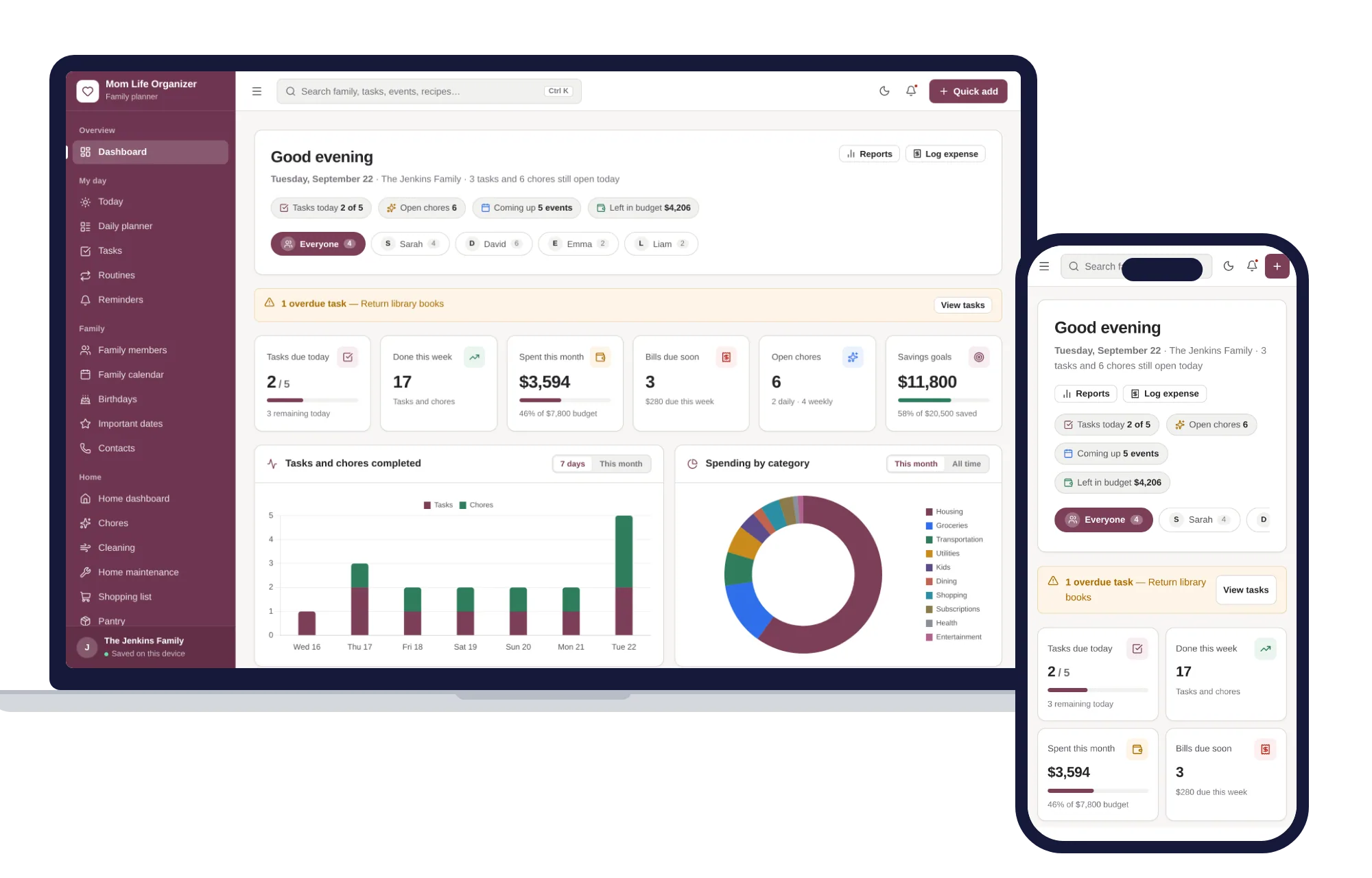
The Mom Life Organizer covers the rest of the house while you are busy: a family calendar, a meal planner that jumps to the grocery list, chores shared by family member, a shopping and pantry list, and health records. If you are stocking the freezer before the birth, our guide to meal planning on a budget that cuts food waste helps.
On cost, a baby app at, say, $9 a month is $108 for the first year alone. The tracker is a one-time price.
Keeping it all in one place
Both open with a sample family, so you can tap around before the baby arrives. There is no account or sign-up, they work offline, even in a hospital with no signal, and records stay in the browser on your own device. The honest limit: you and your partner log on the same device, picking your name under Logging as, because each device keeps its own records. A backup restored on a second device is a copy, not a live link.
Both sit on the Family & parenting shelf, so they also come together in the bundles, which cost less than buying them one by one. You can also browse other planners for family and parenting.
You can see everything inside the Pregnancy & Newborn Tracker and try it with the sample family tonight, well before the next 3 a.m. feed.
Skip the setup
The Pregnancy & Newborn Tracker has the records this guide describes already set up. One-tap feed, sleep and nappy log, a week-by-week journal, kick counter and contraction timer. Offline, no subscription.
$24.99 one-time
- Sample data to try it the same day
- Works offline, records stay on your device
- A PDF guide in the download
See everything inside the Pregnancy & Newborn Tracker. Or take the whole Family & parenting shelf: 5 systems for $79.99, $44 less than one by one.
Common questions
Do I need to track every newborn feed?
Many parents find it helpful in the first weeks, when feeds come around the clock and tiredness makes times hard to remember. A short note per feed is enough: the start time, plus the side or the bottle amount. Your pediatrician may ask you to keep a closer record for a while, for example if they are watching weight gain, so follow their lead.
How long should I keep a baby feeding and sleep log?
There is no fixed rule. Many parents log closely for the first few weeks, then cut back once feeding is settled and the pediatrician is happy with progress. Some keep a lighter log for months because it helps with shift changes or sleep routines. If your pediatrician asks you to keep tracking something, keep going until they tell you otherwise.
What should I bring to my newborn's first pediatrician appointment?
Bring your feeding, sleep and diaper notes from the last few days, a numbered list of questions, any discharge papers from the hospital, the record book you were given, and your insurance card. Pack spare diapers, wipes, a change of clothes and a burp cloth, and bring a pen so you can write down what the doctor tells you.
Should I log the start or the end time of a feed?
Most parents log the start time, because the gap between feeds is usually counted from the start of one to the start of the next. Consistency matters more than the choice itself. Agree on one approach with everyone who does feeds, write it at the top of the log, and stick with it so the times can be compared.