Check-out is at 11. The next guests arrive at 4 and have already messaged to ask if they can drop their bags early. You have five hours, one cleaner, and a washing machine that takes ninety minutes a load.
This is where a written routine and a short-term rental turnover checklist earn their keep. When every turnover follows the same order, nothing gets forgotten, your cleaner can work without calling you, and you stop finding out about the missing toilet paper from a guest review.
How much time do you need between guests?
The deadline for every turnover is the next arrival, not the last departure. So the first thing to know is how long you have. A same-day turnover, where one guest leaves and another arrives on the same day, is your tightest window. A gap night gives you breathing room for deeper jobs.
Plan backward from check-in and keep a buffer. For an 11 a.m. check-out and a 4 p.m. check-in, a workable timeline looks like this:
- 11:00 Guest leaves. Cleaner arrives at 11:15 and does a quick walk-through with a phone camera.
- 11:30 Strip every bed, gather towels, start the first wash.
- 11:45 Empty all trash and recycling, load the dishwasher.
- 12:00 Kitchen: counters, appliances, inside the microwave and fridge.
- 12:45 Bathrooms: toilet, shower, sink, mirror, floor.
- 1:30 Dust top to bottom, then make the beds with a clean spare set.
- 2:15 Restock supplies to par levels.
- 2:45 Floors, last, working toward the door.
- 3:15 Final walk-through and sign-off.
- 3:30 Done, with half an hour spare for the thing that always goes wrong.
The trick that makes this work is a spare set of linens for every bed. If you’re waiting on the dryer before you can make the beds, the whole timeline slips. Two or three full sets per bed means laundry can finish after the guests arrive.
Your short-term rental turnover checklist, in order
Work top to bottom and dirty to clean. Dust falls, so surfaces come before floors. Start the slow jobs (laundry, the dishwasher) first so they run while you do everything else.
Keep a room-by-room checklist, and make it specific. “Clean kitchen” invites shortcuts. “Wipe inside the microwave, check the fridge for leftovers, run the dishwasher, refill dish soap” does not. Include the jobs guests notice and cleaners forget:
- Hair in the shower drain and on the bathroom floor
- Crumbs in the toaster and under the couch cushions
- Fingerprints on mirrors, glass doors and light switches
- The coffee maker emptied and rinsed
- Remote controls wiped and put back where the house manual says they live
Restock to par levels
A par level is the amount of something that should be in the property at every check-in. Write it down for each item, then restock to that number every time. You stop guessing, and your shopping list writes itself.
A starting list for a two-bedroom, one-bathroom place might be:
- Toilet paper: 2 rolls on the holder, 6 spare
- Paper towels: 1 on the holder, 2 spare
- Shampoo, conditioner and body wash: one full bottle each
- Dish soap and dishwasher tablets: enough for a week
- Coffee and tea: enough for two mornings
- Trash bags: 1 in each bin, 10 spare
- Bath towels and hand towels: 2 sets per guest the listing sleeps
When your cleaner counts what’s left, anything below the spare level goes on a restock list for the next shop run.
Damage and maintenance checks
Do the walk-through before cleaning, not after. That way you see the place exactly as the guest left it. Take photos of every room and close-ups of anything wrong: stains on linens, a chipped glass, a mark on the wall, a broken lamp.
Then check the things that are easy to miss:
- Every light and lamp works
- Appliances turn on, including the oven
- The wifi works and the password on the card is correct
- Smoke alarms are in place and test fine
- No leaks under sinks or around the toilet
If you plan to claim for damage through a booking platform, check its rules and deadlines for reporting, and keep your photos with the booking. Small fixes that can wait go on a maintenance list so they don’t get forgotten between stays.
Hand your cleaner a printed checklist
A checklist that lives only in your head doesn’t help anyone else. Print one with the steps in order, a space to count supplies, a box to note damage and a line for the cleaner to sign off. It also settles any question later about what was done and when.
Know what each stay really earned
A turnover is a cost, and the money side deserves the same routine as the cleaning. Here’s a made-up example of one stay:
- 3 nights at $140 = $420
- Cleaning fee the guest paid: $90
- Platform fee (for illustration): $15.30
- Payout: $494.70
- Cleaner’s pay for the turnover: $85
- Supplies used: $12
- What the stay really left you: $397.70
Notice the cleaning fee. It came in as $90 and went straight out again as $85 to the cleaner. Counting it as profit is an easy way to overestimate what you earn. If your cleaner charges $95 for a rushed same-day turnover, that fee didn’t even cover the clean. A short-term rental host planner that works out host net for every stay does this sum for each booking, with the cleaner’s pay taken off so the cleaning fee is never counted as profit.
Any occupancy tax you collected belongs on a separate line too. It was never your income. Rules on it vary by location, so check what applies to you with your local tax office.
Run these numbers for a month of stays and patterns show up: whether your cleaning fee covers the clean, whether one-night stays are worth the turnover, and what’s left after the mortgage, utilities and repairs. If hosting income adds to your tax bill, a simple monthly habit for setting money aside for tax keeps that part from becoming a surprise.
Keeping it all in one place
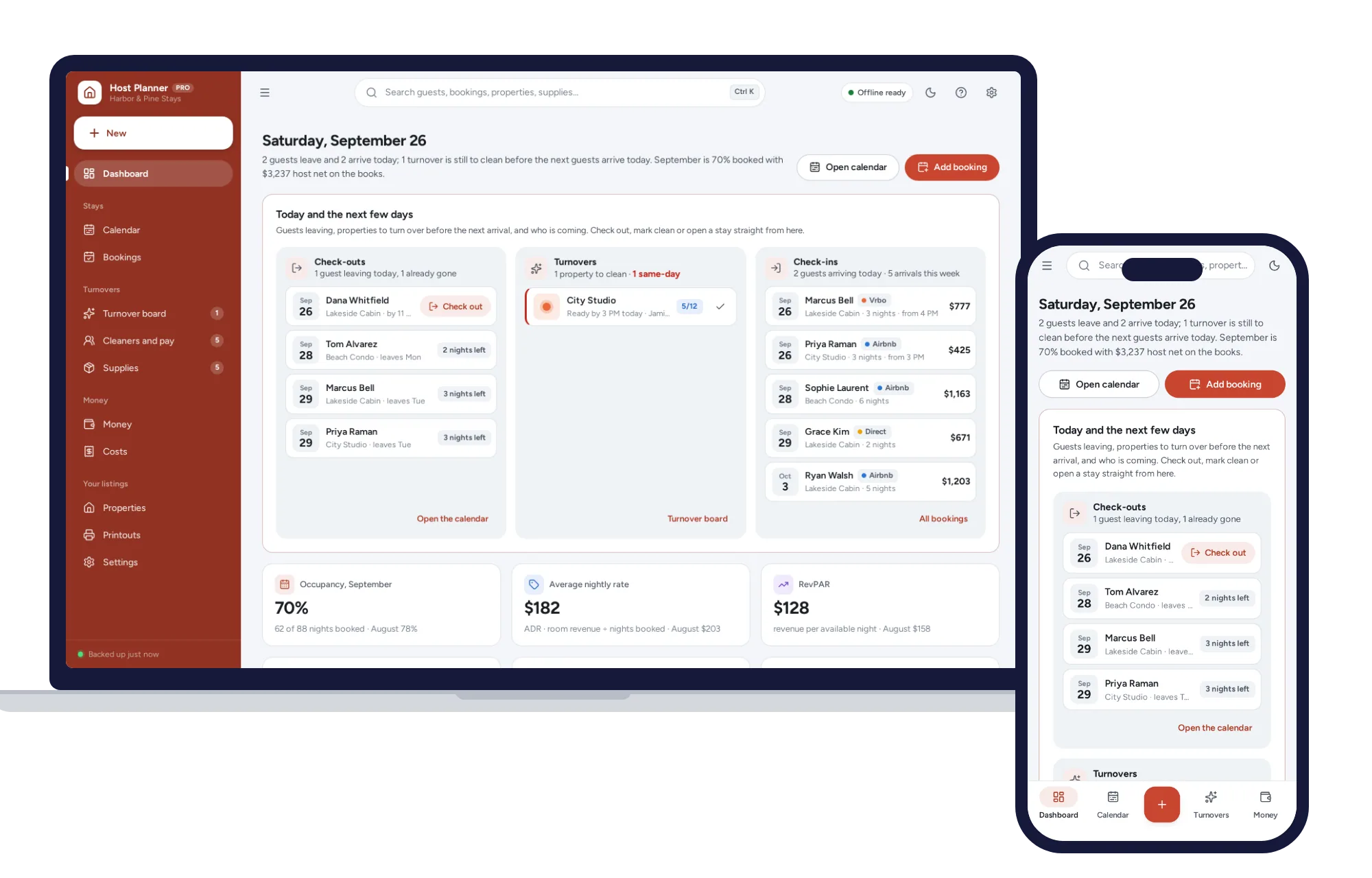
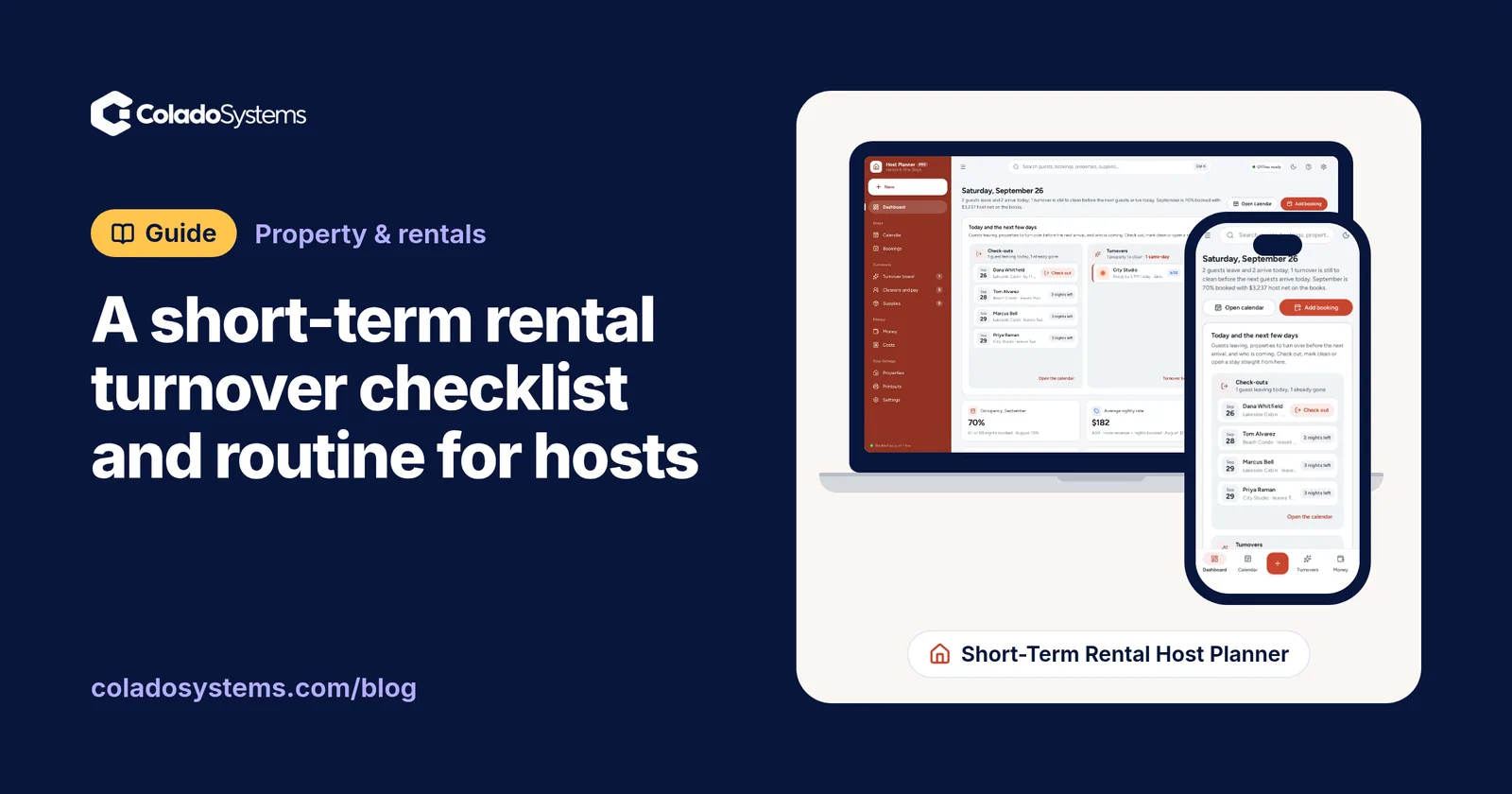
The Short-Term Rental Host Planner is built around this routine. When you check a guest out, the clean goes onto a turnover board with the next arrival as its deadline, and same-day turnovers show in red. Every turnover carries its checklist, the cleaner and their pay, and supplies are counted down as each one is done, against par levels with a restock list. You can print the turnover checklist for your cleaner with the steps, a supplies count, a box for damage and a sign-off.
On the money side, it works out host net for every stay line by line, with the cleaning fee counted in, the cleaner’s pay counted out, and occupancy tax kept apart. A booking calendar refuses double bookings, and a printable house manual covers check-in, wifi and house rules. It runs offline on your own device and doesn’t connect to any booking platform, so you add each booking yourself. It’s built for hosts with one to five listings, with no account and no subscription.
If you also let a place long term, here’s how to track rent payments, repairs and leases as a small landlord. And you can browse other systems for property and rentals.
Skip the setup
The Short-Term Rental Host Planner has the records this guide describes already set up. See what every stay really leaves you after fees and cleaning. No formulas to break, no subscription.
$29.99 one-time
- Sample data to try it the same day
- Works offline, records stay on your device
- A PDF guide in the download
See everything inside the Short-Term Rental Host Planner. Or take the whole Property & rentals shelf: 6 systems for $99.99, $79 less than one by one.
Common questions
How long should a short-term rental turnover take?
It depends on the size of the place, how the guests left it and how many people are cleaning. Time a few of your own turnovers from check-out to sign-off, then add a buffer for surprises such as a stained mattress protector or a slow dryer. Plan the work backward from the next check-in rather than forward from the last check-out.
What should be on a vacation rental cleaning checklist?
Group it by room and make every line specific: strip and remake the beds, run the laundry, empty every bin, clean the kitchen including the fridge and microwave, scrub the bathroom, dust from high to low, restock supplies and finish with the floors. Close with a walk-through of lights, appliances, wifi and smoke alarms, plus space to note damage and sign off.
How many sets of sheets do I need for a rental property?
Two or three full sets per bed is a practical place to start. One set is on the bed, one is clean and ready, and the third covers a stain, a delayed wash or back-to-back same-day turnovers. With a spare set on the shelf, the beds can be made while the laundry is still running, so a slow dryer never holds up check-in.
Is the cleaning fee profit for an Airbnb host?
Treat it as money passing through. It arrives as part of the payout, but most or all of it goes straight to whoever cleans. When you work out what a stay earned, count the cleaning fee in and the cleaner's pay out, so the figure shows what is really left. For how it is treated for tax where you host, ask an accountant.