Here’s the short answer to how to price HVAC jobs. Add up what the job really costs you, including a fair share of your overhead, then set the price so the profit you want is a percentage of the price, not of the cost. Most underpriced HVAC quotes get one of those two things wrong.
The longer answer takes four numbers. Once you have them, quoting a service call or a replacement stops being a gut feeling.
The four parts of every HVAC price
- Labor: what the hours on the job actually cost you, not just the tech’s wage.
- Parts and materials: everything that goes into the job, including the small stuff.
- Overhead: the cost of keeping the business open, spread across the hours you bill.
- Margin: the profit left after all of the above.
Leave any one of them out and you can be busy all summer and still wonder where the money went.
Step 1: Work out your real labor cost
A tech you pay $30 an hour costs you more than $30 an hour. On top of the wage come payroll taxes, workers’ comp, insurance, paid time off and any benefits. Say those add 30 percent. Your real labor cost is $39 an hour.
Your actual add-on depends on where you operate and what you offer, so get the figure from your payroll records or your accountant. Don’t guess low. Every quote is built on this number.
Count the hours honestly, too. Drive time, the parts-house run, the walk-through with the homeowner and cleanup are all hours you pay for.
Step 2: Spread your overhead across billable hours
Overhead is everything not tied to one job: rent, truck payments, fuel, insurance, phones, software, office staff, tools and advertising. Add up a normal month.
Then work out how many hours you actually bill in that month. Not hours on the clock. Hours you can charge to a customer.
Say your monthly overhead is $12,600 and you have three techs who each bill about 120 hours a month. That’s 360 billable hours.
$12,600 ÷ 360 = $35 of overhead per billable hour.
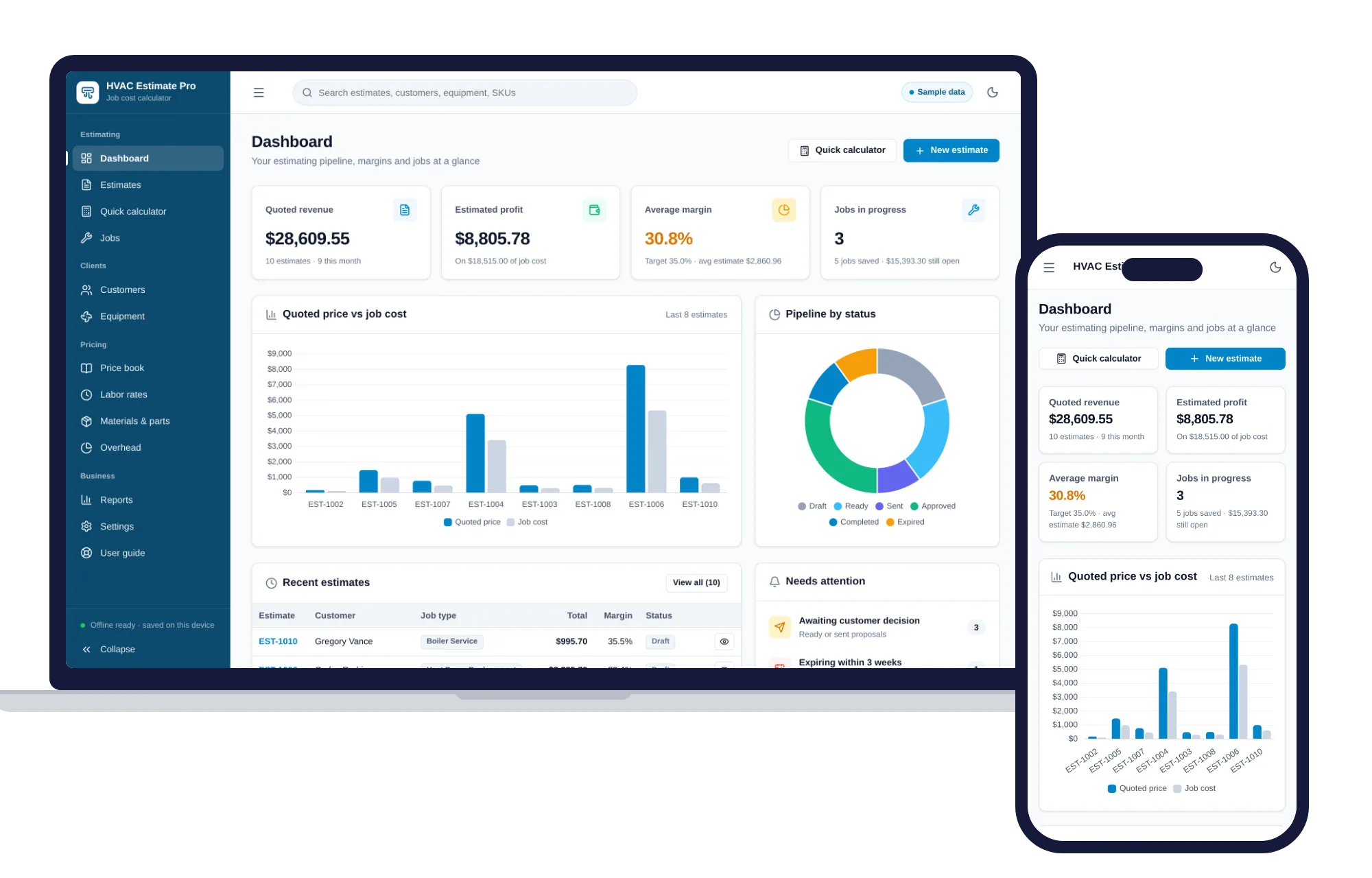
That figure surprises a lot of owners. Every hour a tech spends on a job has to carry $35 of overhead before it earns a cent of profit. Recalculate it when something big changes, like a new truck or a new hire. You can keep this sum in a spreadsheet, or in an HVAC estimate and job cost calculator that lists your monthly expenses and shows the overhead cost per hour for you.
Step 3: Price parts and materials properly
List every part at your cost from the supplier invoice. Then add the things that tend to fall off quotes: refrigerant, fittings, tape, fasteners, filters and disposal fees. A small materials allowance on each job covers the consumables you’d never itemize.
Many contractors mark up parts, partly to cover the time spent sourcing them and the cost of warranty callbacks. However you handle it, be consistent. Keep your usual prices and markups in a price book rather than working them out fresh on every call.
Whether parts and labor are taxed, and how, depends on your state. Ask your accountant and add tax to the quote the way they tell you. If you’re a one-truck operation, pair this with a simple monthly habit for setting aside tax when you’re self-employed, so the tax you collect and owe isn’t spent twice.
Step 4: Know the difference between markup and margin
This is where money quietly disappears.
- Markup is profit as a share of cost: (price - cost) ÷ cost.
- Margin is profit as a share of the price: (price - cost) ÷ price.
A 50 percent markup is only a 33.3 percent margin. If you want to keep 40 percent of every job and you add 40 percent to your costs, you’ve actually priced for about 28.6 percent.
To hit a target margin, divide your cost by one minus the margin. For a 40 percent margin, divide by 0.60.
How to price HVAC jobs: a worked example
A homeowner’s AC is running but the outdoor fan isn’t spinning. You find a failed condenser fan motor and a weak capacitor. Here’s how the quote comes together using the numbers above.
Labor. You allow 2.5 hours, including the drive and cleanup. 2.5 × $39 = $97.50
Overhead. The same 2.5 hours. 2.5 × $35 = $87.50
Parts and materials at your cost:
- Fan motor: $165
- Capacitor: $28
- Materials allowance: $12
- Total: $205
Total cost of the job: $97.50 + $87.50 + $205 = $390
Price at a 40 percent margin: $390 ÷ 0.60 = $650
Check it: $650 - $390 = $260 profit, and $260 is 40 percent of $650.
Now compare. If you’d simply added 40 percent to the cost, you’d have quoted $546. That’s $104 less on one service call, and your margin drops under 29 percent. Repeat that across a few hundred calls a year and you can see where the season’s profit went.
And if you’d left overhead out entirely? Labor and parts come to $302.50, a 40 percent markup gives $423.50, and once overhead is paid you’ve made $33.50 on the job.
How much should you charge for an HVAC service call?
There’s no universal number, but there is a universal method. Many contractors charge a set diagnostic or trip fee that covers the drive and the first stretch of time on site, then quote the repair separately. Work that fee out the same way as any job: the hours it takes, labor cost, overhead and margin.
Replacement bids have more pieces: the equipment, crew hours (often two people), line sets, pads, electrical, permits, removal and disposal of the old unit, and any duct changes. Price each one, and add a line for anything you can’t see until you open things up. Permit and code requirements vary by area, so check what yours needs before you commit to a number.
Check every job against the quote
A quote is a prediction. After the job, compare it with what happened: hours on site, parts used, any second trip. If one type of job keeps running over, fix the price book instead of trying to work faster.
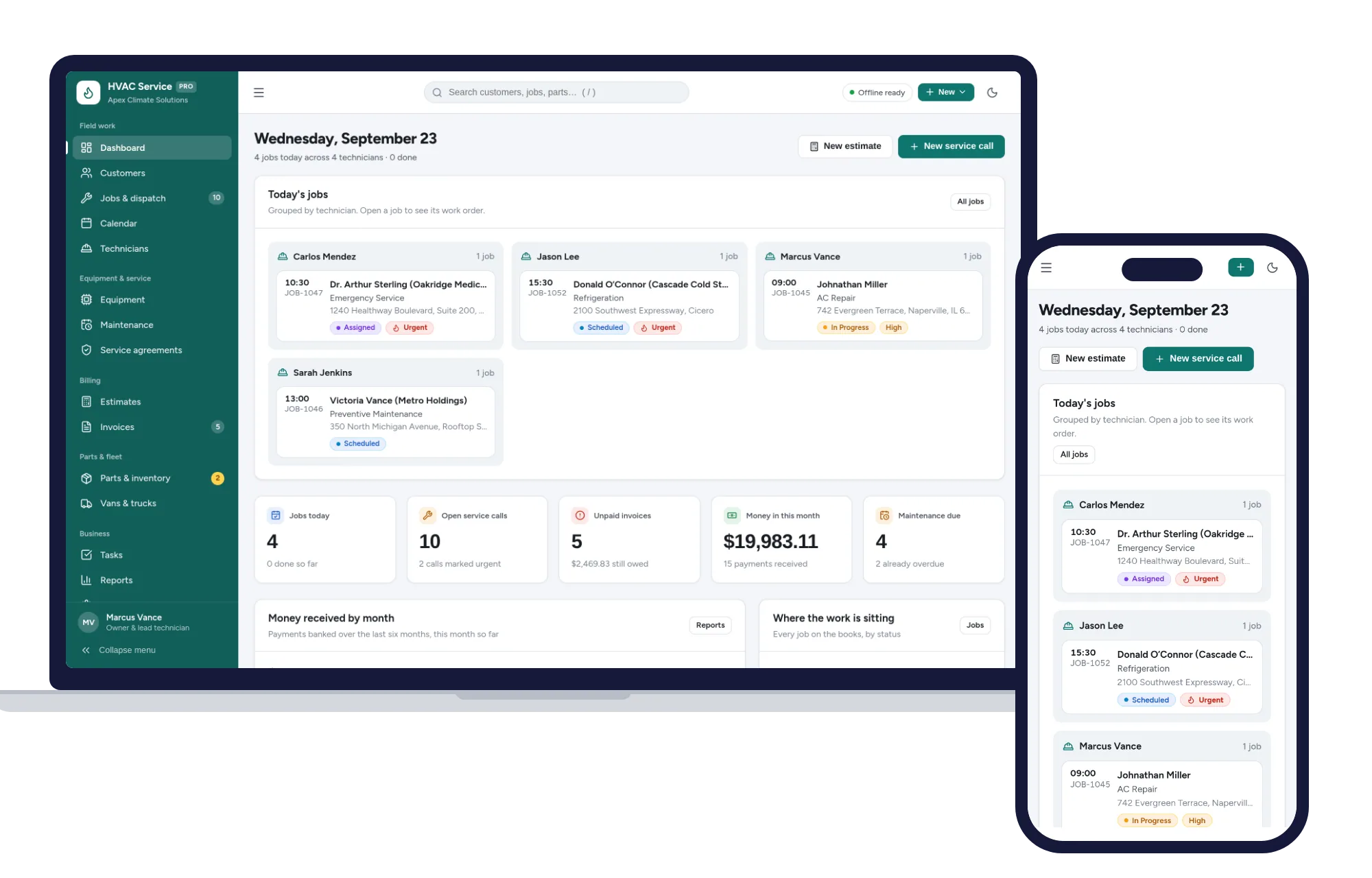
This is much easier when the field side records the actual numbers as it goes. A work order with the diagnosis, work done, time on site and parts pulled straight from van stock, like the ones in HVAC Service & Field Management, gives you the real figures to set beside the quote.
A simple habit: every Friday, pick three finished jobs and write the estimated profit next to the actual profit. Patterns show up within a month.
Keeping it all in one place
You can do all of this in a spreadsheet. The HVAC Estimate & Job Cost Calculator does it in one offline app instead. You list your monthly business expenses and it shows your overhead cost per hour, which is then added to estimates automatically. The quick calculator takes labor, parts, travel and overhead, prices by markup or target margin, and saves the result as a full estimate. The price book holds parts, equipment and services with a default markup and margin for each item. Approved estimates become jobs, where you compare estimated and actual profit, and proposals print or save as PDF with your own company details and terms.
Once a quote is approved, HVAC Service & Field Management handles the work itself: dispatch, work orders, a record of every unit you service with its warranty and next service date, maintenance agreements, and invoices with payments and balances.
Both run on your own computer or tablet with no account and no subscription, so they keep working in a van with no signal. If you also want your repair orders, parts and invoices in order, see how a small repair shop stays organized without monthly software, or browse other systems for trades and field service.
Price every job the same way, check it afterward, and your quotes will start paying for the business instead of just keeping it busy.
Skip the setup
The HVAC Estimate Calculator has the records this guide describes already set up. Estimates, job costing, overhead and margins for HVAC contractors — one offline app.
$29.99 one-time
- Sample data to try it the same day
- Works offline, records stay on your device
- A PDF guide in the download
See everything inside the HVAC Estimate Calculator. Or take the whole Trades & field service shelf: 7 systems for $114.99, $94 less than one by one.
Common questions
What is a good profit margin for HVAC jobs?
There is no single right figure, because it depends on your overhead, your market and the type of work. Work out your full cost first, including overhead per billable hour, then choose a margin that leaves real profit on top. Many contractors set different targets for service calls, maintenance and replacements, and adjust them as job costing shows what each type actually earns.
How do I calculate overhead per hour for an HVAC business?
Total a typical month of costs that are not tied to one job, such as rent, truck payments, fuel, insurance, phones, software, office wages and advertising. Divide that total by the hours your technicians actually bill to customers in a month, not the hours they are paid for. The result is what each billable hour must carry before any profit.
How do I convert markup to margin?
Divide the markup by one plus the markup. A 50 percent markup is 0.5 divided by 1.5, or about 33 percent margin. To go the other way, divide the margin by one minus the margin, so a 40 percent margin needs roughly a 67 percent markup on cost. Pricing from a target margin keeps you from quoting less than you meant.
Should HVAC contractors charge for travel time?
Drive time is time you pay for, so it has to be covered somewhere. Some contractors build it into a set trip or diagnostic fee, others add it to the labor hours on each quote, and some charge by zone. Pick one method, use it on every job, and make sure the hours appear in your estimates so they are not lost.