The most common way new cleaners set prices is to copy a competitor’s flyer. It feels safe, but that competitor might have no employees, a paid-off car and a habit of working sixty-hour weeks. Their price says nothing about your costs.
If you want to know how to price house cleaning jobs so each one pays, work from your own numbers: what an hour of cleaning costs you, how long the home will take, and what you add for extras and travel. Then choose how to present that price to the client. Here’s the whole method, with a worked example near the end.
Start with what an hour of cleaning costs you
Every price rests on one figure: your cost per working hour. It has three parts.
- Labor. What you pay yourself or your cleaners per hour, plus any payroll costs on top of wages. Your accountant can tell you what those add where you work.
- Overhead. Insurance, phone, advertising, software, vehicle costs and anything else that isn’t tied to one home. Add up a typical month and divide by the hours you actually clean, not the hours you’re busy.
- Supplies. Products, cloths, vacuum bags and so on, averaged per hour.
Say you want to pay yourself $28 an hour, your overhead runs $1,100 a month across 100 cleaning hours ($11 an hour), and supplies average $3 an hour. Your cost is $42 an hour before any profit.
Now decide on a margin. If you want 25 percent of every price left as profit, divide your cost by 0.75. That gives an hourly rate of $56. Quoting $42 an hour would only break even.
Hourly vs flat rate vs square footage: which pricing should you use?
| Method | How it works | Works well for | Watch out for |
|---|---|---|---|
| Hourly | Your rate times the hours worked | First deep cleans, move-outs, homes in unknown condition | Clients watch the clock, and you earn less as you get faster |
| Flat rate | One price per visit, built from estimated hours | Recurring clients and standard cleans | Misjudging a cluttered home you haven’t seen |
| Per square foot | A rate times the size of the home | Quick ballpark quotes, empty homes | It ignores bathrooms, clutter and pets |
Many established cleaners quote a flat rate but build it from hours. The client gets a clear price, and you keep the benefit when your team gets quicker. Square footage is a useful sense check, not a pricing method on its own: two 1,800-square-foot houses, one with a single bathroom and one with three, can differ by an hour or more.
Estimate the time from rooms, size and condition
Time each part of a standard clean for a few weeks and write down the averages. For illustration, yours might look like this:
- Kitchen: 45 minutes
- Each bathroom: 30 minutes
- Each bedroom: 20 minutes
- Living and dining areas: 30 minutes
- Floors, entry and hallways: 15 minutes
Then adjust for condition. A first deep clean in a home that hasn’t been cleaned professionally takes longer than a standard visit, and a move-out can take longer still. Pets, clutter and stairs add time too. Ask for photos or do a quick walk-through before quoting a large or unusual job.
Price on labor hours, not time on site. A two-person team that finishes in three hours has worked six.
A cleaning business quote calculator that takes bedrooms, bathrooms, square feet, condition and extras can run this sum for you. A printed time sheet works too, as long as you use it on every quote.
Add-ons, minimums and recurring discounts
List your extras with a time for each, so they’re priced as consistently as the base clean. Common ones include the inside of the oven, the inside of the fridge, interior windows, inside cabinets, hand-wiped baseboards, laundry and changing bed linen.
Set a minimum charge, too. A small apartment still costs you the drive, the setup and a gap in your day.
Recurring clients usually get a lower price per visit, because a home cleaned every week or two takes less time than one cleaned once a season. If you offer one, check the discounted price against your cost per hour first.
Don’t forget travel
Drive time is paid time, whether or not the client sees it. You can cover it three ways:
- Add the round-trip drive to the labor hours on each quote.
- Charge a set trip fee by zone, such as one fee within 15 minutes and a higher one beyond.
- Fold it into your minimum and keep your service area tight.
Pick one and use it on every quote. If sales tax applies to cleaning services where you work, add it the way your accountant tells you, since the rules vary by state.
How to price house cleaning jobs: a worked example
A new client has a three-bedroom, two-bathroom house of about 1,800 square feet. It hasn’t been cleaned professionally in a long time, and they want the inside of the oven and fridge done. They’re 20 minutes away, and you add the drive to the labor hours. Assume a first deep clean takes half as long again as a standard visit. Using the figures above:
Standard clean time. Kitchen 0.75 hours, two bathrooms 1 hour, three bedrooms 1 hour, living and dining 0.5 hours, floors and entry 0.25 hours. Total: 3.5 hours.
First deep clean. 3.5 × 1.5 = 5.25 hours.
Add-ons. Oven 0.75 hours, fridge 0.5 hours. Running total: 6.5 hours.
Travel. A 45-minute round trip, including parking and unloading, is 0.75 hours. Total: 7.25 hours.
Price. 7.25 × $56 = $406, which you might round to $405.
If they then want a biweekly plan, the standard 3.5 hours plus the drive is 4.25 hours, or $238. Offer 10 percent off for recurring visits and the price is $214. Check it: $214 ÷ 4.25 hours is about $50 an hour, still above your $42 cost.
As a sense check, $405 works out to about 23 cents a square foot for the first visit, and $214 to about 12 cents for each recurring one. If you’d quoted a flat 12 cents a square foot from the start, the first clean would have lost money.
Spreadsheet, subscription app or a system you buy once?
A spreadsheet handles the math for free, and many cleaners start there. It gets harder once you add a crew schedule, recurring visits, door codes, invoices and pay. A subscription scheduling app does all of that and often messages clients for you, but at, say, $40 a month that’s $480 a year, every year. A ready-made offline system is bought once and keeps records on your own device, but there’s no live sharing between devices, and you keep your own backups.
Keeping it all in one place
To do everything above in a spreadsheet, you’d need a rate table, a time sheet by room, condition multipliers, an add-ons list, a recurring calendar and an invoice template, and you’d have to keep them all in step. One missed update and a recurring client gets the wrong price, or a Tuesday visit never makes it onto anyone’s schedule.
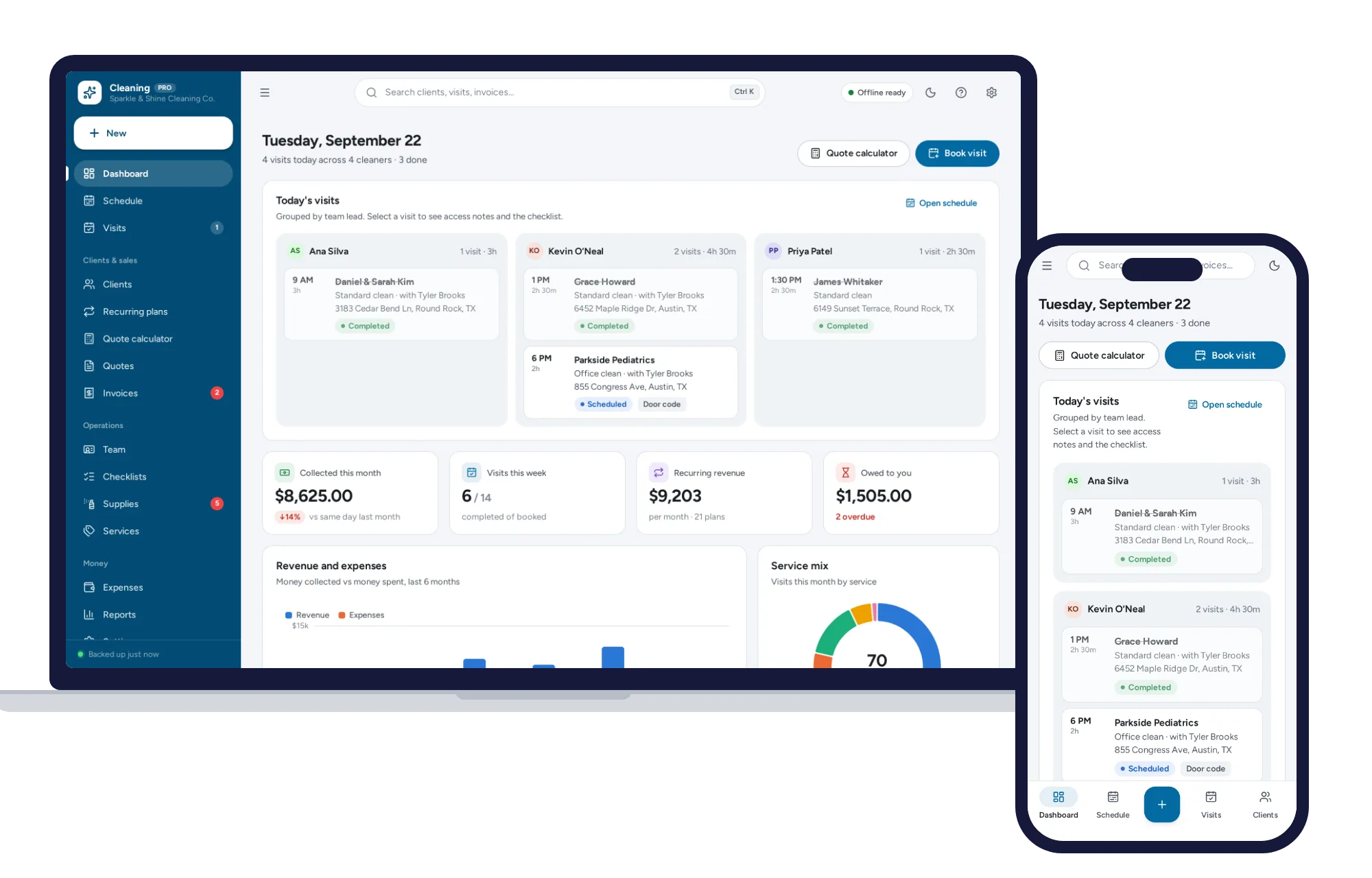
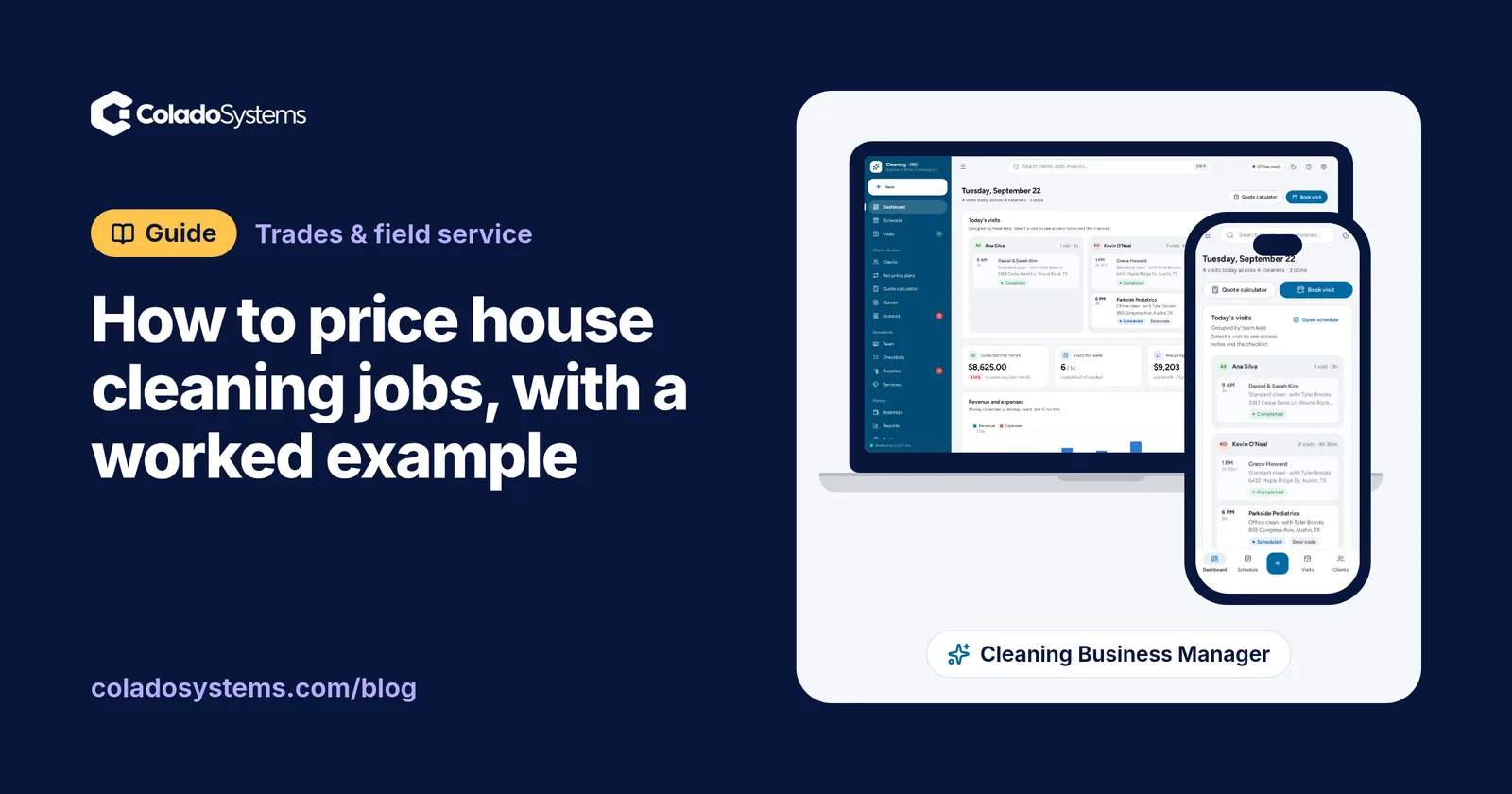
The Cleaning Business Manager has that work done. Its quote calculator prices a clean from bedrooms, bathrooms, square feet, condition and extras, with your recurring discounts and minimum price built in, and saves the result as a quote, a booking or a recurring plan in one click. Recurring plans book visits eight weeks ahead and show your recurring revenue by month and year. Client records keep door codes, pets and parking notes, checklists run room by room, and invoices go out as branded PDFs with card, cash, check and part payments recorded. Reports show profit by month after expenses, plus team hours and pay.
It opens with sample data so you can try a quote straight away, needs no account, works offline and comes with a PDF guide. Once a quote turns into a client, this client onboarding checklist for small service businesses helps you start them off well, and how to price your services when you work for yourself goes deeper on setting your own pay. You can also browse other systems for trades and field service.
When you’re ready, see everything inside the Cleaning Business Manager and run your next quote through it with the sample data the same day.
Skip the setup
The Cleaning Business Manager has the records this guide describes already set up. Schedule crews, price quotes in seconds, run recurring clients and get paid — all in one offline app.
$29.99 one-time
- Sample data to try it the same day
- Works offline, records stay on your device
- A PDF guide in the download
See everything inside the Cleaning Business Manager. Or take the whole Trades & field service shelf: 7 systems for $114.99, $94 less than one by one.
Common questions
How much should I charge to clean a house?
Work it out from your own costs rather than copying a competitor. Add your pay per hour, a share of monthly overhead and supplies to get your cost per cleaning hour, then add the profit margin you want. Multiply that rate by the hours the home will take, including add-ons and travel, and set a minimum so small jobs still pay.
Is it better to charge hourly or a flat rate for house cleaning?
Many cleaners use both. Hourly suits first deep cleans and homes in unknown condition, because the time is hard to predict. A flat rate suits regular visits, since clients like a fixed price and you benefit when your team gets faster. The safest flat rates are built from your hourly rate multiplied by the hours you expect the clean to take.
How do you price house cleaning by square foot?
Divide your usual price for a typical home by its size to get a rate per square foot, then use it only as a quick estimate or a sense check. Square footage misses the things that take the most time, such as bathrooms, kitchens, clutter and pets, so adjust the figure once you know the rooms and the condition of the home.
Should house cleaners charge for travel time?
Driving between homes is time you are not paid for unless your prices cover it. Some cleaners add the round trip to the hours on each quote, some charge a trip fee by distance zone, and others set a minimum charge that absorbs it and keep their service area small. Choose one approach and apply it to every client.