When should the caterer be booked? When is the final headcount due? Who’s chasing the florist’s balance, and did anyone tell the band where to load in?
If the answers live in your head and five email threads, the event will probably still happen. It’ll just cost you a lot more sleep. An event planning timeline fixes that. Not a vague checklist, but a working plan that says what happens when, who owns it, and what money moves at each stage.
How far ahead should an event planning timeline start?
The one below is built around a typical event booked nine to twelve months out, such as a 120-guest wedding or a company gala. That’s a comfortable lead time for a big event, because venues and popular vendors fill their calendars early. Smaller parties and corporate meetings often work on a few months, sometimes weeks. With less time, the same steps simply happen closer together.
Stage 1: Inquiry to signed contract
Every event starts as a lead, and leads go cold fast. When an inquiry comes in, capture:
- Client name and contact details
- Event type, date and any backup dates
- Rough guest count and budget range
- Venue ideas, or whether they need help finding one
- How they found you
Check venue availability before anyone gets attached to a date. Send your proposal, then follow up on a set day, not “sometime next week.”
The event becomes real when two things happen: a signed contract and a deposit. Record both, along with the payment schedule you agreed. A common pattern is a deposit to book, a second payment partway through and the balance before the event, with exact dates written into the contract. Have your contract template checked by a lawyer where you work before you rely on it.
Stage 2: Nine to twelve months out
This is when the big pieces get locked in.
- Venue: confirm in writing, with access times, capacity and any restrictions.
- Key vendors: catering, photography, music, and anyone who books up early in your area.
- Budget: break the client’s total into lines and agree them together. For weddings, how to build a wedding budget you can stick to walks through priorities, guest count and mapping every deposit and due date.
Start a vendor sheet now and keep it for the life of the event. For each vendor, record the contact name, a phone number for the day itself, what they’re providing, whether the contract is signed, the deposit paid, the balance and its due date, cancellation terms, and their arrival time once you know it. A spreadsheet works, or an event planning management system that tracks vendor contracts and balances inside each event.
That last column stays empty for months. Then, in the final week, it becomes the most important thing you have.
Stage 3: Six months out
- Design direction, rentals, decor and stationery
- Guest list started, with a firm date for the client to finalize it
- Second round of vendors: florist, rentals, transport, hair and makeup
- The client’s second payment invoiced on schedule
Update the budget every time a vendor contract is signed, in two columns: budgeted and actual. It takes a minute each time and saves an awkward conversation later.
Stage 4: Three months out
Now build the first draft of the run-of-show. It will change, but having it early shows the gaps. When does the florist need the room? When does the band sound-check? How long does dinner service really take for 120 people?
Also at this stage:
- Do a site visit with key vendors if you can
- Start the seating plan as replies come in
- Ask the photographer when the light is best for portraits, and plan the afternoon around it
Photographers can usually tell you sunset and golden hour for the date well ahead. Those using Photography Studio Manager get both calculated offline for each session, which makes it easy to slot portraits into your timeline.
Stage 5: One month out
- Confirm every vendor’s scope and arrival time
- Put the caterer’s final headcount date on your calendar
- Send the draft run-of-show to each vendor and ask them to correct it
- Schedule vendor balance payments by their due dates
- Invoice the client’s final balance
Stage 6: The final week
Contact every vendor to confirm arrival time, load-in point and who’s in charge on the day. Lock the run-of-show and print it. Everyone with a role gets the same version.
A run-of-show is a list of times, what happens and who leads it. A slice of one might look like this:
| Time | What happens | Lead |
|---|---|---|
| 1:00 pm | Florist and rentals load in | Dana |
| 3:30 pm | Band sound-check | Marco |
| 4:45 pm | Couple portraits with the photographer | Dana |
| 5:30 pm | Doors open, drinks service | Venue manager |
| 6:30 pm | Dinner service begins | Caterer |
| 8:00 pm | Speeches | Dana |
| 11:30 pm | Last song, vendor load-out | Marco |
Pack a day-of kit as well: the printed run sheet, the vendor sheet with phone numbers, any balances you’re handing over, and the basics such as tape, scissors, safety pins, phone chargers and a first-aid kit.
What to do the day after an event
The event isn’t finished when the last guest leaves.
- Pay any remaining vendor balances
- Send the client their final invoice or receipt
- Close the budget. Say the catering line was budgeted at $14,000 and came in at $15,200 because the headcount rose by ten. Write down why.
- Note what worked and what didn’t, vendor by vendor
- Ask the client for a review while the night is still fresh
Comparing budget with actual on every event is how you learn what to quote next time.
Keeping it all in one place
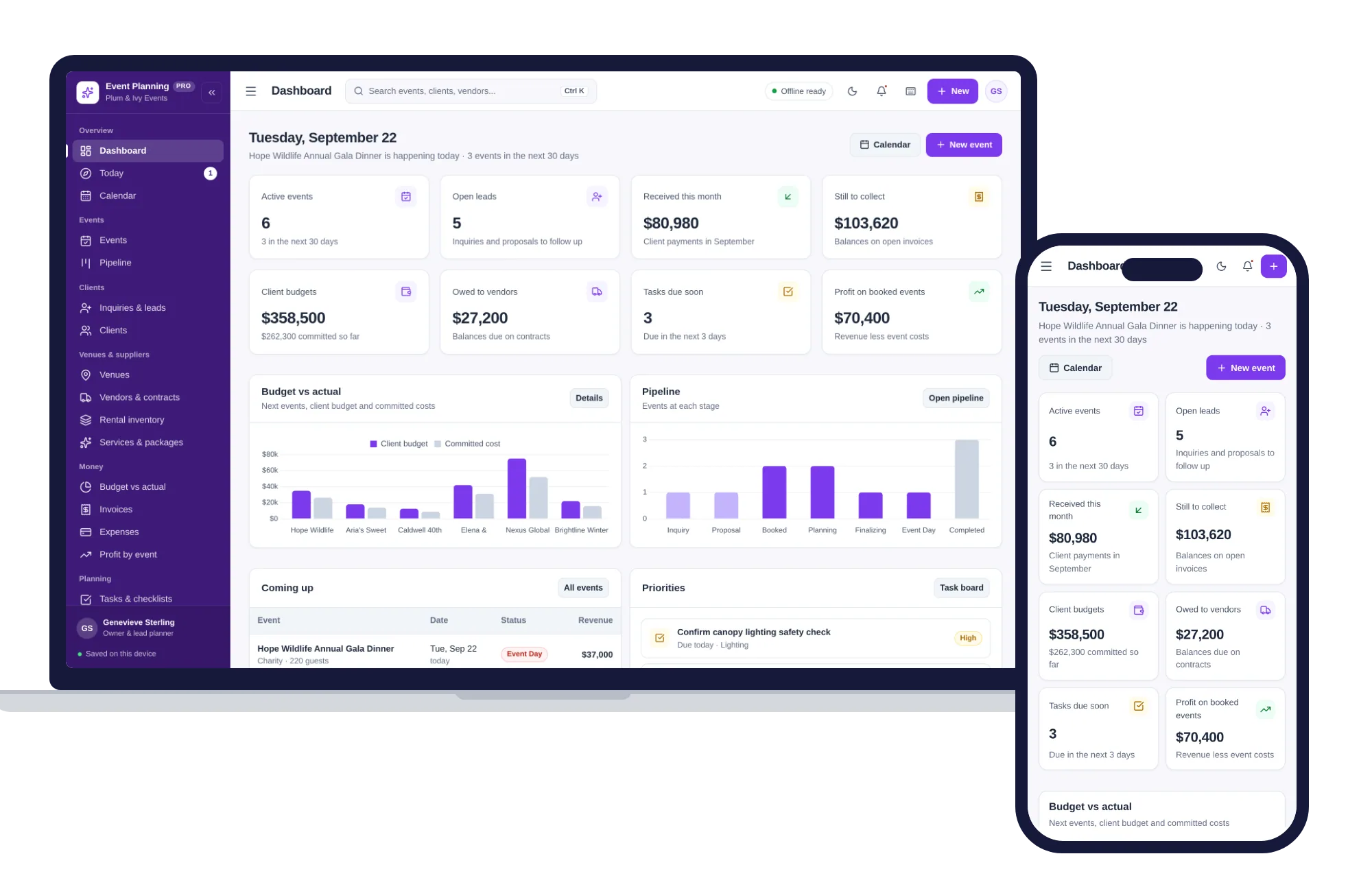
The hard part of this timeline isn’t any single step. It’s that the client, the vendors, the money and the schedule live in different places. The Event Planning Management System keeps them together in one offline app. A pipeline takes each event from inquiry to event day. Vendors are tracked with contracts and balances. Each event has a budget showing spend, what’s left, and profit and margin, and invoices log deposits and payments. Venues show capacity and confirmed bookings so you don’t double-book one, and there’s a seating module for tables and guest lists.
On the day, the Today page shows the run-of-show with times and leads, and prints a run sheet for your team. Before the day, a PDF brief gives you the event details, budget figures and full timeline.
If you’re the photographer on these timelines, or your studio does both, the Photography Studio Manager covers that side: sessions with sunset and golden hour, shot lists to tick off on the day, contract templates that fill themselves in, and galleries with overdue deliveries flagged.
Both work without internet and keep your records on your own device, so a dead venue Wi-Fi signal doesn’t take your run sheet down with it. You’ll find them with more systems for salons, studios and events.
Skip the setup
The Event Planning Manager has the records this guide describes already set up. Events, pipeline, clients, venues, vendors, budgets and run-of-show timelines — one offline app.
$29.99 one-time
- Sample data to try it the same day
- Works offline, records stay on your device
- A PDF guide in the download
See everything inside the Event Planning Manager. Or take the whole Salons, studios & events shelf: 6 systems for $99.99, $79 less than one by one.
Common questions
How far in advance should you plan an event?
For a large wedding or gala, many planners start nine to twelve months ahead, because venues and in-demand vendors fill their calendars early. Smaller parties and corporate meetings can come together in a few months or less. Whatever the lead time, work backward from the date and set firm deadlines for contracts, payments, the final headcount and the run-of-show.
What is a run-of-show for an event?
A run-of-show is a timed schedule for the event day. It lists each moment, such as vendor load-in, doors opening, dinner service and speeches, along with the person responsible for it. Everyone working the event gets the same printed version, so vendors and staff know what happens next without needing to ask the planner.
What should be on an event vendor list?
Keep one row per vendor with their main contact, a mobile number that works on the event day, the services or items they are supplying, contract status, deposit and balance amounts with due dates, cancellation terms and load-in time. Reviewing the list a week out catches unpaid balances and unconfirmed arrivals before they turn into problems.
How do event planners schedule client payments?
Most planners set out a payment schedule in the contract, often a deposit to hold the date, one or more payments along the way and a final balance before the event. Record each due date and each payment as it arrives, and send invoices on time. Have your contract and payment terms reviewed by a lawyer where you work.