The cancellation email arrives on the first of the month. It’s from a member who used to be in at 6 a.m. four days a week, the kind of regular who knew everyone’s name. You scroll back through the sign-in sheets and find her last visit: five weeks ago. She didn’t leave today. She left in the middle of last month, and nobody noticed.
That is the quiet truth behind gym member retention. Members rarely quit on the day they cancel. They drift first, and the drift shows up in attendance long before it shows up in your payments. Catch it early and a short, friendly message often brings people back. Catch it late and you’re writing a goodbye.
Why gym member retention starts at the front desk
Every visit is a clue, but only if you record it. A member who checks in three times a week and then once a week is telling you something.
So the first job is boring and essential: make check-in the source of truth. Pick one method and use it for every visit, every class and every personal training session.
- Paper sign-in sheet: cheap and fast, but someone has to type it up before you can see patterns.
- Key tags or cards with a scanner: quick for members, and every scan lands in a log.
- A spreadsheet tab: date, member name or number, and visit type, one row per visit.
Whatever you choose, the desk should also show who is behind on payments, who hasn’t signed a waiver and anything staff need to know before someone trains. A gym management app with front-desk check-in can search by name, member number, phone or key tag and flag balance, waiver and health notes in one place. A well-kept clipboard is still far better than nothing.
How do you know a member is about to quit?
Look for a change from that person’s own normal, not from an average. Someone who has always come once a week is fine at once a week. Someone who came four times and now comes once is not.
Watch for these signals:
- Visits halve. Compare the last 30 days with the 30 before.
- Not seen lately. Pick a gap that fits your gym, such as 14 days, and list everyone past it each week.
- A regular class goes quiet. They booked Tuesday spin for months and haven’t for three weeks.
- No-show streaks. Booking and not turning up is often one step before not booking at all.
- Freeze requests. A freeze can be a lifeline or a slow exit. Follow up before it ends.
A worked example: say Marcus averaged 12 visits a month for six months. Last month he came 5 times, and this month he has been in once in two weeks. He hasn’t cancelled anything, but he goes on next week’s call list, because the pattern says he’s sliding.
What to say when someone drifts
Keep it short, personal and free of guilt. Something like: “Hey Marcus, we’ve missed you at the 6 a.m. class. Everything all right? Dana is starting a new strength block on Monday if you want an easy way back in.”
A few rules help:
- One person owns the not-seen list each week, so it actually gets worked.
- Offer something specific: a class, a time, a short session with a coach.
- If life has changed, offer a freeze or a cheaper off-peak plan before a cancellation.
- Write down what they said. “New baby, back in March” is worth knowing in March.
The first 90 days decide most memberships
New members are the easiest to lose, because the habit isn’t built yet. Give them a plan for their first weeks instead of a tour and a wave.
- Book their first three visits before they leave the sign-up desk.
- Suggest one or two classes that suit their level, and introduce them to the coach.
- Take starting measurements if they want them, and repeat them at six weeks so progress is visible.
- Check in personally at week two, week four and week eight.
If someone mentions an injury or a health condition, note it for staff and suggest they check with their doctor before starting a new program. Your job is to keep them safe and welcome, not to give medical advice. For a fuller welcome routine, this client onboarding checklist for small service businesses adapts well to new members.
Build classes people come back for
Classes create the friendships that keep people showing up. Protect them.
- Keep the timetable steady. A class that moves every month never builds regulars.
- Set a capacity and a waitlist. Full classes feel lively, and a waitlist that moves up fairly keeps people booking.
- Mark attended and no-show. Without it, you can’t tell a popular class from a popular booking.
- Check fill rates monthly. Say a class has 20 spots and averages 6. Move it, change the format or merge it with another before it starts to feel empty.
Renewals and churn: watch the numbers
Your monthly churn rate is simple: members who left during the month, divided by members at the start, times 100. Start the month with 120 and lose 6, and that’s 5%.
Now turn it into money. At, say, $60 a month, each member is worth $720 a year. Keep three extra members a month who would otherwise have left, and that’s about $2,160 a year in dues you don’t have to replace with new sign-ups, from a single month’s saves.
Run renewals from a calendar, not memory. Contact members 30 days and again 7 days before their paid-through date, mention the renewal when they check in, and follow up anyone who lapses within a few days. Trial visitors deserve the same care. A trial that ends without a follow-up is a member you paid to attract and never asked.
Paper, spreadsheet or gym software?
Paper costs almost nothing and never crashes, but it can’t tell you who is drifting unless someone reads every sheet.
A spreadsheet can do the job if you build it carefully: a visits tab, a members tab with paid-through dates, a formula that counts visits in the last 30 days, and highlighting for anyone past your not-seen gap. It fails when someone forgets to type in a day of sign-ins, or sorts one column without the others.
Subscription gym software usually takes card payments, bills automatically and gives members an app to book classes. If you need those, it earns its fee. The fee never stops, though: an app at, say, $100 a month is $1,200 a year, every year. If you’re weighing that up, read when buying software once beats a monthly subscription.
A ready-made offline system is a one-time price and works at the desk without internet. The trade-offs are real: no automatic billing or member booking app, each device keeps its own copy instead of syncing across a team, and you make the backups.
Keeping it all in one place
Building everything above in a spreadsheet means a members tab, a visit log, a renewals list sorted by date, class rosters with capacity and a waitlist, a churn formula and conditional formatting to flag the drifters. That’s a few weekends, and one broken formula from failing quietly.
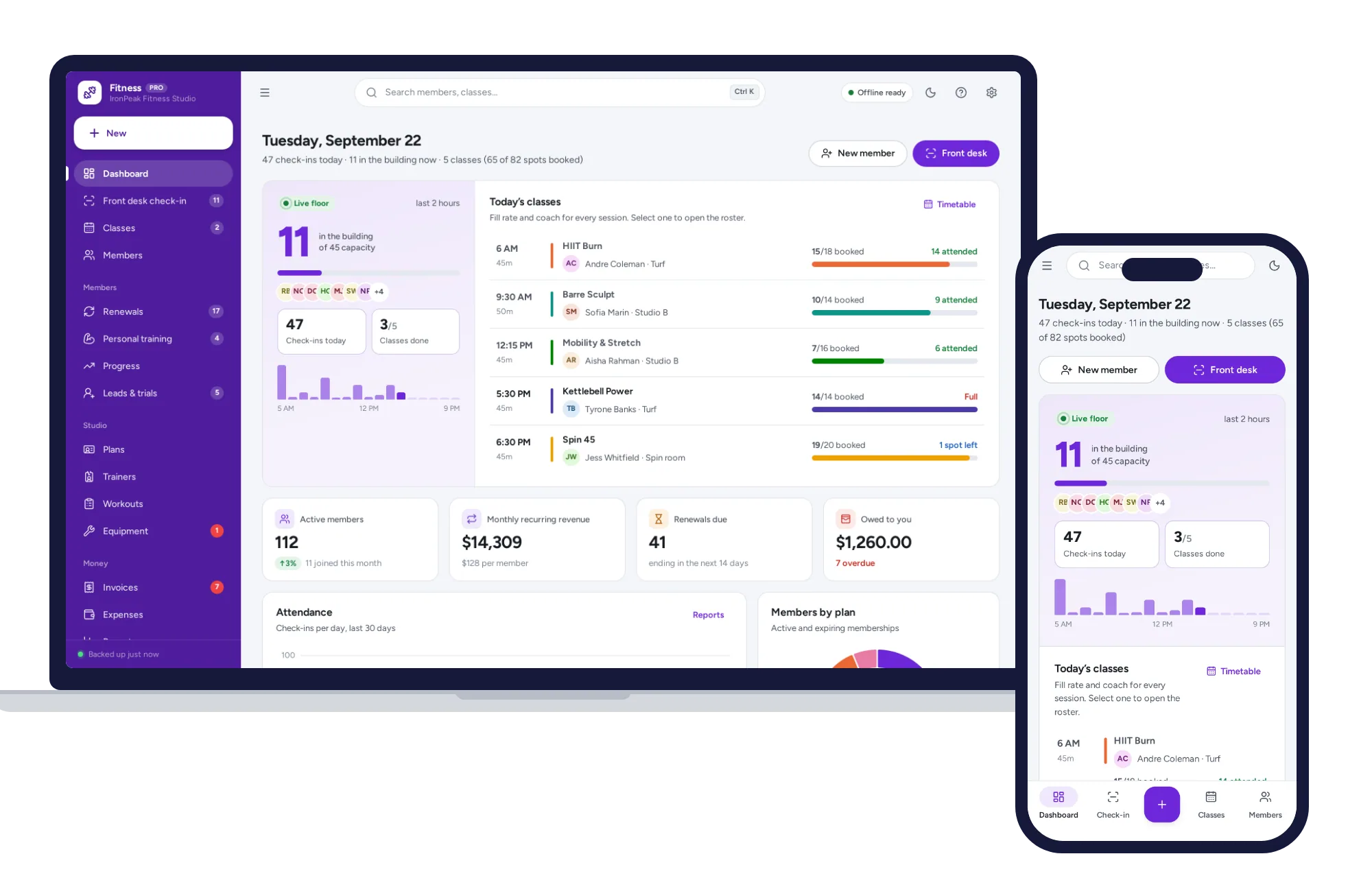
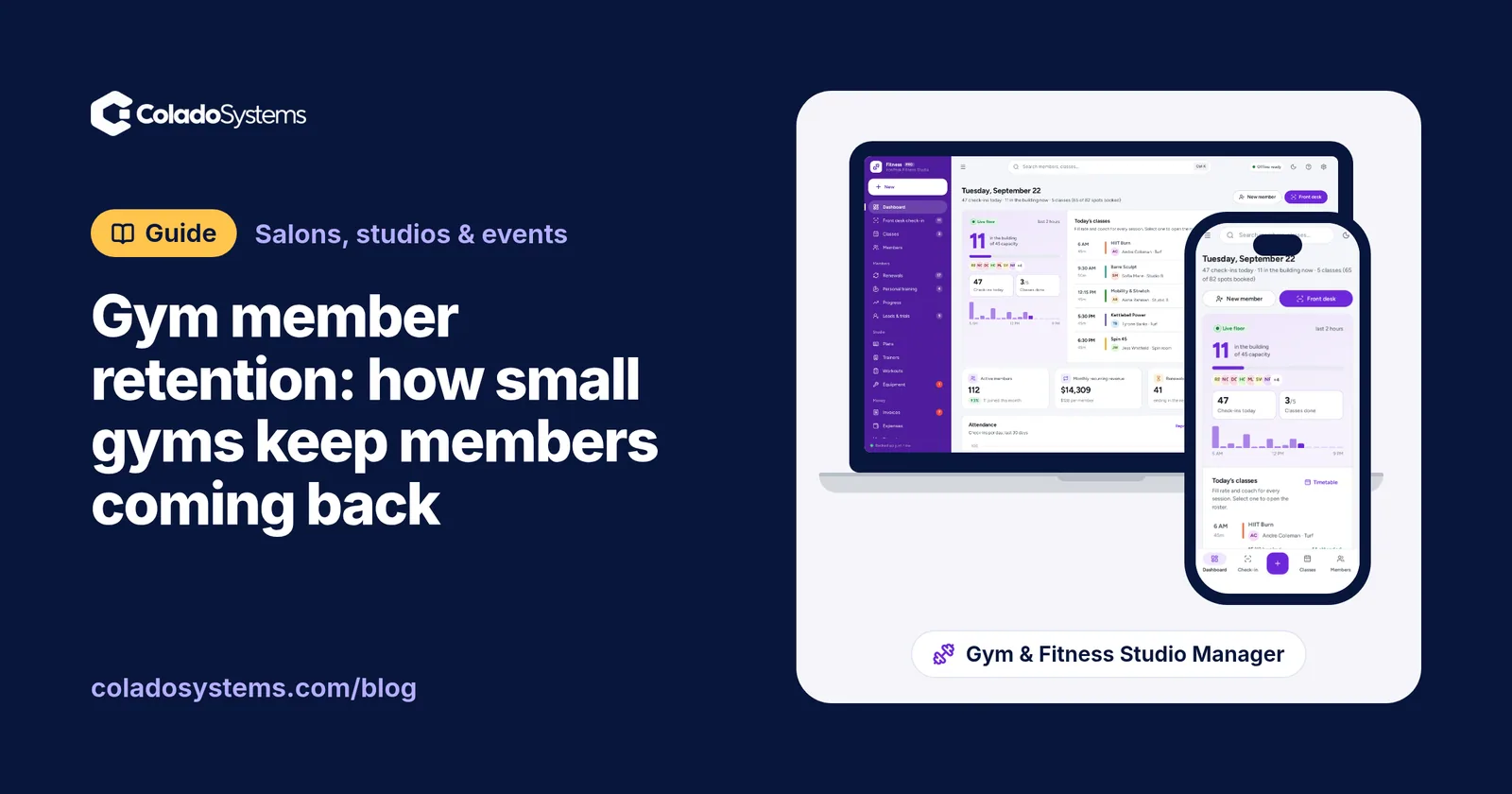
The Gym & Fitness Studio Manager already has those pieces. The front desk shows each member’s status as active, expiring, expired or frozen. The Renewals screen lists expiring, expired, frozen and not-seen-lately members together, one-click renew creates the invoice, and it tracks monthly recurring revenue and churn. Classes are built from a weekly template that generates four weeks, with capacity and a waitlist on every class. Rosters mark attended and no-show in one tap, and the waitlist moves up automatically. Each member record holds the plan, paid-through date, visits, balance and personal training credits, and the Leads & trials board turns trial visitors into members and shows where your best members come from. It works with USB scanners at the desk, too.
It doesn’t take card payments or bill automatically; it records the payments you take and shows who is due or overdue. It opens with sample data so you can try it straight away, there’s no account or sign-up, it works offline, member records stay on your own device, and a PDF guide is included. You can also browse more systems for salons, studios and events.
You can see everything inside the Gym & Fitness Studio Manager and try it with the sample data the same day.
Skip the setup
The Gym & Fitness Studio Manager has the records this guide describes already set up. Front-desk check-in, memberships and renewals, classes, personal training and progress — one offline app.
$29.99 one-time
- Sample data to try it the same day
- Works offline, records stay on your device
- A PDF guide in the download
See everything inside the Gym & Fitness Studio Manager. Or take the whole Salons, studios & events shelf: 6 systems for $99.99, $79 less than one by one.
Common questions
What is a good member retention rate for a gym?
There is no single figure that fits every gym, because contract length, price, location and the kind of training you offer all change it. A more useful habit is to measure your own monthly churn the same way every month and work to bring it down. Compare yourself with last quarter and last year rather than with a number you read online.
How do you calculate gym churn rate?
Take the number of members who cancelled or lapsed during the month, divide it by the number you had on the first day, then multiply by 100. Starting with 200 members and losing 8 gives 4 percent. Track frozen memberships separately so you can see whether freezes turn back into active members or quietly become cancellations later.
Why do people stop going to the gym?
Common reasons include a change in work or family schedule, not seeing progress, an injury or illness, feeling that nobody would notice if they left, and cost. Several of these can be softened if you spot the drop in visits early, ask how things are going and offer a practical option such as a different class time, a coach session or a freeze.
How do I win back gym members who have stopped coming?
Reach out personally and soon, ideally within two or three weeks of the last visit. Keep the message warm and short, mention something specific to that person, and offer an easy way back such as a beginner-friendly class or a quick session with a coach. If their circumstances have changed, a freeze or a cheaper plan keeps the relationship going.