Most people don’t drop a Bible reading plan because they stop caring. They drop it around day 40, after a busy week, when the checklist shows nine unticked boxes and catching up feels like a second job. Starting over next January seems more honest than reading nine chapters on a Tuesday night.
There’s a better way, and it starts before day one. Choose a Bible reading plan that fits the time you really have, decide in advance what you’ll do when you miss days, and keep notes short enough that you’ll read them again. None of this depends on your tradition or translation, and it works on paper or on a screen.
Start with the time you really have
Time yourself reading one medium-length chapter at your normal pace. If it takes about four minutes, three chapters a day is twelve minutes, plus a few more for notes.
Then be honest about your mornings or evenings. If you have five minutes, choose a plan that fits five. A smaller plan you finish will do more for you than a big one you abandon in February.
Some useful arithmetic. The 66-book Protestant Bible has 1,189 chapters, so reading it in a year means a little over three chapters a day. Bibles with 73 books, such as Catholic editions, have more chapters, so a year plan runs slightly longer each day. The New Testament has 260 chapters, so finishing it in 90 days is about three a day.
Which Bible reading plan should you choose?
There’s no single right plan. Here are common types and what each suits.
| Plan | Daily reading | Good for | Watch out for |
|---|---|---|---|
| Whole Bible in a year | About 3 to 4 chapters | Seeing the whole story | Long stretches of law and genealogies can stall you |
| New Testament in 90 days | About 3 chapters | A first plan with a clear finish | Leaves the Old Testament for later |
| One book, slowly | A chapter or less | Depth and study notes | Progress can feel slow |
| Chronological | Varies | Events in the order they happened | Jumps between books |
| Your church or group’s plan | Varies | Shared reading and discussion | The pace is set for you |
Many churches also follow a lectionary, a cycle of readings tied to the church year. Reading along during the week connects your reading to Sunday.
For a first plan, something short like one Gospel or the New Testament in 90 days gives you a finish line you can see. A pastor, priest or small group leader can also suggest one.
How to stick to a Bible reading plan
A plan sticks when it’s attached to something you already do.
- Same time, same place. With the first coffee, on the train, before bed. Keep your Bible, a pen and your notebook together in that spot.
- Have a minimum version. On a hard day, read one paragraph and call it done. A short reading keeps the habit alive; skipping is what usually ends it.
- Track chapters, not dates. Ticking chapters shows what you’ve read. A calendar of dates mostly shows what you missed.
- Read with someone. A friend or small group on the same plan gives you a reason to keep going and someone to talk it over with.
What to do when you miss a few days
You will miss days. Decide now what happens next, so guilt doesn’t decide for you.
Say you’re on a plan of three chapters a day and miss five days. You’re 15 chapters behind. You have three honest options:
- Add a little extra for a while. Read two extra chapters a day for a week or so, and you’re caught up.
- Spread it out. With 200 days left in the plan, 15 chapters is one extra chapter about every two weeks. You’ll barely notice.
- Keep your pace and finish later. Carry on as normal and finish five days after you planned. Nobody is checking the date.
What you shouldn’t do is start over. The chapters you read still count. A Bible study planner that offers those three catch-up choices works out the new daily readings for you, but the same options work with a printed checklist and a pencil.
How to keep useful Bible study notes
Notes are useful when you can find them again and they’re short enough to reread. Always put the date and the reference (book, chapter and verses) at the top.
One widely used method is SOAP:
- Scripture. Copy the verse or two that stood out, from your own translation.
- Observation. What does it say? Who is speaking, to whom, and what is happening around it?
- Application. What might this mean for your week? Keep it to one specific thing.
- Prayer. A sentence or two in response.
Some people prefer observe, interpret, apply, or simply a few free lines. Pick one approach and give it a month before switching.
Three habits make notes more valuable over time:
- Write one question. Something you didn’t understand. Bring it to your small group, pastor or priest.
- Keep a dated prayer list. Note when you began praying for something and, later, when and how it was answered. Rereading it months later can be encouraging.
- Review monthly. Ten minutes rereading a month of notes shows themes you would never notice day to day.
If you read devotionals, commentaries or other books alongside your Bible, keep those notes too. A reading journal that saves favorite quotes with the page keeps those passages easy to find, and so does a notebook with page numbers.
Paper, a Bible app or a planner?
Each option has real strengths and real limits.
A paper journal and printed plan are simple and keep the phone out of your quiet time. But a printed checklist can turn into a wall of missed boxes, and paper notes are hard to search a year later. If you’re weighing paper against screens more generally, this comparison of paper and digital planners covers the trade-offs.
Bible apps include the text, often with audio and reminders. The same phone also carries every other notification you get. Some offer extra features by subscription, and at, say, $5 a month, that’s $60 a year, every year. Most need an account.
An offline planner costs a one-time price, needs no account and keeps your notes and prayer list on your own device. The one described below includes no Bible text, so you read from your own Bible. It doesn’t share live with your group, and you keep your own backups.
Keeping your plan and notes in one place
You could build this yourself: a checklist of every chapter, a formula that recalculates your plan after missed days, a notes index by book, a dated prayer list and a memory verse schedule. That’s an evening of setup before your first reading.
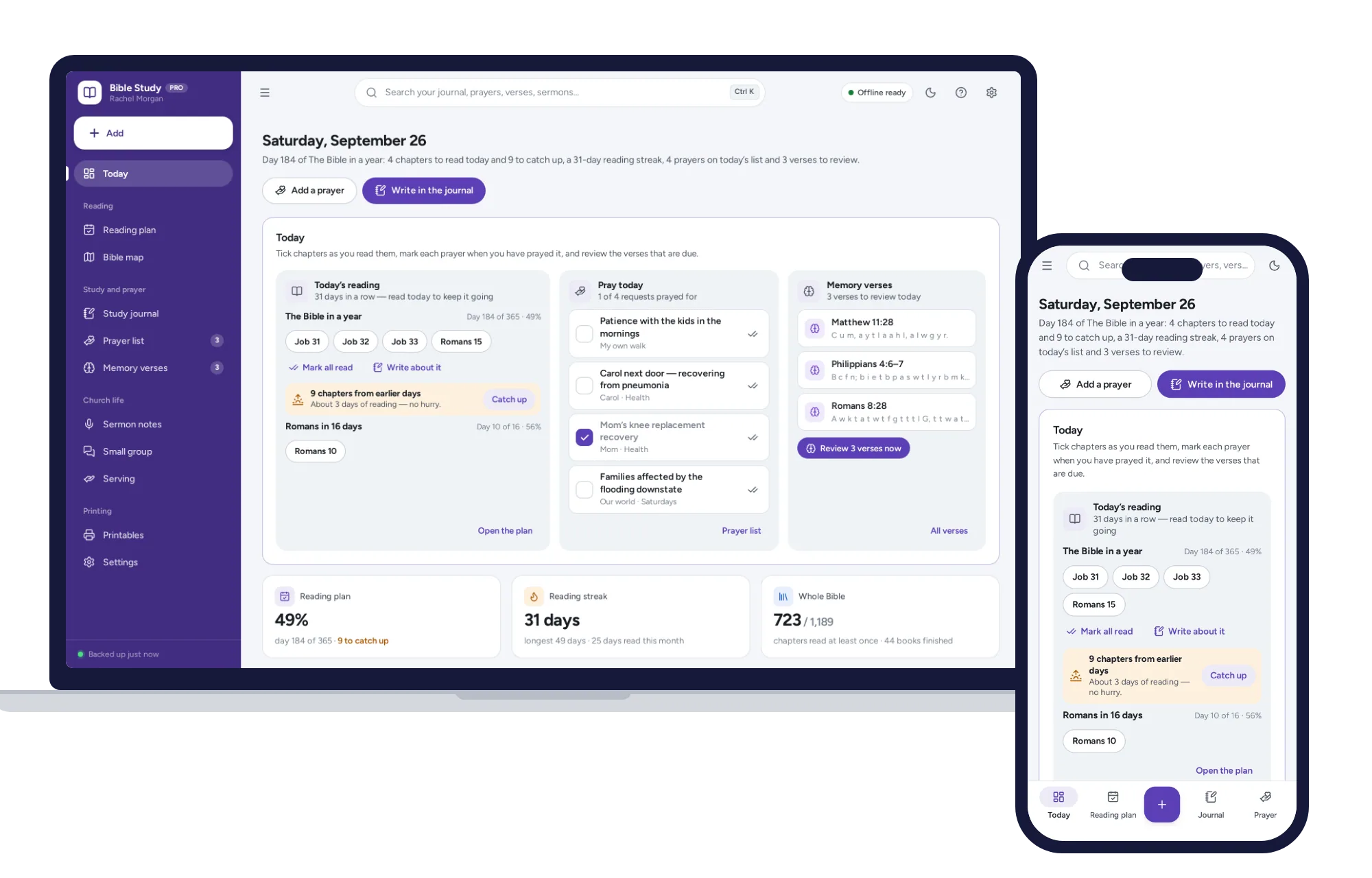
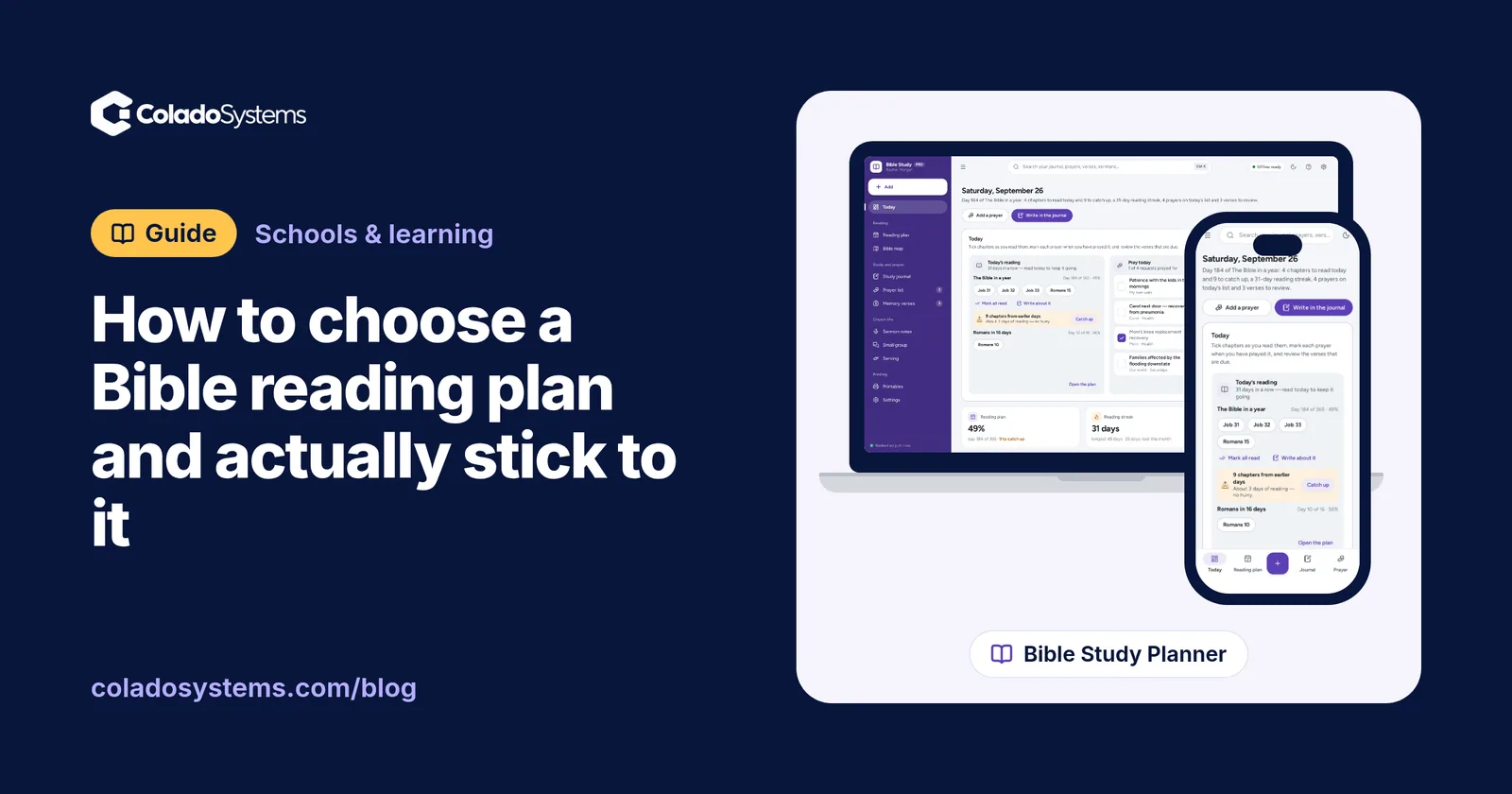
The Bible Study Planner has those parts ready:
- Bible reading plans for the whole Bible in a year, the New Testament in 90 days, or books you choose.
- Catch-up after missed days, with the three choices above. It tells you what each will do before you pick, and nothing you’ve read moves.
- Bible map, showing every chapter you’ve read across 66 books or 73, with your reading streak and books finished.
- SOAP journal, with each entry linked to its book, chapter and verses, plus observe-interpret-apply or free notes, and a search across everything you’ve written.
- Prayer list, shared out over the days of the week, and Answered prayers with the date asked and the date answered.
- Memory verses that come back after 1 day, then 3, 7, 14, 30 and 60, along with sermon notes, small group questions and printable pages.
It works with whichever translation you read, and its own words make no theological claims.
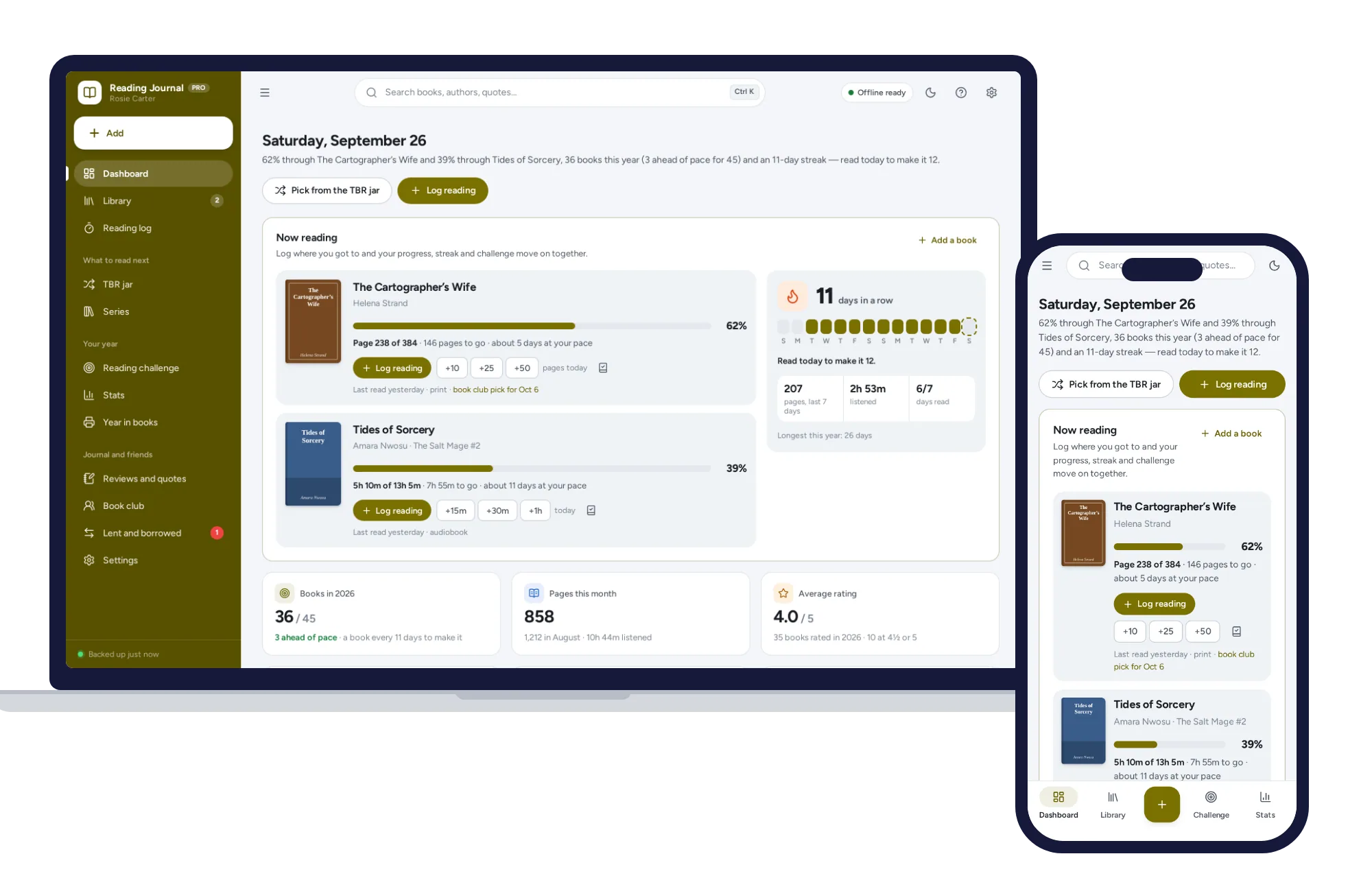
For the other books on your nightstand, the Reading Journal & Book Tracker logs reading sessions and your streak, keeps favorite quotes with the page, and has a book club section for picks and questions. Both sit on the schools and learning shelf, which also comes as one of the bundles for less than buying each system separately.
Each opens with sample data, needs no account and works offline, with your records kept on your own device. You can see everything inside the Bible Study Planner and set up your first plan the same day.
Skip the setup
The Bible Study Planner has the records this guide describes already set up. A Bible reading plan that catches you up when you miss a day, a SOAP journal and a prayer list on one dashboard. No subscription.
$24.99 one-time
- Sample data to try it the same day
- Works offline, records stay on your device
- A PDF guide in the download
See everything inside the Bible Study Planner. Or take the whole Schools & learning shelf: 8 systems for $119.99, $99 less than one by one.
Common questions
How many chapters a day do you need to read to finish the Bible in a year?
A 66-book Protestant Bible has 1,189 chapters, so a year plan needs a little over three chapters a day, which is why most year plans alternate between three and four. Bibles with 73 books have more chapters, so the daily reading runs slightly longer. Time yourself on one chapter to see how many minutes a day that means for you.
What is the SOAP method of Bible study?
SOAP stands for Scripture, Observation, Application and Prayer. You write out a verse or two that stood out, note what the passage says and what is happening around it, write one way it might apply to your life, and close with a short prayer. It keeps study notes brief and consistent, which makes them easier to reread later.
What should I do if I fall behind on my Bible reading plan?
Resist the urge to start over. Pick one of three ways to catch up: read a little extra each day for a week or two, spread the missed chapters across the rest of the plan, or keep your usual pace and finish a few days later than planned. Every chapter you have already read still counts.
What is a good Bible reading plan for beginners?
A short plan with a clear finish line is easier to complete than a whole year. One Gospel read a chapter a day, or the New Testament in 90 days, are common starting points. A pastor, priest or small group leader can also suggest a plan that suits your tradition and the time you have each day.