The listing reads: “Duplex, $260,000, rents $1,350 a side, cash flows.” The math behind that last part is usually rent minus the mortgage: $2,700 in, about $1,297 out, roughly $1,400 a month in your pocket. It looks like a great deal until you add everything the listing left out.
Rental property cash flow is what’s left each month after every cost of owning the property, not just the loan. This guide walks through the method and a full worked example. It’s general guidance, not financial advice, so check your numbers with a lender, an accountant and a local inspector before you commit money.
How do you calculate cash flow on a rental property?
Two numbers matter:
- Net operating income (NOI): the rent you actually collect, minus all the costs of running the property. It leaves out the mortgage.
- Cash flow: NOI minus your loan payments. This is the money that’s actually yours at the end of the year.
Keeping them apart helps. NOI tells you how good the property is. Cash flow tells you how good it is with your particular loan.
Step 1: Start with realistic rent, then take off vacancy
Use rents for similar units nearby that have actually rented recently, not the seller’s hopes or the highest listing you can find. Local property managers and current listings for comparable units are good sources.
Then allow for vacancy. Units sit empty between tenants, and some rent goes uncollected. One empty month a year is about 8 percent of the rent. Pick an allowance that fits your market and apply it every time, even when the unit is rented today.
Step 2: List every operating expense
This is where listing math falls apart. Go through each line:
- Property tax: check the current bill in the county records, and ask whether it will be reassessed after a sale.
- Insurance: get a quote for a landlord policy, which can differ from a homeowner’s policy.
- Repairs and maintenance: a percentage of rent for leaky taps and broken appliances.
- Capital expenses: a separate reserve for big items that wear out, such as the roof, water heater, furnace and flooring.
- Property management: include it even if you plan to manage the place yourself. Your time has value, and you may hire someone later.
- Utilities you pay: water, sewer and trash are often the owner’s bill in multi-unit buildings.
- Other: HOA dues, lawn care, snow removal, pest control and any rental license fees.
Step 3: Work out the mortgage payment
Use the principal-and-interest payment from your lender’s quote or a standard mortgage formula. If your lender collects property tax and insurance in escrow, don’t count them twice: they’re already in your expense list. Your actual rate depends on your lender, credit and loan type, so use a real quote when you can.
A spreadsheet’s payment function will do the sum, and so will the rental property calculator in the Real Estate Investor Planner, which works the payment out from the standard formula alongside cash flow, cap rate and cash-on-cash.
Rental property cash flow, worked through for one duplex
Here’s the duplex from the listing. All figures are made up to show the method.
Purchase: $260,000, with 25 percent down ($65,000), closing costs of 3 percent ($7,800) and $5,000 of repairs before the first tenants. Cash you put in: $77,800.
Loan: $195,000 over 30 years at, say, 7 percent. Principal and interest come to about $1,297 a month, or $15,568 a year.
Income: two units at $1,350 a month is $32,400 a year. A 5 percent vacancy allowance takes off $1,620, leaving $30,780 collected.
Operating expenses for the year:
- Property tax: $3,600
- Insurance: $1,800
- Repairs and maintenance, 6 percent of rent: $1,944
- Capital expense reserve, 6 percent of rent: $1,944
- Property management, 8 percent of rent: $2,592
- Water, sewer and trash: $1,200
- Lawn and snow: $500
- Total: $13,580
NOI: $30,780 - $13,580 = $17,200
Cash flow: $17,200 - $15,568 = $1,632 a year, or about $136 a month.
That’s a long way from the $1,400 a month the listing implied. The property isn’t necessarily a bad buy, but it’s a thin one.
Compare the listing math with an offer price
Here’s the same duplex three ways, including an offer of $240,000 on the same terms. Taxes and insurance are kept the same for simplicity.
| Listing math | Full math at $260,000 | Full math at $240,000 | |
|---|---|---|---|
| Rent collected per year | $32,400 | $30,780 | $30,780 |
| Operating expenses | Left out | $13,580 | $13,580 |
| Loan payments per year | $15,568 | $15,568 | $14,370 |
| Cash flow per month | $1,403 | $136 | $236 |
| Cash you put in | $77,800 | $77,800 | $72,200 |
| Cash-on-cash return | 21.6% | 2.1% | 3.9% |
| Cap rate | 12.5% | 6.6% | 7.2% |
Cap rate is NOI divided by the price. Cash-on-cash is a year’s cash flow divided by the cash you put in. Notice that the duplex passes the popular 1% test, since $2,700 is just over 1 percent of $260,000, and still only clears $136 a month. Rules of thumb are filters for which deals to analyze, not answers.
Lenders often look at debt coverage too: NOI divided by a year of loan payments. Here it’s about 1.1 at the asking price. Ask your lender what they need to see.
Stress-test the deal before you offer
Change one number at a time and see what survives:
- Rent $100 lower per side. The same duplex loses about $168 a year.
- A longer vacancy. Try two empty months on one side instead of 5 percent.
- A higher rate. Rerun the payment a point higher than your quote.
- A big repair in year one. Check whether your cash reserve covers it without touching the mortgage money.
Set your own minimum cash flow per unit before you look at listings, and walk away from deals that don’t meet it.
After you buy, check the numbers against reality
Your projection is a forecast. Once you own the place, record every rent payment and expense by property, and after twelve months set the real figures beside your estimate. If repairs ran at 10 percent instead of 6, your next analysis should use 10. This guide to tracking rent payments, repairs and leases as a small landlord covers the routine, and a landlord manager with a rent roll and cash flow per property keeps those records in one place.
Spreadsheet, online calculator or a planner you buy once?
A spreadsheet is free and flexible, but one formula typed over can quietly break every deal you’ve saved. Free online calculators are quick, but most keep nothing, so you redo the work for every property. Subscription deal software can add market data, but at, say, $30 a month that’s $360 a year, every year. A ready-made offline planner has a one-time price and keeps your numbers on your own device. It doesn’t fetch market data, so its answers are only as good as the figures you type, and you keep your own backups.
Keeping it all in one place
The Real Estate Investor Planner holds the whole method above. Its rental calculator takes vacancy, taxes, insurance, repairs, capital expenses and management, works out the mortgage payment, and shows cash flow, cap rate, cash-on-cash, debt coverage and the 1% test. You set your own default percents and lender terms in Settings. The deal pipeline shows each property’s cash flow at a glance, and a one-page deal sheet prints for your lender. It doesn’t track tenants or rent.
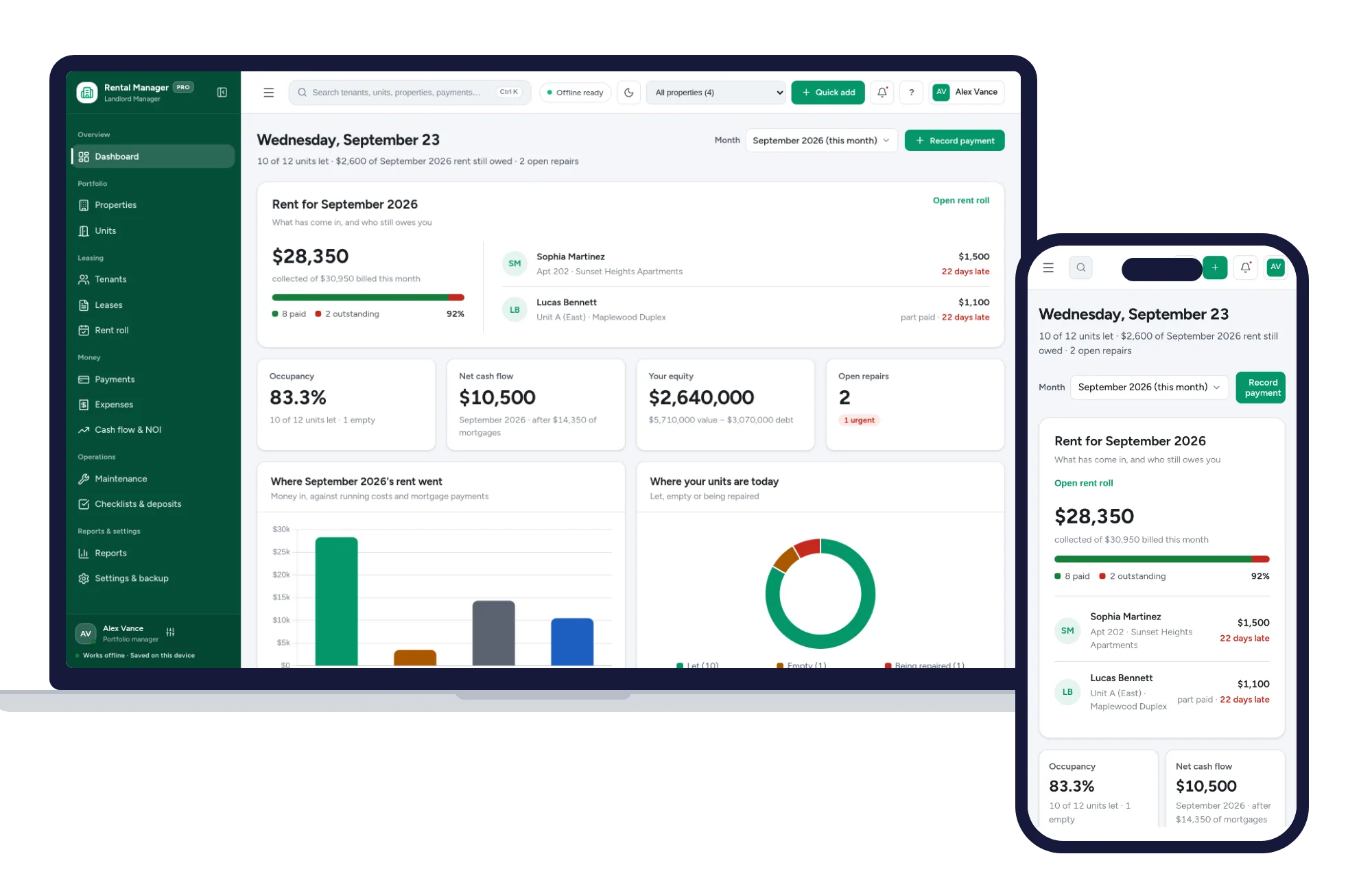
That’s where the Rental Property & Landlord Manager comes in after you buy: a rent roll showing paid, partial and overdue, leases with days left, expenses by category with CSV export for your accountant, and cash flow and NOI per property.
Both open with sample data, need no account and include a PDF guide. They sit on the same shelf, which also comes as a bundle that costs less than buying the systems one by one, alongside other systems for property and rentals.
Before your next offer, see everything inside the Real Estate Investor Planner and run that listing through the sample deal the same day.
Skip the setup
The Real Estate Investor Planner has the records this guide describes already set up. Know your max offer before you make one. No formulas, no subscription.
$29.99 one-time
- Sample data to try it the same day
- Works offline, records stay on your device
- A PDF guide in the download
See everything inside the Real Estate Investor Planner. Or take the whole Property & rentals shelf: 6 systems for $99.99, $79 less than one by one.
Common questions
How do you calculate cash flow on a rental property?
Start with a year of rent, subtract an allowance for vacancy, then subtract every operating cost such as property tax, insurance, repairs, a reserve for big replacements, management, utilities you pay and HOA dues. That gives net operating income. Subtract a year of mortgage principal and interest to get cash flow. Treat it as an estimate and check your figures with a lender and an accountant.
What is a good cash flow per month on a rental property?
There is no universal figure. It depends on the price, your loan, the local market and how much risk you can carry. Many investors set their own minimum per unit after all expenses and reserves, then walk away from deals that fall short. Decide your number before you look at listings, and get advice from a financial professional on your own situation.
What is the 1% rule in real estate?
It is a quick screen that says monthly rent should be at least 1 percent of the purchase price, so a $200,000 property would need about $2,000 a month in rent. It ignores taxes, insurance, repairs and financing, so a property can pass the test and still lose money. Use it only to decide which deals deserve a full cash flow calculation.
What is the difference between cash flow and cap rate?
Cap rate is net operating income divided by the purchase price, and it ignores how you finance the property, which makes it handy for comparing buildings. Cash flow is what remains after the mortgage payments as well, so it depends on your down payment, rate and loan term. Two buyers can see the same cap rate on a property and very different cash flow.