Three weeks into your job search, a recruiter calls about “the role you applied for last Tuesday.” You’ve sent thirty applications from four job boards, and you have no idea which one she means. The posting has already been taken down. You stall, she moves on.
A job search is a project with dozens of moving parts, and most of them have deadlines nobody tells you about. The fix isn’t working harder. It’s learning how to organize your job search around a simple system you trust, so your head is free for the parts that need it: writing, preparing and talking to people.
How to organize your job search as a pipeline
Think of every job as a card that moves left to right through a few stages:
- Wish list: roles you’ve found but haven’t applied to yet
- Applied: sent, waiting to hear
- Screening: a recruiter or first call is booked or done
- Interviewing: you’re in the interview rounds
- Offer: you have one to consider
- Closed: rejected, no reply, or you withdrew
For each application, write down the company, the role, the link to the posting, the date you applied, where you found it, which version of your resume you sent, any contact’s name, the salary if listed, and the next step with a date.
Save a copy of the job description too. Postings disappear, and you’ll want it when an interview comes up three weeks later.
The one rule that holds the whole thing together: every open card has a next step and a date. “Follow up on the 14th.” “Prep for second interview on Thursday.” If a card has no next step, it’s stalled, and stalled applications are the ones that slip.
A spreadsheet can hold all this, or you can use a job application tracker that moves each application from wish list to offer and keeps the next step on every card.
How long should you wait to follow up on an application?
Most people mean to follow up and then don’t, because nothing reminds them. Make it automatic in your routine instead:
- About a week after applying, with no reply, send a short follow-up to the recruiter or hiring manager if you can find them.
- A week after that, one more brief note.
- After two follow-ups with no reply, close it as “no reply” and let it go.
- The day after every interview, send a thank-you note to each person you met.
Keep your messages short. Something like: “Hi Dana, I applied for the operations coordinator role on the 3rd and wanted to say I’m still very interested. My experience running scheduling for a 40-person team seems like a close match. Happy to share anything that would help.” Write a template once, then change the details each time.
Set a weekly rhythm
A job search with no shape expands to fill every hour and still feels behind. Give your week a pattern:
- Monday: plan. Review the pipeline, clear stalled cards, and pick the roles you’ll apply for this week. Set a number you can keep up, say six to eight applications a week.
- Tuesday and Wednesday: tailor and apply. This is your deep work. Do it when your energy is best.
- Thursday: follow up and reach out. Send follow-ups, thank-you notes and messages to people who might refer you.
- Friday: prepare and review. Prep for next week’s interviews and look at your numbers.
Then stop. Weekends off are part of the plan, not a failure of it.
Tailor your resume without starting over
Keep one master resume with every job, every bullet and every skill you might ever use. It can be long. Nobody sees it but you.
For each type of role you’re going for, make a version from that master. Reorder the bullets so the most relevant ones come first, hide the ones that don’t fit, and use the same words the posting uses where they honestly describe your work. If a posting asks for “vendor management” and you “handled supplier contracts,” say vendor management.
Keep the layout plain: one column of real text with standard headings like Summary, Experience, Education and Skills. Applicant tracking systems read that format most reliably.
Name each version clearly (“Operations v2,” “Project coordinator”) and note on each application which one you sent. That’s how you’ll learn which version gets replies.
For cover letters, write a template with blanks for the company, role and hiring manager, then rewrite the middle paragraph for each job. That paragraph is where you connect your experience to what this employer asked for.
Build a story bank for interviews
Most interview questions are versions of the same few: a time you solved a problem, handled conflict, led something, failed and recovered. Write eight to ten stories in the STAR shape: the situation, your task, the action you took, and the result. Tag each one with the skills it shows.
Before each interview, pick the three or four stories that fit the role, and write down two or three questions you want to ask. Bring it all on one page.
Read your numbers
After a few weeks, your records start telling you things. Say that over four weeks you sent 24 applications. Eighteen came from job boards and got 2 responses. Six came through referrals or direct contact and got 3. That’s a clear signal to spend more of Thursday reaching out to people.
A few common patterns:
- Few responses at all: look at your targeting and your resume.
- Responses but few interviews: your screening calls may need work.
- Interviews but no offers: practice your stories out loud.
Keeping it all in one place
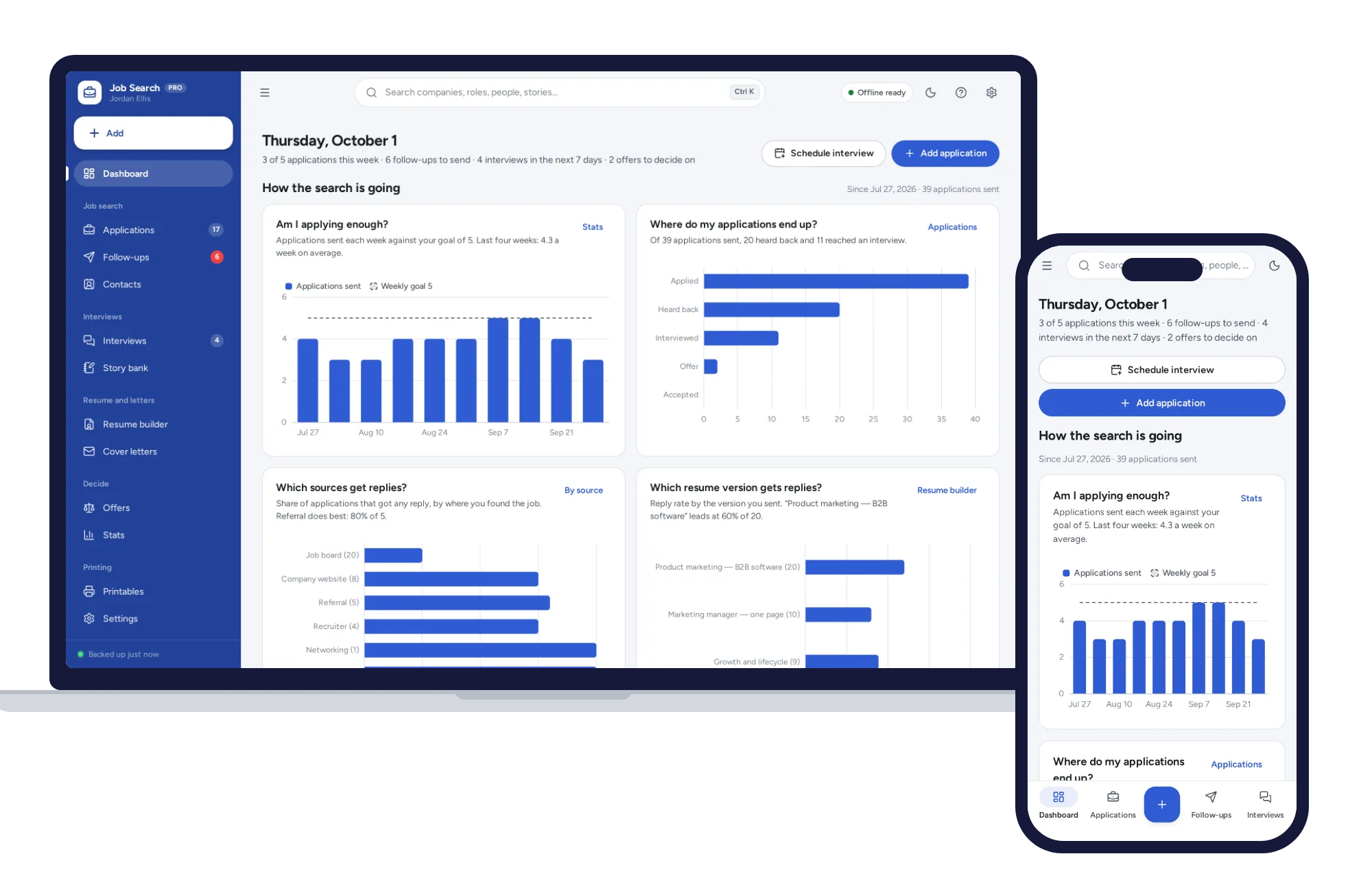
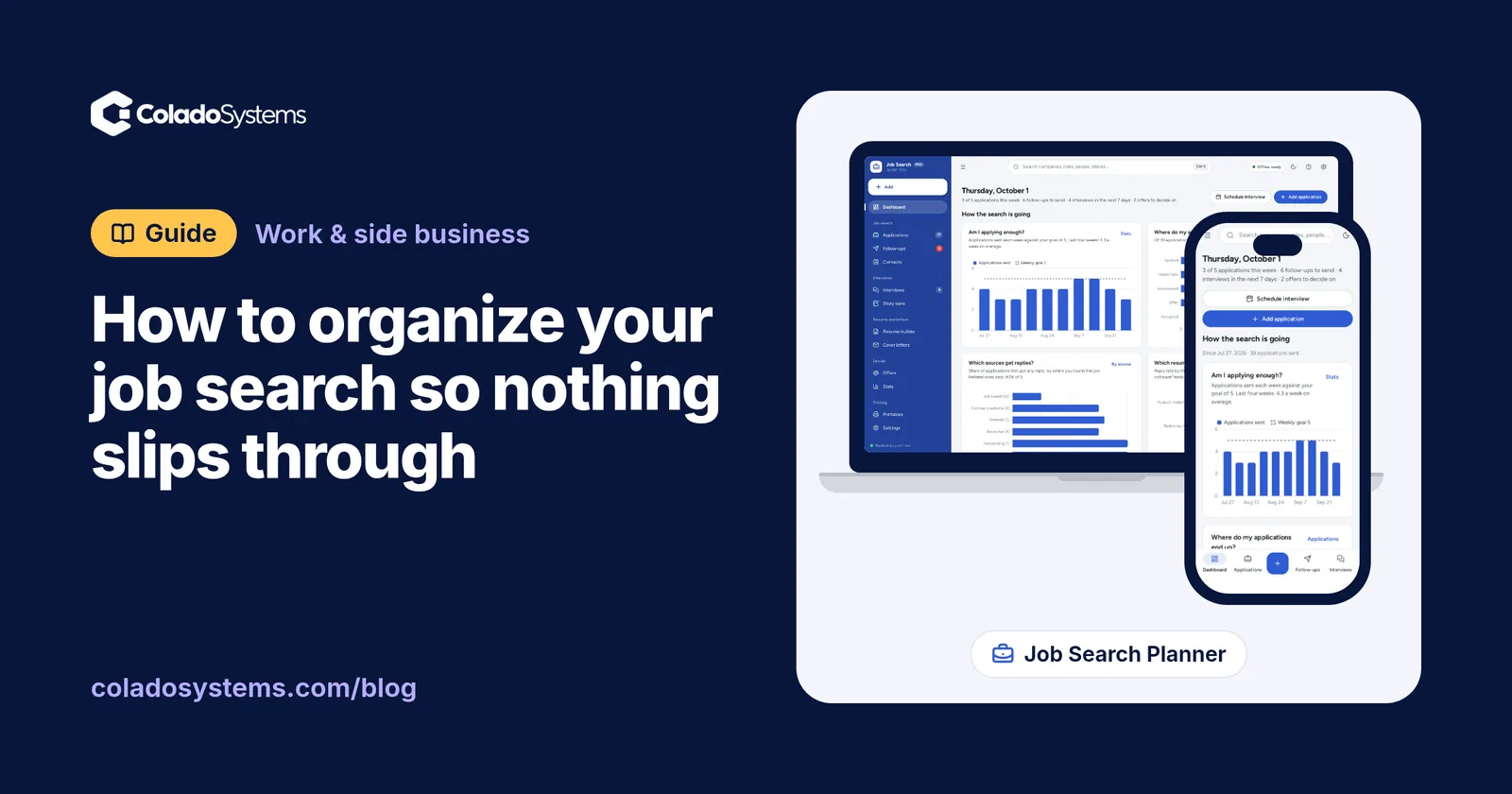
The Job Search Planner is built for exactly this. Applications move from wish list to offer, with salary, link, source and contacts on each one and the next step on every card. Follow-ups schedule themselves seven days after you apply with no reply (you can change that), a thank-you note comes due the day after each interview, and both are drafted from your own templates.
It has a STAR story bank linked to each interview, and a resume builder that keeps your history once and makes a version for each role, with three single-column print layouts. Cover letters fill in the company, role and hiring manager from the application. There’s an offer comparison, a weekly goal, and a dashboard showing your response and interview rates and which sources and resume versions get replies.
It won’t write anything for you, and it doesn’t connect to job boards. It runs offline on your own device, with no account. You can also browse other systems for work and side businesses.
If you’re freelancing to cover the gap while you search, this simple monthly habit for setting money aside for tax when you’re self-employed keeps that income from causing trouble later.
Skip the setup
The Job Search Planner has the records this guide describes already set up. A job search dashboard with every application from wish list to offer, follow-ups that schedule themselves, and a resume builder that prints three layouts. No formulas to break, no subscription.
$24.99 one-time
- Sample data to try it the same day
- Works offline, records stay on your device
- A PDF guide in the download
See everything inside the Job Search Planner. Or take the whole Work & side business shelf: 3 systems for $59.99, $19 less than one by one.
Common questions
How do I keep track of job applications?
Give every application its own entry in one list or board: company, role, posting link, date applied, source, resume version, contact and the next step with a date. Move each one through stages such as applied, screening, interviewing and offer. Review the whole list once a week, and never leave an open application without a next step and a date attached.
How long should I wait to follow up after applying for a job?
About a week is a reasonable gap if you have heard nothing. Keep the note short: restate your interest and give one strong reason you fit the role. If there is still no reply a week later, one more brief message is fine. After that, close it and put your energy into new applications instead of waiting.
How many jobs should I apply to per week?
There is no magic number. Pick a weekly target you can keep up while still tailoring each application, since a handful of well-matched applications tends to beat a pile of generic ones. Track your response rate for a few weeks. If it is low, work on your targeting and your resume before you raise the volume.
Should I tailor my resume for every job application?
Tailor it for each type of role, then adjust it lightly for each job. Keep a master resume with everything in it, build a version for each kind of role you want, and reorder the bullets so the most relevant come first. Use the wording from the posting where it honestly describes your work, and note which version you sent.