You sell a hand-thrown mug for $38. The clay and glaze cost about $5.50, so you made $32.50. That’s the number a lot of makers carry around in their heads, and it’s off by a long way.
When you calculate profit on handmade items properly, real profit is what’s left after every cost that sale caused, including the time you spent making it. Once you count it that way, you’ll know which products carry your shop, which ones quietly cost you, and what to charge next time. It takes about ten minutes per product to set up, and you mostly do it once.
How do you calculate profit on handmade items?
Start with what the buyer pays you, then take off five kinds of cost.
Materials
Count everything that ends up in or on the piece, by the amount you actually use. If a pound of clay costs $1.60 and a mug uses a pound and a half, that’s $2.40. Glaze, wicks, jump rings, thread, labels: price each one per use, not per bag. Add a share of anything used up along the way, like kiln electricity or blades that wear out. A rough figure beats leaving it out.
Your time
This is the cost most makers skip, and it’s the one that matters most. Time yourself making a batch, divide by the number of pieces, and include the packing. Then pick an hourly rate you’d be happy to earn. Say $20 an hour.
Counting your time doesn’t mean you have to pay yourself that wage every week. It means your profit figure tells the truth: what the shop earns on top of paying you. If a product only looks profitable when your time is free, it’s a hobby, not a business line.
Listing and transaction fees
Online marketplaces usually charge in layers: a small fee to list, a percentage of the sale, a payment processing fee, and sometimes an advertising fee on orders that came through their ads. Many of these percentages apply to the total the buyer pays, shipping included, not just the item price.
Fees differ by platform and by country, and they change. Check your shop’s current fee page instead of trusting a number you remember.
Selling in person changes the fees, not the method. At a craft fair there’s no listing fee, but the stall fee and any card reader fees need sharing across the day’s sales. If you ring those sales up in a small business system with point of sale and a profit and loss statement, they sit alongside the rest of your numbers instead of in a notebook.
Shipping
Compare the postage you actually pay with the shipping you charge. Plenty of sellers set a flat rate that felt right two years ago and now lose a dollar or two on every parcel without noticing. If you offer free shipping, the whole postage cost comes out of your price.
Packaging
Box, tissue, tape, bubble wrap, the thank-you card, the sticker. Each one is a few cents. Together they’re often a couple of dollars per order, and that adds up fast over a year.
A worked example: one $38 mug
Here are some made-up but realistic numbers. The buyer pays $38 for the mug plus $6 shipping, so $44 comes in (before any sales tax, which was never yours to keep). For illustration, say the marketplace charges $0.20 to list, 6.5% of the order as a transaction fee, and 3% plus $0.25 for payment processing.
| Cost | Amount |
|---|---|
| Clay, glaze and kiln share | $5.50 |
| Box, wrap, tape and card | $2.00 |
| Postage actually paid | $7.40 |
| Listing fee | $0.20 |
| Transaction fee (6.5% of $44) | $2.86 |
| Payment processing (3% of $44, plus $0.25) | $1.57 |
| Your time (45 minutes at $20 an hour) | $15.00 |
| Total | $34.53 |
$44.00 minus $34.53 leaves $9.47. That’s your real profit, earned on top of the $15 you paid yourself. As a margin, it’s about 21% of what the buyer paid.
Not $32.50. And if that order had come through a marketplace ad carrying, say, a 15% fee, another $6.60 would go, leaving you under $3.
Two things jump out. Postage costs $1.40 more than the shipping you charged. And fees plus postage come to more than twice the cost of the materials. Neither shows up if you only subtract materials from the price.
What to do when the number is too small
Price for a target margin. Pick the margin you want, say 30%, and work backward. In the example, the fixed costs (materials, packaging, postage and time) are $29.90, and the fees grow as the price does. A mug at $44.95 with $6 shipping brings in $50.95. The fees come to about $5.29, and the profit is $15.76, close to 31%. A seven-dollar price rise adds more than $6 of profit to every mug. Because the fees move with the price, this takes a little trial and error by hand; a pricing calculator for handmade sellers solves the price for your target margin after the fees in one step.
Make shipping match postage. Raise the shipping charge, or build the gap into the item price and offer free shipping. Either works. Losing money quietly on every parcel doesn’t.
Cut time per piece. Make in batches. Glazing twelve mugs in one session takes far fewer minutes per mug than glazing two.
Buy materials better. Once you know your cost per use, a bulk order or a cheaper supplier shows up as real dollars per sale.
Retire the losers. If a product only breaks even after you count your time, reprice it or stop making it. That time is better spent on the pieces that pay.
Make it a habit, not a one-off
Work out the real profit for each product once, then check it again whenever something changes: a supplier raises a price, postage goes up, or a marketplace updates its fees. At the end of each month, add up sales, fees, cost of goods and profit, so you can see which fees cost you the most. Keep the year’s totals for whoever does your accounts, and if your sales add to your tax bill, this simple monthly habit for setting money aside for tax stops it from arriving as a shock.
Count your materials every so often too. Your cost of goods is only as good as your shelf counts, and this stock count routine for a small shop or stockroom works just as well for jars, wicks and spools of thread.
Keeping it all in one place
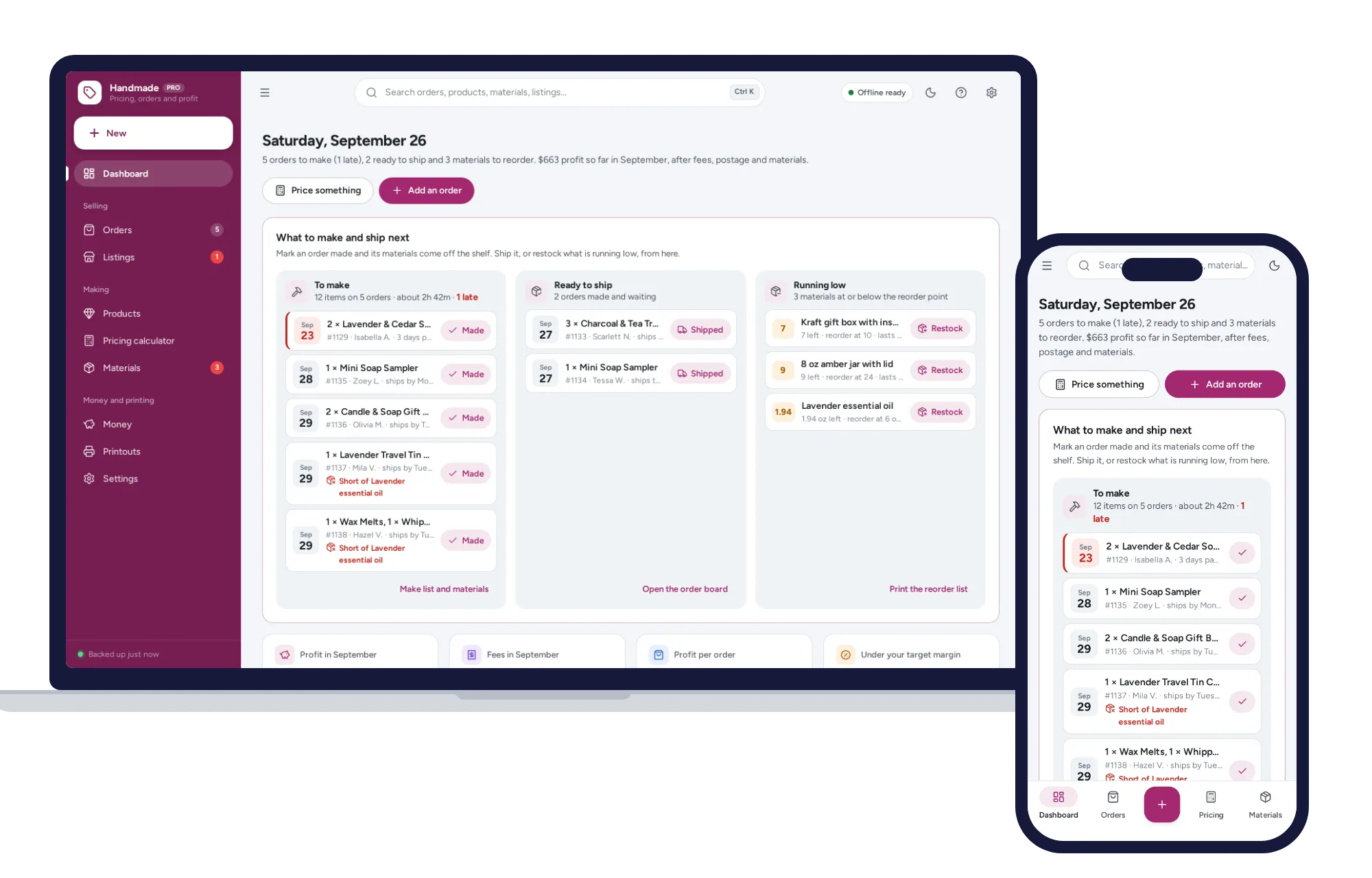
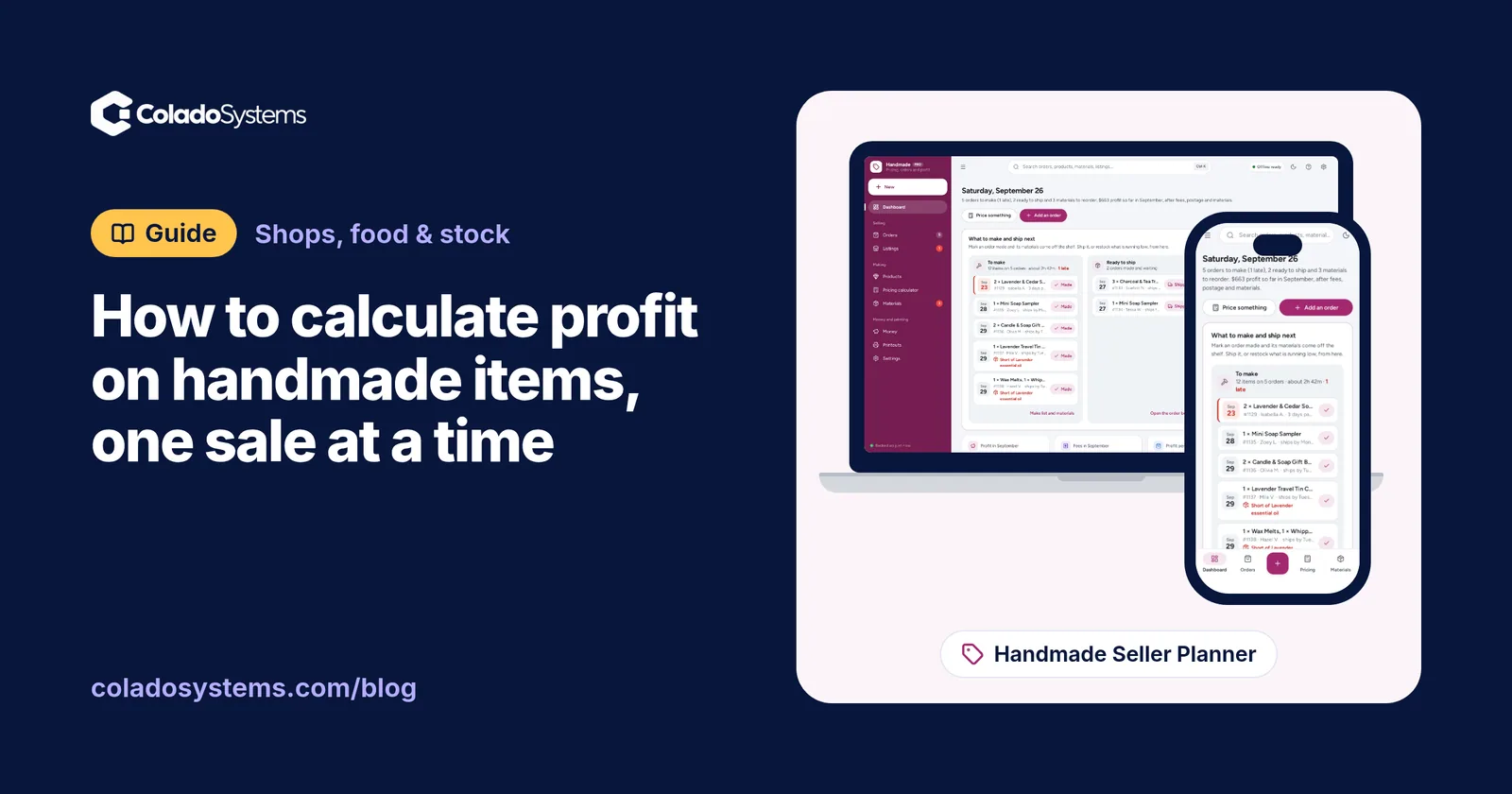
If your spreadsheet keeps breaking, the Handmade Seller Planner does this arithmetic for you. You build each product’s cost of goods from your materials list, with your minutes counted at your own hourly rate, and a supplier price rise updates every product that uses that material. The pricing calculator solves the price for the margin you choose after listing, transaction and payment fees, and the fee tracker shows the true profit on every order, line by line. The fees are editable, because they change and differ by country. There’s also an order board, materials that count down as you make, monthly profit and year-end totals. It runs offline on your own device, with no account and no subscription.
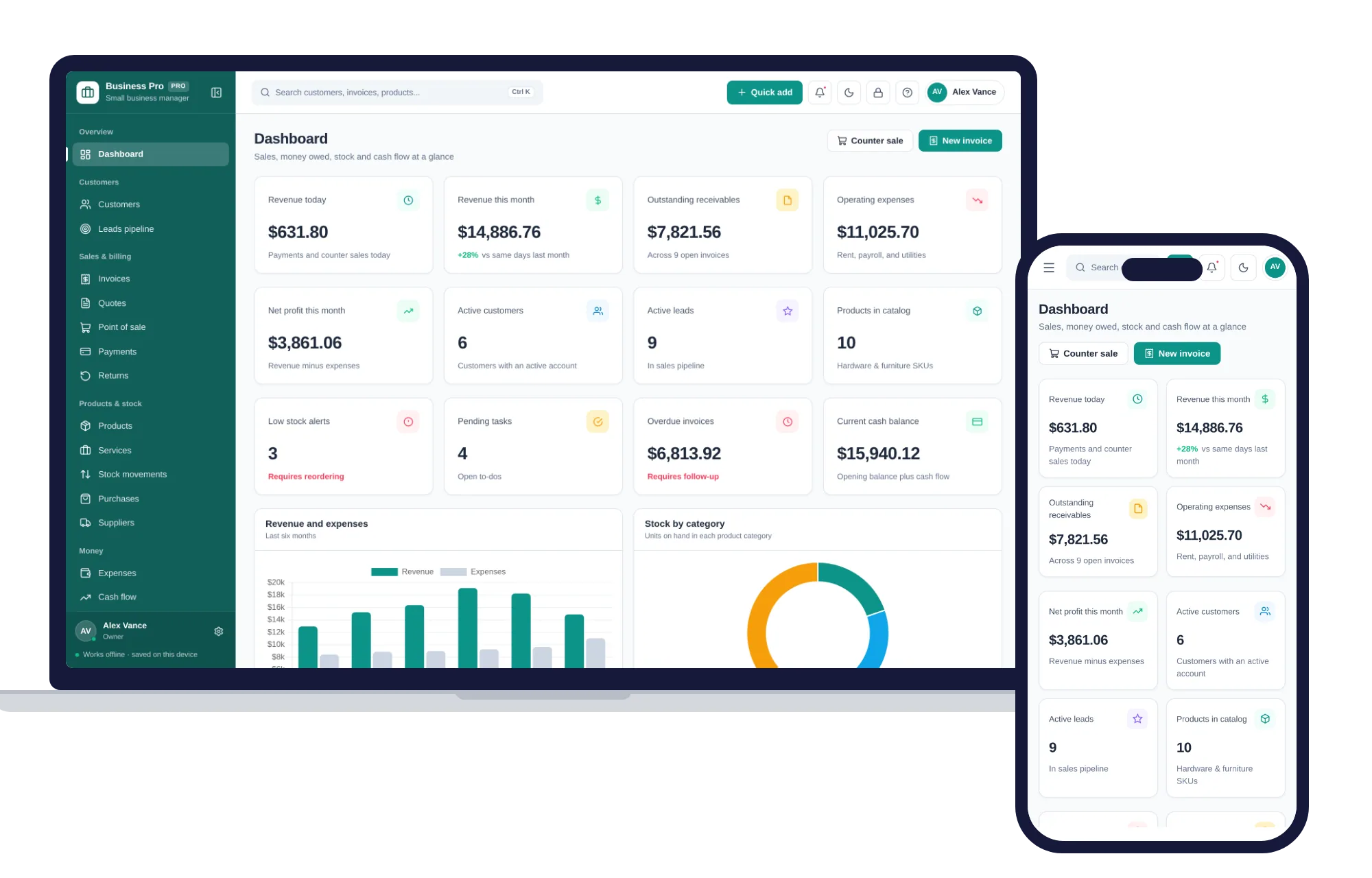
If you also sell at craft fairs or to shops that want a proper invoice, the Small Business Management System covers point of sale for counter sales, invoices with payment tracking, stock with cost, price and margin per item, expenses, and a profit and loss statement. You can also browse other systems for shops, food and stock.
Either way, start with one product this week. Time yourself, list the costs, and find out what that sale really earns.
Skip the setup
The Handmade Seller Planner has the records this guide describes already set up. The price that leaves your margin after every listing, transaction and payment fee — and the true profit on every sale. No formulas to break, no subscription.
$29.99 one-time
- Sample data to try it the same day
- Works offline, records stay on your device
- A PDF guide in the download
See everything inside the Handmade Seller Planner. Or take the whole Shops, food & stock shelf: 7 systems for $114.99, $94 less than one by one.
Common questions
How do you calculate profit on a handmade item?
Start with what the buyer pays, including any shipping you charge but not sales tax. Subtract the materials the piece used, the packaging, the postage you paid, every marketplace fee and your time at an hourly rate you choose. What remains is what the shop earns on top of your wage. Divide it by what the buyer paid and you have your margin.
Should I include my time when pricing handmade items?
Yes. Leave your time out and every sale looks better than it is, so you cannot tell a product that pays from one that only works because you make it for nothing. Time a whole batch, divide by the number of pieces, include packing, and multiply by an hourly rate you would be glad to earn.
What is a good profit margin for handmade products?
There is no single right figure. It depends on your costs, your market and whether your time is already counted as a cost. A practical approach is to pay yourself an hourly rate first, choose a target margin on top of that, work the price backward from it, and then see whether buyers still pay it. Adjust from there.
Do marketplace fees apply to the shipping I charge?
Often they do. Many marketplaces take their transaction and payment processing percentages from the total the buyer pays, which can include shipping. So a higher shipping charge also nudges your fees up a little. Rules differ by platform and country and change over time, so check the fee page for your own shop before you set prices.